O Oriens. (Advent Meditations)
by VP
Posted on Saturday December 20, 2025 at 11:00PM in Advent Sermons
“
O Orient, Splendor of eternal light and Sun of justice ; come and
enlighten those who sit in darkness and in the shadow of death.”
1.
The night of pagan times was long and dark, and seemed hopeless. Deeper
and deeper the nations were sinking in misery and vice. But at length
the Orient, the brightness of the eternal light of heaven, rose, and
scattered the darkness, changing the gloom into a brilliant day. So too
for those who have been long shrouded in the dense gloom of sin or
sorrow there waits the same divine Light, ready to scatter their
darkness in a moment, if only they will draw nigh to Him. He waits for
me, ready to brighten my path, to scatter my sins and sorrows, if I will
avail myself of His love.
2. That rising Light is the Sun of
justice, Who shall exercise His justice in delivering the captive, and
in recompensing His friends a hundred, nay, a thousandfold, for every
little service done to Him. For His justice is virtually identical with
His mercy, and rejoices to employ itself in works of pity and of love.
3.
Come then, O Orient, O Sun of justice ; shine on those who sit in
darkness, on those who are enveloped in the thick mists of heathendom
and heresy. Come and enlighten their ignorance, that they may not
perish. Come and deliver them from the shadow of death, for they cannot
deliver themselves. Pour upon them such a flood of light and grace as
may guide their feet into the way of peace."Meditations # 25 for Advent . By Rev. Richard F. Clarke S.J. The Catholic Truth Society, London 1891
Saint Andrew Christmas Novena: Hail and blessed be the hour and moment in which the Son of God was born of the most pure Virgin Mary, at midnight, in Bethlehem, in the piercing cold. In that hour vouchsafe, I beseech Thee, O my God, to hear my prayer and grant my desires, [here mention your request] through the merits of Our Savior Jesus Christ, and of His blessed Mother. Amen. (15 times)
Prayer to the Holy Infant for priests:Jesus, Divine Infant, I bless and thank Thy most loving Heart for the institution of the priesthood. Priests are sent by Thee as Thou were sent by the Father. To them Thou entrusted the treasures of Thy doctrine, of Thy Law, of Thy Grace, and souls themselves. Grant me the grace to love them, to listen to them, and to let myself be guided by them in Thy ways. Jesus, send good laborers into Thy harvest. May priests be the salt that purifies and preserves; may they be the light of the world; may they be the city placed on the mountain. May they all be formed after Thy own Heart. And in heaven may they be surrounded by a joyous throng of those they shepherded on earth. Amen.Glory Be (three times).
Infant Jesus, make me love Thee more and more.
Fourth Sunday of Advent: Christmas
by VP
Posted on Saturday December 20, 2025 at 11:00PM in Sermons

1. The thought of home.
2. But no home for the poor wayfarers at Bethlehem.
3. Now, as then, our Lord seeks a home.
4. Let us resolve to give Him a welcome, and make a home for Him in our hearts.
There is a word ever dear to our hearts, but dearer at this Christmas season than at any other time. Our hearts agree with the old saying, "There is no place like home." Home! what a charm, a fascination clings to that word. It does not matter whether it is a mansion or a cottage, so that it is our home. Childhood's affection nestles round our home, and it is the pride and comfort of venerable old age. And Christmas is the time of all others when our memory and thoughts gather round our home. We all go home in spirit or in glad reality at Christmas. And amidst all our pleasures and comforts we have a thought, a loving thought for those who are far away, whether distance or death separate us. We remember them all at Christmas. We miss their voices and their tender glances; we notice a vacant chair or a little token of the past. Perchance on coming to the Christmas Mass we may cast a wistful glance at the churchyard, where in their little home some dear one is at rest.
Just as it was nineteen hundred years ago, there will be gatherings of friends and happy hours spent in our homes this Christmas-time.
Yes, it was a busy and a festive time at Bethlehem, the little city of David, so many centuries ago. All the friends and kinsfolk of the place were gathered together for the taking of the census. By order of the Roman Emperor the people had to be counted, each in his native place, the old home of the family. So that all the people, rich and poor, had come from all parts, far and near, each to be enrolled in his own city. Each house was full and the inn crowded with these family gatherings.
But there were two poor travelers, oh, you know them well, who had journeyed in the winter-time all the way from Nazareth. And they had no home. No welcome was waiting for them. Doors were pitilessly closed against them as they humbly sought a shelter. And the Gospel says: "There was no room for them in the inn." When the bleak night came on, Mary and Joseph sought refuge in a cave, which was used as a stable. There our Lord was born "and she brought forth her firstborn Son, and wrapped Him up in swaddling clothes, and laid Him in a manger; because there was no room for them in the inn" (Luke ii. 7). The very One Who provided all those homes for others had no home Himself. He came unto His own, and His own received Him not " (John i. II).
As of old, so now, Christ Jesus our Lord is seeking a home. How many at this holy Christmas-time, taken up with the comforts and pleasures of the season, with their house full of friends, will treat Him like the Bethlehemites of old! How many will fail to recognize the wanderers, and, closing the door against them, will soon forget the cold and cheerless night without! There are those standing without, who indeed deserve a home. Joseph and Mary would bring Jesus to us, if we would but let them. Oh, the bitter irony of this festive time ! Why is it a festive time? Because of the birth of Christ. His blessed name and the name of holy Mass united -Christmas- is on every tongue. The world resounds with Christmas greetings, but to so many, so very many, there is not a thought of remembrance of Him.
So much for the world at large, but not, please God, as regards ourselves. Yet even amongst Catholics there are men who forget Christ at Christmas-time. We must redouble the fervor of our piety to make up for those who forget Him. Who is it that their hearts keep standing without, and refuse to bid Him enter, and give Him welcome? Is it a beggar? Yes, a beggar indeed! "He came into the world, and the world was made by Him, and the world knew Him not!" Everything we have belongs to Him. He gave it us all. Where would be our home, if He had not given us our health and our livelihood, our happiness, our children, our very existence? And now He will not force us, but asks us, begs of us to give Him a home. And He that seeks a home is no stranger, but a kinsman and a brother. He made us His brethren. For the Son of God became man, that we poor men should become the sons of God. He came to be in all things like His brethren" (Heb. ii. 17).
He deserves a welcome; and we can give Him one. He seeks a home, and we have one to offer Him-our heart. Do not let this holy time pass by without bidding Him enter and make it all His own. His coming was all for us. He came to atone for us; to give to our poor lives and daily actions an eternal reward. He came as an Infant to force us to love Him; to make it easy for us to remember Him; to take away all fear, and to give us full confidence in His devoted love for us. hearts are unworthy of Him, but if they are all for Him, He will gladly make His home there. And Mary and Joseph will teach us how to serve Him and be faithful. Our hearts, for a little while now, to be His home, where His love will reign supreme; and then, so soon, our home will be with Him in the Kingdom of His glory." Sermons By Fr. Hickey
Saint Paul of Latrus, Hermit
by VP
Posted on Saturday December 20, 2025 at 03:00AM in Saints

TEMPTATIONS.-There are temptations which every one may avoid, and this is a positive duty; for "he who loves the danger shall perish therein," says the Holy Gospel. Some there are which no man can fly from, inasmuch as he bears them about him; neither the desert, nor the cloister, nor the solitary retreat shuts them out; fasting, prayer, and confidence in God are the only safeguards. St. Paul, the first hermit, St. Anthony, and St. Jerome, are cases in point. St. Paul, an anchorite of Bithynia, experienced temptations while on the arid rocks of Mount Latre, whither he had betaken himself. Although living merely on raw herbs, bitter acorns, and the water flowing near his grot, he had terrible conflicts to endure; but at length the spirit, or rather the power of grace, triumphed over the flesh. The outer world became aware of his virtues and admired him; he founded several retreats, or monasteries, for anchorites. Emperors, princes, pontiffs, and prelates sought the aid of his counsel and profited thereby, for holiness is a good counsellor. He died in 956.
MORAL REFLECTION.—“God is faithful, who will not suffer you to be tempted above that which you are able, but will make also with temptation issue, that you may be able to bear it." -(1 Cor. x. 13.)
Vigil of St. Thomas, APOSTLE.
by VP
Posted on Saturday December 20, 2025 at 03:00AM in Saints

"KEEP this day of penance in such a manner as may be acceptable to God, in humiliation and self-denial. If you practice some penitential works, and yet find ways to court your appetite, commit excesses, and indulge yourself in all your usual liberties, will this be a good preparation for the blessings of heaven? Endeavour in this point to reform yourself and others.
Self-denial is absolutely necessary for a Christian life. This necessity arises from the corruption of our nature, which spreading itself through all the faculties of our soul and body, inclines them all, with a sort of violence, to evil; so that if they have the liberty of following their own inclination, they will all run into sin, and seek satisfaction in it. This corruption then obliges us to self-denial; because the will and law of God are holy and we cannot walk according to these, unless we check and suppress in us all those inclinations, which would carry us out of the way of this holiness, and lead us to evil. If we follow that which is just and good, we must of necessity stand against and resist that which binds us to sin.
This is declared by Christ Himself, who thus says to His disciples: "If any man will come after me, let him deny himself, and take up his cross and follow me". Here self-denial is expressly declared a necessary condition for becoming a disciple of Christ. This is to be practiced by keeping a strict watch upon all the faculties of the soul, and senses of the body; and bringing them into subjection to the will of God, as often as any motions or inclinations are perceived in them, contrary to the divine will. Hence a guard is to be set upon the inward and outward man: all is to be kept under government. The understanding, the will, the memory, the heart, the affections, the desires, the whole list of passions, the eyes, the ears, the tongue, the taste, the hands and feet, and the rest. No liberty is to be allowed to any of them, but in accordance with the divine will. Thus is a Christian to practice what he professes, that is, to be a follower of Christ." The Catholic Year by Fr. John Gother
Ember Saturday Advent : the day Christ was entombed. (Fast and abstinence)
by VP
Posted on Friday December 19, 2025 at 11:00PM in Ember Days

Source: Our Lady Mother of Priests Fr Lawrence Lew, O.P.
Saturday in Ember Week.
"The Church directs the Ember-days to be spent in humiliation, fasting and prayer. Besides the two objects of obtaining a blessing on the fruits of the earth, and upon those who are promoted at this time to Holy Orders, she enjoins us to pray for a seasonable time, and that God would preserve us from all pestilential distempers. All creatures are in the hands of God. Beg of Him therefore mercifully to dispose all, so that they may contribute to our life and health, and not to our destruction. We have offended God in all His creatures, and if all of them were to be armed against us, we could not complain of any injustice, because our sins deserve the greatest of His rigours. But appeal to His goodness still; and beseech Him to forgive our iniquities, and to oblige us to be more faithful to Him by the wonders of His mercy, and not of His justice." The Catholic Year, Fr. John Gother
"All
good Catholics must needs feel an interest in the future priests of the
Church, for ordination not only confers an immense privilege on those
who are ordained, but also affects the salvation of those souls, who are
hereafter to be entrusted to their care. The recurrence of the Ember
Days should, therefore, remind all to pray:
1. for vocations to the priesthood, that God would send fit laborers for reaping the harvest;
2. that those about to be ordained may be filled with the true spirit of their high calling;
3. for the success of the labors of the Bishops and clergy, both secular and regular, as also for their welfare.
We may sum up by stating that the three good works, styled eminent, are inculcated upon us at the Ember seasons. Prayer and fasting hold a prominent place: St. Leo, who said so much on Ember days, adds almsgiving: " Let us spend in good deeds," he says, "What we take from indulgence."
No better time than the Ember Days could be chosen to lay aside, or offer, an alms towards the support of seminaries and other institutions of the training of candidates for the priesthood; or for an object which is equally important, the maintenance of the clergy in general.
To carry out the success these intentions of the Church at Ember-tide, no new confraternity need be established; all that is required is a full appreciation of the spirit of the Church as manifested in her Liturgy and observances, when these seasons come round. The test of true love for our Lord, as His own words tell, is obedience to His Will. We may apply to the Church, His representative, and her ordinances, this same test of true love, which He Himself has given: "If you love Me, keep my commandments." Source:The Ember Days. page 20 Publication of the Catholic Truth Society Vol. XXXII Dom Columba Edmonds OSB
A Prayer for Vocations to St. John Vianney:
O God our Father, You promised "I will
appoint shepherds for My sheep who will shepherd them so that they need
no longer fear and tremble:
and none shall be missing." (Jer. 23:4-5). Hear the prayers of Your
flock. Through the intercession of Your beloved priest, Saint John
Vianney,
we beg You to call to the sacramental priesthood generous men who will
desire nothing more than to serve You in imitation of Your Son, Our
Lord Jesus Christ, our High Priest. And after You call them, we pray
that You sustain the doubtful, console the discouraged, and strengthen
the weak as they start the long and demanding preparation for the
priesthood.
Mary, Mother of priests, and example of faithful, humble,
and joyful acceptance of Godʼs will, help all those who are called to
the priesthood to open their ears and hearts to the gentle call of the
Holy Spirit.
Amen.
Litany for the Church (For private use)
Lord, have mercy.
Christ, have mercy.
Lord, have mercy on us.
Christ, Divine Founder of the Church, hear us.
Christ, Who didst warn of false prophets, graciously hear us.
God, the Father of Heaven, have mercy on us.
God, the Son, Redeemer of the World, have mercy on us.
God, the Holy Ghost, have mercy on us.
Holy Trinity, One God, have mercy on us.
Holy Mary, Mother of God, pray for us.
St. Joseph, Patron of the Universal Church, pray for us.
St. Michael, Defender in Battle, pray for us.
St. Peter, the Rock upon which Christ built His , Church, pray for us.
St. Paul, Protector of the Faithful Remnant, pray for us.
St. Francis of Assist, Re-builder of the Church, pray for us.
St. Anthony, Hammer of Heretics, pray for us.
St. Pius V, Restorer of the beauty of the Sacred Liturgy, pray for us.
St. Pius X, Foe of Modernism, pray for us.
All ye Holy Angels and Archangels, pray that we may resist the snares of the Devil.
St. Catherine of Siena, pray that Christ's Vicar may oppose the spirit of the world.
St. John Fisher, pray that bishops may have the courage to combat heresy and irreverence.
St. Francis Xavier, pray that zeal for souls may be re-enkindled in the clergy.
St. Charles Borromeo, pray that seminaries may be protected from false teachings.
St. Vincent de Paul, pray that seminarians may return to a life of prayer and meditation.
St. Therese of the Child Jesus, pray that religious may rediscover their vocation of love and sacrifice.
St. Thomas More, pray that the laity may not succumb to the Great Apostasy.
St. Francis de Sales, pray that the Catholic press may again become a vehicle of Truth.
St. John Bosco, pray that our children may be protected
from immoral and heretical instruction.
St. Pascal, pray that profound reverence for the Most Blessed Sacrament may be restored.
St. Dominic, pray that we may ever treasure the Holy Rosary.
Lamb of God, Who takest away the sins of the world, spare us, O Lord.
Lamb of God, Who takest away the sins of the world, graciously hear us, O Lord.
Lamb of God, Who takest away the sins of the world, have mercy on us.
Christ, hear us. Christ, graciously hear us.
Pray for us, O Holy Mother of God, That we may be made worthy of the promises of Christ.
Let us pray: Jesus, our God, in these dark hours when Thy Mystical Body
is undergoing its own Crucifixion, and when it would almost seem to
be abandoned by God the Father, have mercy, we beg of Thee, on Thy
suffering Church. Send down upon us the Divine Consoler, to enlighten our minds and strengthen our wills.Thou,
O Second Person of the Most Holy Trinity, Who canst neither deceive nor
be deceived, have promised to be with Thy Church until the end of time.
Give us a mighty Faith that we may not falter; help us to do Thy Holy
Will always, especially during these hours of grief and uncertainty. May Thy Most Sacred Heart and the Immaculate and Sorrowful Heart of
Thy Holy Mother be our sure refuge in time and in eternity. Amen
O Clavis David. (Advent Meditations)
by VP
Posted on Friday December 19, 2025 at 11:00PM in Advent Sermons

"O
Key of David, and Scepter of the house of Israel ; Who openest and no
man shutteth, and shuttest and no man openeth ; come and deliver from
the prison-house the captive who sits in darkness and in the shadow of
death"
1. The key and the scepter are the symbols of supreme
authority ; they indicate the sway that the Savior is to hold over His
faithful people, and the right which He alone possesses of opening the
gate of heaven to the children of men, and of extending to them the
golden scepter of His mercy and forgiving love. To me, O Key of David,
unworthy though I am, open in Thy mercy the door of heaven ; stretch out
to me,all undeserving, the scepter of Thy favor and Thy love.
2.
Thou shuttest, O Lord, and no man opens. O shut not upon me the door
which will admit me to draw nigh to Thee! Shut not upon me the door of
Thy mercy and grace. Shut not the door which leads me into the inner
sanctuary of Thy love. Shut not the door of that fold wherein Thy
favorite children dwell in peace and happiness. Shut not, above all, the
door of paradise at my last hour.
3. Come then, O Lord, and
open to me now the door of my captivity. I am a captive to my own
self-will ; a captive to my want of charity ; a captive to my vanity and
love of display; a captive to my self-indulgence and dislike of
mortification ; a captive to a thousand faults of which I am scarcely
conscious. Come, O Lord, and set the captive free. I am weak, and cannot
break my chains unless I receive from Thee the necessary strength ;
come, O Lord Jesus, come quickly. "
Saint Andrew Christmas Novena: Hail and blessed be the hour and moment in which the Son of God was born of the most pure Virgin Mary, at midnight, in Bethlehem, in the piercing cold. In that hour vouchsafe, I beseech Thee, O my God, to hear my prayer and grant my desires, [here mention your request] through the merits of Our Savior Jesus Christ, and of His blessed Mother. Amen. (15 times)
Glory Be (three times).
Infant Jesus, make me love Thee more and more.
St. Nemesion, Martyr, A.D. 250.
by VP
Posted on Friday December 19, 2025 at 03:00AM in Saints

"In the persecution of Decius, Nemesion, an Egyptian, was apprehended at Alexandria, and accused of theft, by certain enemies of his faith, whose malice suggested this way of destroying both his life and reputation. The servant of Christ easily cleared himself of that false charge; but his faith in Christ was then made his crime, and he was accused of being a Christian. Hereupon he was sent to the prefect of Egypt, and confessing his faith at his tribunal, he was ordered to be scourged, and tormented even more grievously than the thieves. After this he was condemned to be burnt with the most criminal among the robbers and other malefactors; whereby he had the honour and happiness more perfectly to imitate the death of our divine Redeemer.
False accusations are a
severe trial: therefore, let not your charity be wanting in praying for
those who are under it. And for yourself, consider this matter
seriously. Reproach, ignominy, and disgrace, were some of those evils, to which Christ Himself submitted; and being sanctified in His sacred person, may be to you a sanctification, if you receive them in the spirit of Jesus
Christ, that is, with His patience, charity, and meekness. It is
allowable, in such cases, to justify yourself with moderation and peace:
but if your plea be not received, then is the time to join yourself to Christ, and imitate His humility and silence in submitting to the scourge
which God is pleased to lay upon you. It may be just from His hand,
though not from those who appear against you. Let this be your rule, and
permit not every ordinary provocation of this kind to fill your mind with resentment and passion. This is a sure mark of pride, a certain proof that you have not yet learnt the maxims of the Cross, and are far from the humility of your Saviour, who delivered Himself up to him who judged him unjustly. It is unworthy of your Christian profession, and will be the loss of that advantage which God puts into your hands, when He sends you these trials. Pray then for the grace to bear them with humility and patience, prepare for their approach, and practise these virtues when the trial comes." The Catholic Year by Fr. John Gother
O Radix Jesse. (Advent Meditations)
by VP
Posted on Thursday December 18, 2025 at 11:00PM in Advent Sermons
“O
Root of Jesse, Who standest for a sign to the nations, before Whom
kings shall shut their mouth, of Whom the Gentiles shall entreat mercy ;
come to set us free, and no longer delay.”
1. The King Who is
to come is of the root of Jesse, since He is of David’s royal line. He
is the true David, Who laid low the spiritual Goliath, the prince of
darkness, who in pagan times defied the power of the living God. He is
above all the Man after God’s own heart, in that the one motive of His
heart was to carry out His Father’s will. If this is the motive power of
my life, then I too am of the root of Jesse, and in spite of failings
am a man after God’s own heart, just in proportion as this motive is
ever present to me.
2. Jesus is a sign to the nations; a sign of
contradiction to His enemies, but before Whom the most powerful will
have to shut their mouth in humble subjection; a sign to His friends,
the men of good-will in every clime and country, who will be drawn to
Him to offer their joyful homage at His feet, entreating of Him that
mercy which He is more ready to grant than they to ask. To me He is a
sign, either fondly loved, or neglected and treated as of no account.
3.
O Root of Jesse, O King and Savior, come and set us free ; free from
all that displeases Thee, free from the snares that entangle our feet,
free from our perverse attachment to our own will, free from the power
of the devil, free from our slowness in obeying Thy commands and holy
inspirations, free from all that hinders us in Thy service ; come and
say the word, and we shall be delivered. "
Saint Andrew Christmas Novena: Hail and blessed be the hour and moment in which the Son of God was born of the most pure Virgin Mary, at midnight, in Bethlehem, in the piercing cold. In that hour vouchsafe, I beseech Thee, O my God, to hear my prayer and grant my desires, [here mention your request] through the merits of Our Savior Jesus Christ, and of His blessed Mother. Amen. (15 times)
Glory Be (three times).
Infant Jesus, make me love Thee more and more.
Ember Friday Advent : Christ was crucified (Fast and abstinence)
by VP
Posted on Thursday December 18, 2025 at 11:00PM in Ember Days
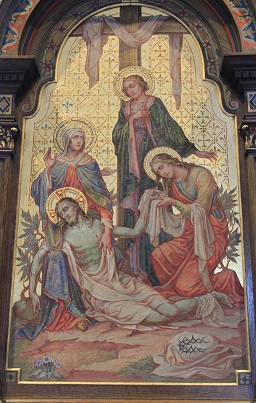
Station of the Cross, Holy Name of Jesus Cathedral, Raleigh NC
Friday in Ember Week.
"This being an Ember-day,
fail not to pray for all the intentions of the Church in the institution
of these days. One important object of your prayers should be, to beg a
blessing upon all those who are at this time promoted to Holy Orders.
God has ordained His Church to be provided with pastors for the good of
the flock: beseech Him therefore to have mercy on all who at this time
receive Holy Orders. Beg of Him to give them a spirit answerable to
their function; that they may be a light to all those, who are to be under their charge. Pray to Him
to give them a zeal for the good of souls, that they may be ready to do
good to all, according to their necessities, and be prepared at all
times to give their life for their flock." The Catholic Year, Fr. John Gother
Prayer for our Bishop:
O Jesus, Prince of Pastors, Shepherd and Bishop of our souls, give our bishops ................ all those virtues, which they need for their sanctification! May they watch over themselves and the entire flock, with which the Holy Spirit has entrusted them! Fill their hearts with Thine own Spirit! Give them faith, charity, wisdom and strength! Send them faithful co-laborers in the great work of saving and guiding souls! Make them shepherds after Thine own heart, living only for their holy office, fearing nobody but Thee, and hoping for nothing but Thee, in order that when Thou shalt come, to judge shepherds and flocks, they may obtain the unfading reward of eternal life! Amen Imprimatur: Most Rev. Vincent S. Waters, D.D. Raleigh, N.C. March 25, 1956
"The violence of the enemy is always directed against those priests who
are most generous and most loyal.The more you are like your Divine
Model, your Savior and your God, the more certainly will you be the
target for the calumnies, the abuse and persecutions of the wicked." Revs. Jacques Nicolas et P. Millet, S.J. (Jesus Living in the Priest: Considerations on the greatness and Holiness of the Priesthood)
Way of the Cross for Priests ( Especially for those who are suffering persecution)
The Expectation of the Blessed Virgin Mary.
by VP
Posted on Thursday December 18, 2025 at 03:00AM in Saints

"By the great mystery of the Incarnation, the Blessed Virgin Mary contracted the most intimate union with the eternal Son of God, whom she was privileged to conceive and bear in her womb. She was ever humble, and remained respectfully silent, without any boasting of the great things which God had accomplished within her. But what tongue can express the inward feelings and affections which filled the glowing heart of the most pure Mother of God? What light shone in her understanding, to penetrate the mysteries and the unfathomed goodness of God? What ardours of holy love inflamed her will? These affections increased in her soul, as the time drew nigh when she should give birth to the world's Redeemer. And this festival is appointed by the Church, to encourage us to contemplate the sentiments of the Blessed Virgin at this time; so that by endeavouring to acquire some share of her dispositions, we may be well prepared for the approaching festival of our Lord's Nativity.
Having had the great happiness to conceive our Blessed Saviour, the holy Virgin ardently desired to give Him birth. She knew that He was given for the salvation of all, and was anxious that a work so important should be begun upon the earth.
How often do you conceive God in your souls by holy desires and good
resolutions; but how rarely are these brought forth to any practical
result? Study in future to cherish holy resolutions and bring them to
maturity. The Blessed Virgin, knowing the decree of God, that Christ should be born of her,
earnestly desired His birth, that she might see Him, adore Him, and
minister to Him. Learn hence to give to your Saviour, not your
affections only, but your external homage and service; and minister to Him in the persons of the poor and of every neighbour. The Blessed Virgin prepared herself for the happy event which she expected, by inflamed acts of divine love and holy desire, and the perfect exercise of every virtue. Employ this day, and every day before the great festival of Christmas, in the like holy exercises; and beseech the Blessed Virgin to obtain for you grace to share in her holy dispositions." The Catholic Year by Fr. John Gother
