Saint Edmund Arbishop of Canterbury, confessor, A.D. 1242
by VP
Posted on Thursday November 20, 2025 at 12:00AM in Saints

"ST. EDMUND was born of pious parents at Abingdon in Berkshire. Of his devout mother he learnt from a child, to fast on all Fridays on bread and water. He grew up under her care in all Christian virtues: and was so dutiful to her, as never by word or look to contradicted her inclinations. He performed the first part of his studies at Oxford, in which he gave early indications of great genius. Retirement and prayer were his delight, and he sought no companions, but those of the like inclinations. From Oxford he was sent to study at Paris, whence he was recalled by the sickness of his mother, who gave him her blessing on her deathbed, and recommended to him the care of his brother and two sisters. Edmund neglected nothing that might benefit his own soul: he shunned the vanities of youth, dreaded pleasures, waged a perpetual war with idleness, frequented churches, and wholly addicted himself to prayer, fasting, and study. His chief care was to preserve his purity without spot or stain; which by the counsel of a holy priest he dedicated by vow to God, under the patronage of the most Blessed Virgin Mary. Her intercession, he declared at his death that he had experienced to be so powerful, that he had never called on her without finding assistance in his temptations, comfort in his afflictions, and relief in his necessities.
Returning to Paris he there finished his studies, and was ordained priest. He came back to England, and taught for some years at Oxford. He preached with great zeal and fruit, converted many sinners, and formed many excellent men of prayer. Being chosen to fill the see of Canterbury, he submitted after much resistance, and received the episcopal consecration. This dignity, however, made no alteration in his humble sentiments or behavior. His chief employment was to inquire into and relieve the necessities of his flock, and he soon acquired the reputation of a primitive pastor. His zeal raised him many adversaries, and finding it impossible to remedy great abuses, he retired into France, where he soon after died the death of the just, on the sixteenth of November, 1242.
St. Edmund was a great proficient in divine love, because he learned perfectly to die to himself. Pray for the like spirit of self-denial. Pray for your country: and let the many disorders you observe in it, oblige you to importune heaven for remedy. Can you be silent, when so many souls are carried away by vice and error? This is the punishment of sin. Pray for mercy; and be careful not to add to the scourge by your own disorders and sins." The Catholic Year by Fr. John Gother
Saint Elizabeth of Hungary, Widow, A.D. 1231
by VP
Posted on Wednesday November 19, 2025 at 04:00AM in Saints
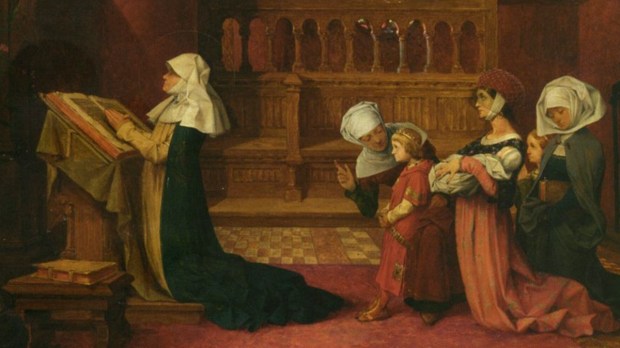
"Enter into your own hearts, and resolve to imitate St. Elizabeth of Hungary, a saint and a queen, who would go with all royal pomp to Holy Mass, but on entering Church, would take the crown from her head, the jewels from her fingers, and, despoiled of all ornament, would remain covered with a veil, so modest in deportment, that she never was seen to direct a glance in any direction but the altar.This so please Almighty God that He chose to make His satisfaction apparent to all, for once, during Mass, the Saint was so glorified with Divine splendor, that the eyes which looked on her were dazzled, and she seemed to all as it were an angel of Paradise. Make use of this noble example, and be assured you will thus become pleasing to God and to man, and your share in the Divine Sacrifice will be of the highest profit to you in this life and in the next." The hidden treasure: or, The value and excellence of holy mass. by Blessed Leonard of Port-Maurice 1855 p111
"SHE was daughter of the king of Hungary, and from her childhood accustomed to all the exercises of piety. Being married to the Landgrave of Hesse, her whole business was in assisting orphans and widows, and helping the sick. This she did, without any regard to her quality or state; judging nothing more honorable, than to do good. After her husband's decease, she embraced the third Order of St. Francis Spiritual and corporal works of mercy
occupied her, even to her last moments; and by her moving exhortations,
many obstinate sinners were converted to God. In prayer she found her
comfort and strength in her mortal pilgrimage, and was favored with
frequent raptures and heavenly communications. Being forewarned by
Almighty God of her approaching death, she redoubled her fervor, and ceased not to pray, or to discourse on the life and sufferings of our Redeemer, and his future coming to judge: The day of her happy death was the 19th of November in 1231.
She is an instruction to all states; and teaches virgins, wives and widows to seek first the kingdom of God, and not let the distractions of this world be a bar to the next Her example cannot be followed without great labor and self-denial, in overcoming those inclinations, which keep the soul down, and confine it to this world. Vanity, solicitude and the desire of reputation, are powerful charms, but they look not beyond the earth; and how will this turn to a good account with them, who having but a short time to provide for the next world, consume it all in their concern for this? Think seriously of this
ill management, and pray for all who are subject to it. Pray in
particular for those, whose quality sets them above others, that they
may have a sense of what is truly honorable; that if they take their measures from the gospel, there is more honor in helping the poor
and distressed, and practicing humility and patience, than in all those
ways in which their vanity leads them. What is all that honor, which
will be the contempt of devils?" The Catholic Year by Fr. John Gother
Nineteeth Day: Holy Communion of Great Benefit to the Departed
by VP
Posted on Wednesday November 19, 2025 at 03:00AM in Purgatory Month Meditations
"The Holy Doctor and Cardinal, St. Bonaventure, of the Order of St. Francis, who wrote much concerning the holy souls, urges especially frequent Communion in their behalf. "Let love and compassion for your neighbor," so he writes, "lead you to the Holy Table, for nothing is so well calculated to obtain eternal rest for the holy souls.!
This is confirmed by the following example. Ludovio Blosio relates that a pious servant of God, in a vision, beheld a departed friend wrapped in flames, and learned from him that he suffered terribly, because he had received Our Lord in Holy Communion with but little preparation. "Therefore," added this departed friend, "I beg of you, for the love we bore each other, to communicate for the benefit of my soul, but to do so with great preparation and fervor; I then hope certainly to be released from the terrible sufferings that I indeed have well deserved for my negligence towards the Blessed Sacrament." The friend at once complied with the request, and having received Holy Communion with due preparation, he saw the same soul enveloped in light, winging its festive flight to Heave, to behold face to face the King of eternal glory.
Prayer: O Lord Jesus Christ, Who in the Most Holy Sacrament of the Altar hast given us Thine own flesh and blood for the nourishment of our souls, and a pledge of our own future resurrection, grant us the grace always to receive worthily this Most Holy Mystery, that it may be to us and the souls in Purgatory a source of salvation. Who livest and reignest, world without end. Amen.
Prayer for Priests in Purgatory: My Jesus, by the sorrows Thou didst suffer in Thine Agony in the Garden, in Thy Scourging and Crowning with thorns, in the Way to Calvary, in Thy Crucifixion and Death, have mercy on the souls of priests in Purgatory, especially those most forgotten and who have no one else to pray for them. I wish to remember all those priests who ministered to me, the priests my heart has never forgotten, and for those that I no longer recall due to my frailty of memory. Do Thou deliver them from the dire torments they endure; call them and admit them to Thy most sweet embrace in Paradise.
Pope Saint Pius X and Saint John Vianney, pray for us and especially for our priests. Amen
Special Intercession: Pray for the souls who were negligent in their preparation for Holy Communion
Lord grant them eternal rest, and let perpetual light shine upon them. May they rest in peace. Amen. (three times)
Invocation: My Jesus, mercy!
Source: Manual of the Purgatorian Society, Redemptorist Fathers. 1907
Dedication of the Churches of Ss. Peter and Paul, Apostles
by VP
Posted on Tuesday November 18, 2025 at 04:00AM in Tradition
"A FEAST in memory of that day, when Constantine the Great, having laid the foundation of St. Peter's church at Rome, it was consecrated by the Pope St. Sylvester, and has been ever since visited by great numbers of Christians in honour of the glorious Apostles SS. Peter and Paul, whose bodies partly lie there, and partly in the church of St. Paul, on the Ostian Road. The tombs of the great conquerors and lords of the world have been long since destroyed and for gotten; but those of the glorious apostles are still venerated by the faithful. Give thanks for the peace then restored to Christians, after three hundred years of persecution. Remember that all places appointed for the worship of God are holy; and see that you never profane them by any kind of irreverence.
Be therefore mindful in whose presence you are, as often as you go to
prayer; and if your there expect blessings, provoke not that hand, from
which they had to come. How miserable are you, if instead of mercy, you draw down judgments on your own head! Have a great respect likewise for all holy things, especially for the Holy Scripture; and never make any part of that the subject of your diversion, or jests. Leave such profanation to infidels and apostates; for it cannot be a Christian's part to trample under foot the bread of life. Pray that Almighty God would in His mercy remember this nation, and grant that the faithful
may reform all abuses, as often as they meet to pay homage to their
God. That as often as they come into His holy place, they may remember
in whose presence they are, call to mind His infinite majesty and their
wants; and as these demand, so regulate their outward and inward man.
That they may have so much faith and seriousness, as to be afraid of provoking
Him there, where they come to ask His blessings; but rather make their
petitions with an attention and solicitude answerable to their
necessities." The Catholic Year by Fr. John Gother
Eighteenth Day: The Efficacy of Holy Mass for the Departed
by VP
Posted on Tuesday November 18, 2025 at 03:00AM in Purgatory Month Meditations
"The Sacrifice of the Mass is the great devotion of the Catholic Church. And of all means to assist the souls in Purgatory none is more valuable or meritorious. For there Jesus Christ offers Himself with His infinite merits to His Heavenly Father, by the hands of the priest, in behalf of the suffering souls. The unbloody Sacrifice of the Mass does not essentially differ from the Sacrifice of the Cross, but only accidentally as to the manner of offering. And no limit can be place to the effect of this great Sacrifice, which contains in itself all grace.
From this inestimable efficacy, however, we may not infer that the offering of one Mass is sufficient to release the souls we love. For, though the Sacrifice on Calvary was infinite we cannot conclude that the application of it through the Mass must also be infinite. St. Thomas Aquinas tells us, it was not the intention of Jesus Christ to bestow the full efficacy of His suffering and death, which is commemorated in every Mass, upon us. His merits are applied according to His Adorable Will, for the ways of God are often inscrutable.
It is very salutary therefore, to have the Holy Sacrifice offered frequently for the repose of a soul. Should the souls who are dear to us and for whom we intercede in this manner, be already in the enjoyment of eternal bliss, Divine Wisdom and Goodness will bestow the merit of the Masses offered on other suffering souls."
Prayer: O Lord Jesus Christ, Who didst institute the unbloody Sacrifice of the Mass in commemoration of Thy Sacrifice upon the Cross, we beseech Thee, bestow the merits of this Holy Sacrifice upon the souls in Purgatory, that they may soon be released from their pains. Thou Who livest and reignest, world without end. Amen.
Prayer for Priests in Purgatory: My Jesus, by the sorrows Thou didst suffer in Thine Agony in the Garden, in Thy Scourging and Crowning with thorns, in the Way to Calvary, in Thy Crucifixion and Death, have mercy on the souls of priests in Purgatory, especially those most forgotten and who have no one else to pray for them. I wish to remember all those priests who ministered to me, the priests my heart has never forgotten, and for those that I no longer recall due to my frailty of memory. Do Thou deliver them from the dire torments they endure; call them and admit them to Thy most sweet embrace in Paradise.
Pope Saint Pius X and Saint John Vianney, pray for us and especially for our priests. Amen
Special Intercession: Pray for the souls of those who were the most zealous to assist at Mass.
Lord grant them eternal rest, and let perpetual light shine upon them. May they rest in peace. Amen. (three times)
Invocation: My Jesus, mercy!
Source: Manual of the Purgatorian Society, Redemptorist Fathers. 1907St. Odo of Cluny
by VP
Posted on Tuesday November 18, 2025 at 03:00AM in Saints
 St. Odo of Cluny
" On Christmas-eve, A.D. 877, a noble of Aquitaine implored Our Lady to grant him a son. His prayer was heard; Odo was born, and his grateful father offered him to St. Martin. Odo grew in wisdom and in virtue, and his father longed to see him shine at court. But the attraction of grace was too strong. Odo's heart was sad and his health failed, until he forsook the world and sought refuge under the shadow of St. Martin at Tours. Later on he took the habit of St. Benedict at Baume, and was compelled to become abbot of the great abbey of Cluny, which was then building. He ruled it with the hand of a master and the winningness of a Saint. The Pope sent for him often to aot as peacemaker between contending princes, and it was on one of those missions of mercy that he was taken ill at Rome. At his urgent entreaty he was borne back to Tours, where he died at the feet of "his own St. Martin," A.D. 942.
Reflection." It needs only," says Father Newman, "for a Catholic to show devotion to any-Saint, in order to receive special benefits from his intercession."
"The Mass" says St. Odo, Abbot of Cluny, "is the act on which is based the salvation of the World." The Holy Mass: The Sacrifice for the Living and the Dead, by Rev. Fr Michael Müller 1875 p 288.
"When and how was this yearly commemoration of the
departed introduced? The time of the introduction of this commemoration
cannot be determined; for as easily as the time of Tertullian he
mentions that the Christians of his day held a yearly commemoration of
the dead. Towards the end of the tenth century St. Odo, abbot of the
Benedictines, at Cluny, directed this feast to be celebrated yearly, on
the 2nd of November in all the convents of his Order, which usage was
afterwards enjoined upon the whole Christian world by Pope John XVI. The
feast of this day was probably established in order that, after having
on day before rejoiced over the glory of the saints in heaven, we should
this day remember in love those who are sighing in purgatory for
deliverance.
Prayer: O God, the Creator and Redeemer of
all the faithful, grant to the souls of Thy servants departed the
remission of all their sins, that, by our pious supplications, they may
obtain the pardon which they have always desires. Who livest and
reignest,etc. All Souls' Day. p456 Devout Instructions on the Epistles and Gospels for the Sundays and Holydays Front Cover Leonhard Goffiné Benziger, 1896
St. Rose Philippine Duchesne, Virgin nun 1769- 1852 (4th American Saint)
by VP
Posted on Monday November 17, 2025 at 11:00PM in Saints

Saint Rose-Philippine Duchesne, sister of the Society of the Sacred Heart of Jesus, founderess of the congregation first house in America (1818)
"Mother Rose Philippine Duchesne, Virgin, foundress, in America, of the first houses of the Society of the Sacred Heart.
Born at Grenoble, France, August 29, 1769, she was educated by the Visitation Nuns, entered that Order, saw its dispersion during the Reign of Terror and vainly attempted the reestablishment of the convent of Sainte-Marie d'en-Haut, near Grenoble. Finally, in 1804, she accepted the offer of Mother Barat, to incorporate her community into the Society of the Sacred Heart. In 1818 Mother Duchesne set out with four companions for the missions of America. Bishop Dubourg welcomed her to New Orleans, whence she sailed up the Mississippi to St. Louis, finally settling her little community at St. Charles. Cold, hunger and illness, opposition, ingratitude and calumny served only to fire her lofty and indomitable spirit with new zeal. Having founded the new houses at Florissant, Grand Coteau, New Orleans, St. Louis and St. Michel, La., she yearned to teach the poor Indians. Old and broken as she was, she went to labor amongst the Pottowatomies at Sugar Creek, Kansas. But one year later she returned to St. Charles and died October 18, 1852. Preliminary steps for her beatification have been taken. " BAUNARD, Histoire de Mme. Duchesne, Paris, 1878.
"At Bordeaux, for example, Robespierre had ordered the construction of a huge guillotine having four blades, thus to make short work of the execution of the twelve hundred priests imprisoned there. Four days before that fearful decree was to be carried into effect, Robespierre met his own death by the knife of another guillotine.
Some few of the faithful priests escaped deportation and wandered through France, giving the Last Sacraments to the sick and dying, saying Mass in hiding wherever they might and encouraging the faithful to persevere. So Philippine became a "priest-hunter." She seemed to have an intuition for recognizing those who could give her sick poor what would be their only comfort in their last hours. When she had failed to find one of these outlawed priests, she would pray beside the dying, exhorting them to contrition and to confidence. One day she carried a woman to her own lodging, placed her in the bed which she shared with another Dame de la Miséricorde, and prayed beside her all the night until she died. Fear seemed unknown to Philippine. Danger was evident, even to her, but she scorned the thought of it if there were hope of saving souls. In those years of terror, she would go at any hour of the night to visit the sick in the hovels they called home and, if she left them before dawn, it was to find her way to some secluded spot where Mass was to be said.
At last there came a respite when with the death of Robespierre in 1794 the application of the laws against the loyal clergy was relaxed. Some of the clerical prisoners were set free and so many exiled priests returned, that the Convention in alarm gave them a month in which to quit France once more. Vacillation was, in most cases, the characteristic of the Convention, which revoked, renewed, and withdrew the renewal of the decrees which it had made." Mother Philippine Duchesne By Marjory Erskine
"The hard soil about them was but a type of the harder soil in the population of the new land which they came to serve. Souls neglected, hardened, arrogant, ignorant, filled with self-conceit, devoted to ease and pleasure and self-indulgence, gave little encouragement for the future. Yet the good nuns struggled on. But in one year they had to leave the placeanother instance of the constant disappointment that was to be Mother Duchesne's earthly portion. "One day the Sacred Heart was to return to that place, and to gather in the harvest she had prepared. This was always her part of the work in our Lord's vineyard. Others reaped where she had conquered the soil inch by inch. She opened the way amidst brambles and briers. She was in the desert the pioneer of Christ." Catholic World, Volume 65 Mother Duchesne BY S. L. EMERY. p 687
Saint Gregory the Wonderworker, Bishop and Confessor
by VP
Posted on Monday November 17, 2025 at 04:00AM in Saints
"He was bishop of Neocæsarea in Pontus; eminent for his great learning and virtues, but much more for his miracles, which he wrought in such numbers that he was called Thaumaturgus, which signifies, Worker of Miracles. In this respect, as St. Basil says, he might be compared with Moses and the apostles. When he built a church at Neocæsarea, he commanded a mountain which obstructed the work, to remove and yield place, which it did. He fixed his staff near the bank of a river, which sometimes overflowed and swept away inhabitants, houses, cattle and crops; and no such floods happened again. His staff also grew, and became a tree. A lake, which was a subject of contention between two brothers, was dried up at the prayers of the saint, and became solid land, whereby the cause of dispute was removed. He was a man of a prophetic and apostolic spirit; and in his devotions, he shewed the greatest reverence and recollection. He abhorred lies and falsehood, and particularly all detraction. No anger or bitterness ever appeared in his words or behavior. A little before his death, he inquired how many infidels yet remained in the city; and being told that there were seventeen, he sighed, and lifting up his eyes to heaven, expressed his grief that any continued strangers to the true religion, but thankfully acknowledged as a great mercy, that having found but seventeen Christians at his first coming thither, he left but seventeen idolators. He died in the year 270, or 271
Pray for all the pastors of the church; that by their vigilance and good example, they may bring forth a plentiful harvest. All who are engaged in error, or in a sinful state, stand in need of their help, and ought to be the subject of their labors and prayers, that none may perish through their neglect. In whatever degree you are, let your words and example be to edification. Endeavor to do good to all, and let the great charity of this saint teach you not to conceal any thing that may be beneficial to the public." The Catholic Year by Fr. John Gother
"St. GREGORY was born in Pontus, of heathen parents. In Palestine, about the year 231, he studied philosophy under the great Origen, who led him from the pursuit of human wisdom to Christ, Who is the Wisdom of God. Not long after, he was made Bishop of Neo-Cæsarea in his own country. As he lay awake one night an old man entered his room, and pointed to a lady of superhuman beauty, and radiant with heavenly light. This old man was St. John the Evangelist, and the lady told him to give Gregory the instruction he desired. Thereupon he gave St. Gregory a creed which contained in all its fulness the doctrine of the Trinity. St. Gregory set it in writing, directed all his preaching by it, and handed it down to his successors. Strong in this faith, he subdued demons; he foretold the future. At his word a rock moved from its place, a river changed its course, a lake was dried up. He converted his diocese, and strengthened those under persecution. He struck down a rising heresy; and, when he was gone, this creed preserved his flock from the Arian pest. St. Gregory died in the year 270.
Reflection.-Devotion to the blessed Mother of God is the sure protection of faith in her Divine Son. Every time that we invoke her, we renew our faith in the Incarnate God; we reverse the sin and unbelief of our first parents; we take our part with her who was blessed because she believed." Little Pictorial Lives of the Saint edited by John Gilmary Shea
Seventeeth Day: The Manner in which the Church bestows Indulgences upon the Souls in Purgatory
by VP
Posted on Monday November 17, 2025 at 03:00AM in Purgatory Month Meditations
The Church does not apply indulgences to the souls in Purgatory as she does to the faithful upon earth through the tribunal of penance and absolution, but confers them simply through pious supplications and sacrifices offered in their behalf; thus they are relieved indirectly. Holy Church opens her rich treasures of merit and satisfaction in proportion to the suffrage of the faithful, who offer expiation and fervent prayers to God for the relief of the suffering souls.
God has reserved to Himself the right to accept entirely, or in part, the satisfaction offered for any soul in Purgatory. This acceptance depends upon His holy and adorable Will, and perhaps, in great measure upon the care of the soul to render herself worthy of the Divine Assistance during her earthly career. Besides, there may be some obligation neglected by the person who intends to gain the indulgence, owing to ignorance or forgetfulness on his part.
Therefore, we have no assurance whatever that an indulgence given by us to the souls has had the desired effect. Considering this, we should prepare most carefully, and fulfill all obligations required for gaining an indulgence. However, let us place with entire confidence in the tender hand of Divine Mercy the application of indulgences to departed souls who are especially dear to us.
Prayer: Have mercy, O Lord, upon the suffering souls in Purgatory; mitigate the severity of Thy judgments; let the infinite merits of Thine only begotten Son and those of Thy saints assist the holy souls and deliver them from their sufferings. Through Christ Our Lord. Amen.
Prayer for Priests in Purgatory: My Jesus, by the sorrows Thou didst suffer in Thine Agony in the Garden, in Thy Scourging and Crowning with thorns, in the Way to Calvary, in Thy Crucifixion and Death, have mercy on the souls of priests in Purgatory, especially those most forgotten and who have no one else to pray for them. I wish to remember all those priests who ministered to me, the priests my heart has never forgotten, and for those that I no longer recall due to my frailty of memory. Do Thou deliver them from the dire torments they endure; call them and admit them to Thy most sweet embrace in Paradise.
Pope Saint Pius X and Saint John Vianney, pray for us and especially for our priests. Amen
Special Intercession: Pray for the souls of those who neglected to gain indulgences for the souls in Purgatory.
Lord grant them eternal rest, and let perpetual light shine upon them. May they rest in peace. Amen. (three times)
Invocation: My Jesus, mercy!
Source: Manual of the Purgatorian Society, Redemptorist Fathers. 1907
Saint Gertrude, Virgin and Abbess A.D. 1292
by VP
Posted on Sunday November 16, 2025 at 04:00AM in Saints

" St. Gertrude, Spouse of Christ, Pray for us.
If you want to find me, look for me near the Altar or in the heart of Gertrude."
"JESUS CHRIST IN THE HOLY EUCHARIST.-It was by meditation on the infinite goodness of Jesus Christ in the adorable sacrament of the Eucharist that St. Gertrude, abbess of Rodersdorff, in Saxony, was raised to that high degree of perfection, contemplation, and divine love, which was never surpassed, save by St. Theresa, and which still awakens the admiration of all who are intent upon the contemplative life. But, not content with meditating and praying, she sought to reproduce in her own person the humility, charity, patience, and sweetness of the Divine Exemplar, so that works, without which there is no true virtue, should not be wanting to her Faith. She has sketched the true portrait of her soul in her book of Revelations," which embodies the narrative of her communications with God and the holy transports of His love. She died in 1334, and her last malady was, so to speak, nought but a holy languor of Divine love, so delightful and ineffable were the consolations she enjoyed. Numerous miracles have borne witness to her sanctity.
MORAL REFLECTION..-"Whosoever drinketh of the water that I shall give shall never thirst, but this water shall be in him a well springing up into life everlasting."-(John iv. 13.)" Pictorial half hours with the saints by Fr. Auguste François Lecanu
"AT five years of age, she was offered to God in a Benedictine nunnery in Saxony, and at the age of thirty, chosen abbess. Divine contemplation and devout prayer she always looked upon as the principal duty of her state. The Passion of our divine Redeemer was the favorite object of her devotions. She spoke of Christ with so much unction, as to enrapture all who heard her. The love of God, which burned in her breast, seemed the only spring of her affections and actions. Watching, fasting, abstinence, perfect obedience, and the constant denial of her own will, were the means by which she tamed her passions. But profound humility and perfect meekness had the chief part in this work. Though possessed of great natural talents, her mind was penetrated only with deep sentiments of her own nothingness and imperfections. It was her sincere desire that all should have the same contempt of her, which she had of herself; and she used to say that it seemed to her one of the greatest of all the miracles of God's goodness, that he was pleased to suffer the earth to bear her. Though superior over the rest, she behaved towards them as if she had been the lowest
servant, and one unworthy to approach them. While she gave herself up
to heavenly contemplation, she was very solicitous to attend to the necessities of every one. Her tender devotion to the Mother of God, sprang from the ardor of her love for the divine Son. The suffering
souls in Purgatory had a great share in her compassion and charity. She
never interrupted her sighs and moans, admitting no human consolation,
so long as her desire was delayed. Yet she rejoiced in hope and love in perfect resignation to the will of God, in the visits of the divine
Spirit, in suffering with her loving Redeemer, and for his sake, and in laboring for his service. Her desires were at length fulfilled, and
having been abbess forty years, she was called to her heavenly spouse in
1292; having in her last sickness enjoyed the sweet comforts and presence of the Holy Ghost." The Catholic Year by Fr. John Gother
On another day, as she received the saving Host, our Lord addressed her thus: "Consider that the priest who gives you the Host touches it directly with his hands, and that the vestments with which he is clothed, out of respect, do not reach beyond his arms; this is to teach you, that although I regard with pleasure all that is done for My glory, as prayers, fasts, vigils, and other like works of piety, still (those who have little understanding will not comprehend it), the confidence with which the elect have recourse to Me in their weakness touches Me far more sensibly; even as you see My Flesh is nearer to the hands of the priest than his vestments.” The Life and Revelations of Saint Gertrude
Prayer before Mass (Prayers of St. Gertrude):
O Almighty, everlasting God, seeing that it is the true faith of Thy Church that the holy Sacrifice of the Mass instituted by Thy Son is infinitely pleasing to Thy divine Majesty, and renders Thee an infinite worship and praise, and since by it alone Thou canst be worthily and adequately worshiped and praised; impelled by an ardent desire of Thy honor and glory, I purpose to assist at this present sacrifice with the utmost devotion of which I am capable, and to offer this most Holy Oblation to Thee in union with Thy priest.
I offer Thee not only this sacrifice, but all those which shall be this day offered from every part of the world; and I protest before Thee that if it depended on me whether they should be offered or omitted, I would put forth all my powers to procure and further their being offered. And were I able now to raise up to Thee, of the stone which are scattered over the earth, most devoted priests, who should day by day and with glowing fervor offer to Thee this sacrifice of praise, I would most gladly do it. But, being what I am, I implore Thee, O most holy Father, through Jesus Christ Thy Son, to pour into the hearts of all Thy priests, and especially those who might perchance otherwise offer Thee this acceptable sacrifice coldly and without due recollectedness, the spirit of grace and of fervor, that they may be enabled to celebrate Thy tremendous Mystery with becoming awe and devotion.
Grant to me, and to all those who are here present with me, that we may join in this most sacred action with reverence and devotion, so that we may have our portion in its fruit and effect. I confess to Thee, O almighty God, and to the Blessed Mary ever Virgin, and to all the Saints, my own sins and those of all the world; and I lay them on Thy sacred Altar, that they may be entirely blotted out by the virtue of this sacrifice. Do thou deign to grant us this grace, by that love which held back Thy hand from smiting when Thy most beloved Son, Thy only Son, was immolated by the hands of ungodly men. amen"
Preces Gertrudianae; Prayers of St. Gertrude and St. Mechtilde.
