Day 45. Lent with the Cure d'Ars: Last Judgment
by VP
Posted on Friday April 03, 2026 at 02:00AM in Lenten Sermons
"Our catechism tells us, my children, that all men will undergo a particular judgment on the day of their death. No sooner shall we have breathed our last sigh than our soul, without leaving the place where it has expired, will be presented before the tribunal of God. Wherever we may die, God is there to exercise His justice. The good God, my children, has measured out our years, and of those years that He has resolved to leave us on this earth, He has marked out one which shall be our last; one day which we shall not see succeeded by other days; one hour after which there will be for us no more time. What distance is there between that moment and this - the space of an instant. Life, my children, is a smoke, a light vapour; it disappears more quickly than a bird that darts through the air, or a ship that sails on the sea, and leaves no trace of its course!
When shall we die? Alas! will it be in a year, in a month? Perhaps tomorrow, perhaps today! May not that happen to us which happens to so many others? It may be that at a moment when you are thinking of nothing but amusing yourself, you may be summoned to the judgment of God, like the impious Baltassar. What will then be the astonishment of that soul entering on its eternity? Surprised, bewildered, separated thenceforth from its relations and friends, and, as it were, surrounded with Divine light, it will find in its Creator no longer a merciful Father, but an inflexible Judge. Imagine to yourselves, my children, a soul at its departure from this life. It is going to appear before the tribunal of its Judge, alone with God; there is Heaven on one side, Hell on the other. What object presents itself before it? The picture of its whole life! All its thoughts, all its words, all its actions, are examined.
This examination will be terrible, my children, because nothing is hidden from God. His infinite wisdom knows our most inmost thoughts; it penetrates to the bottom of our hearts, and lays open their innermost folds. In vain sinners avoid the light of day that they may sin more freely; they spare themselves a little shame in the eyes of men, but it will be of no advantage to them at the day of judgment; God will make light the darkness under cover of which they thought to sin with impunity. The Holy Ghost, my children, says that we shall be examined on our words, our thoughts, our actions; we shall be examined even on the good we ought to have done, and have not done, on the sins of others of which we have been the cause. Alas! so many thoughts to which we abandon ourselves - to which the mind gives itself up; how many in one day! in a week! in a month! in a year! How many in the whole course of our life! Not one of this infinite number will escape the knowledge of our Judge.
The proud man must give an account of all his thoughts of presumption, of vanity, of ambition; the impure of all his evil thoughts, and of the criminal desires with which he has fed his imagination. Those young people who are incessantly occupied with their dress, who are seeking to please, to distinguish themselves, to attract attention and praise, and who dare not make themselves known in the tribunal of Penance, will they be able still to hide themselves at the day of the judgment of God? No, no! They will appear there such as they have been during their life, before Him who makes known all that is most secret in the heart of man.
We shall give an account, my children, of our oaths, of our imprecations, of our curses. God hears our slanders, our calumnies, our free conversations, our worldly and licentious songs; He hears also the discourse of the impious. This is not all, my children; God will also examine our actions. He will bring to light all our unfaithfulness in His service, our forgetfulness of His Commandments, our transgression of His law, the profanation of His churches, the attachment to the world, the ill-regulated love of pleasure and of the perishable goods of earth. All, my children, will be unveiled; those thefts, that injustice, that usury, that intemperance, that anger, those disputes, that tyranny, that revenge, those criminal liberties, those abominations that cannot be named without blushes...."
Source: The Sermons of the Cure d'Ars 1960 (Public Domain)
Prayer for Lent: O Lord who, for our sake, didst fast forty days and forty nights; give us grace to use such abstinence that, our flesh being subdued to the spirit, we may worthily lament and acknowledge our wretchedness, and may obtain perfect remission and forgiveness of Thee, the God of all mercy, who livest and reignest with the Father and Holy Ghost, one God, world without end. Amen
Source: Lent with the Cure d'Ars Compiled by the CAPGSt. Richard, Bishop of Chichester, A.D. 1253.
by VP
Posted on Friday April 03, 2026 at 12:00AM in Saints

"The saint's devotion to the Holy Eucharist is shown by his minute and careful legislation regarding all things connected with the service of the altar. Everything surrounding it, and especially the linen used for Mass, must be of spotless cleanliness, and no priest may say Mass in torn or dirty vestments. The chalices must be of gold or silver, and a crucifix must always be placed before the celebrant. When the Holy Viaticum is carried to the sick it must be taken with the utmost reverence, the priest in surplice and stole, accompanied by cross, lights, and holy water, and preceded by an acolyte with a bell to let the people know that their Lord is passing.
Only those who have
passed a sufficient examination are to be admitted to the ranks of the
clergy, and no one is to be ordained to sacred orders if he come with
any other design than to serve God alone; ordination, therefore, should
be refused to anyone for money, favor, or privilege, and all those in
the least tainted with heresy or suspected of leading unholy lives must
be rigorously excluded from the priesthood. (...) Finally,
the clergy are reminded of the duty of instructing their flocks in the
truths of the Faith, and they must teach them simple prayers according
to their ability to learn. Source: Richard of Wyche, labourer, Scholar, Bishop, and Saint. by Sister Mary Reginald OP 1913
"St. Richard was born in Worcestershire. From his childhood, he had a great aversion to dances, shows, and gay amusements; and applied diligently to virtue and learning. Quitting all worldly prospects, he studied first at Oxford, then at Paris, where, with two companions, he lived in great poverty, contenting himself with coarse bread, and drinking only water, which nevertheless he used to say was the most pleasant time of his whole life.
He afterwards went to Bologna, to study canon law; and having taught there a short time, he returned to Oxford, and was chosen chancellor of that university. He was afterwards appointed chancellor to St. Edmund, archbishop of Canterbury; in which charge he was faithful, just, affable, modest, and sincere. He kept close to his holy prelate in all his tribulations, and accompanied him in his exile. Being ordained priest, he returned to England; and not long after was chosen bishop of Chichester. The king, Henry III., opposed his nomination, but Pope Innocent IV. ratified his election, and consecrated him with his own hands at Rome.
The saint returned to England, but found all the revenues of his bishopric seized by the king's officers. He went therefore to his diocese poor and penniless, and suffered great hardships for two years, when his revenues were restored to him, though much impaired. Seated now in his episcopal chair, St. Richard shone forth more illustrious then ever in all virtues. He was fervent in prayer, night and day, liberal in alms-deeds, and rigorous in the chastisement of his body. In visiting his diocese, he always made diligent inquiry after the sick and poor; and not only relieved them, but visited them in person, to comfort them with pious exhortations. God was pleased by miracles to testify his approbation of these great charities; especially when one loaf blessed by the saint, was so wonderfully multiplied, as to satisfy three thousand poor. He suffered at one time a great loss by fire; but with a pleasant countenance he only said: "Perhaps God has punished us, because we were not liberal enough in our alms; and therefore see that we give more bountifully for the time to come."
Whilst he was employed in preaching a crusade for the recovery of the Holy Land, he fell sick; and prepared for his last end, by receiving the Sacraments, and making a general confession of his whole life. He died at Dover on the 3rd of April, 1253, in the fifty-sixth year of his age. Pray for the pastors of the Church, and in particular of this nation, that they may be every way fitted for their charge. Pray for the people also, that peace and charity may reign among them, that they may be united in one faith, and live according to the Gospel." The Catholic Year by Rev. Fr. John GotherPrayer to Saint Richard of Chichester
Most merciful Redeemer,
who gavest to thy Bishop Richard a love of learning,
a zeal for souls, and a devotion to the poor:
grant that, encouraged by his example,
and aided by his prayers,
we may know thee more clearly,
love thee more dearly,
and follow thee more nearly,
day by day;
who livest and reignest with the Father
in the unity of the Holy Spirit, ever one God,
world without end. Amen.
Gratias tibi ego, Domine Jesu Christe, de omnibus beneficiis, quae mihi praestitisti; pro poenis & opprobiis, quae pro me pertulisti; propter quae plactus ille lamentablis vere tibim competebat. Non est dolor sicut dolor meus.
God Surrenders to Man
by VP
Posted on Friday April 03, 2026 at 12:00AM in Poetry
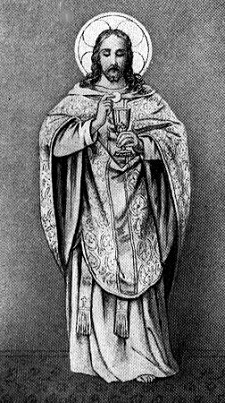
"There is a passage in the Following of Christ, II., 11, in which a Kempis insists that nothing we can offer to God is acceptable unless we offer ourselves. "If a man give his whole substance, it is nothing. If he do great penance, it is but little. If he attain to all knowledge, he is far off still. If he have great virtue and very fervent devotion, there is still much wanting to him, the one thing which is supremely necessary to him." What is the one thing necessary? "that having given all things else to God he give himself."
Now, man, recognizing the demand of God that we surrender ourselves to Him, boldly retaliates with a demand that God surrender Himself to us. Man says to God, " Thou mayest multiply Thy favors; Thou mayest overwhelm me with gifts, but though Thy gifts, temporal and spiritual, be piled in mountains before me, my heart remains unsatisfied, my soul is discontent. I want not Thy gifts, I want Thee. Pardon, my God, if I speak boldly, I speak as Thou hast made me. Thou hast made me man, but Thou hast given me the cravings of a god. Thou mayest empty Thy treasure-house before my feet. Still I demand more, that Thou give me Thyself. Thou hast made me for Thyself. My heart remains empty until it be filled with Thee."
The answer is the Incarnation and the Blessed Sacrament."
Source: A Thought a Day for Lent, Rev. James M Gilles, C.P.; Paulist Press, 1923.
Good Friday
by VP
Posted on Friday April 03, 2026 at 12:00AM in Meditations
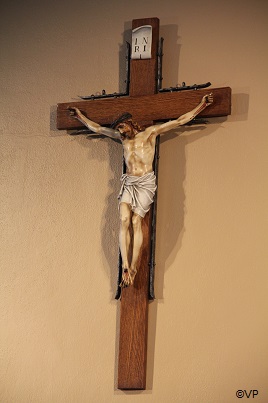
Mother of Mercy, Washington NC.
"On this solemn and sacred day, consider your Blessed Redeemer on Mount Calvary. Being arrived at the holy mount, Jesus is forthwith stretched out upon the cross. His hands and feet are pierced with nails, and with them fastened to the wood: and thus, with shouts and cries of the insulting multitude, He is raised up into the air, and in this manner He offers Himself a bleeding sacrifice to the eternal Father, a propitiation for our sins, and those of the whole world. Who can comprehend what He suffered here, in having His wasted, torn and tormented Body now stretched out upon a cross, His hands and feet fastened to it with nails; and then raised up with shouts into the air between two thieves, with the weight of his whole body now resting only on His wounds? Who will give us a heart to adore our Redeemer, and tears to lament His sufferings, and our sins, which are the occasion of them, and are the very nails, which have bored His sacred hands and feet, and nailed him to the cross?
The first words which our Blessed Saviour uttered, when raised up upon the cross, were: "Father, forgive them, for they know not what they do". Adore the charity of your crucified Redeemer. He prayed for those who treated Him with the utmost cruelty. This shows that it was an excess of love, that brought Him to this ignominious death, since He offered His blood for those who shed it. Beg of Him to open your breast to that divine charity, of which He has here given you so great an example, and to teach you the practice of forgiving all injuries, and even the worst of enemies.
They that passed by reviled Him and mocked Him. But He was pleased to suffer even to His last breath. We are sensible how great a trial it is to be despised in time of affliction; and yet contempts and insults are His entertainment in His greatest humiliation. Bless the humility and patience of your Saviour, who suffered all this for your sake from the hands of sinners. Pray that being His disciple, you may inherit some portion of His spirit, and then remember what is your duty when you are in affliction, or under contempt.
That the Scripture might be fulfilled, Jesus said:"I thirst". How great must our Saviour's thirst have been, when He complained of that, after going through so many torments without opening His mouth! Bless your Redeemer for whatever He suffered in this His last hour, and beg that this His thirst may be the expiation of your intemperance, as likewise of all your niceness and self-love. Beseech Him on this day of mercy to give you a better spirit; that by the merit of His adorable thirst, all self-love may be moderated in you, and such a change be wrought, that you may no more thirst after the false goods of the world, nor be distracted with those vain desires, which have so often wasted your spirit, and taken your heart from the solicitude of more substantial goods.
About the ninth hour, Jesus cried with a loud voice: "My God my God! why hast thou forsaken me?" How great must His suffering have been, for Him thus to cry out ! This is the complaint of nature, which thus expresses its uneasiness under the cross, which the spirit had chosen. It is rather an instruction from the sacred mouth of our Redeemer, to put us in mind of the greatness of His torments, of the rigour of His divine justice, and of the cause for which He is exposed to this extremity. It is to lead us to consider and ask why He suffers all this. It is for the redemption of man: for us poor worms, wretched sinners, enemies of God, captives of hell. Blessed be this His mercy for ever!
And Jesus crying again with a loud voice, yielded up the ghost. Thus all is accomplished; the great sacrifice is offered for the sins of the world, in the death of Jesus on the cross on this day. Let it be a memorial to you; a memorial of the humiliations
of Jesus, of His torments, and of His death. Let it be a day of
thanksgiving, a day of humiliation, of patience, of contrition, and
penance. On this day, lament your Saviour's sufferings, and your own
sins; and do nothing on it, but what may be agreeable to the spirit
of an humble penitent and if anything painful happens, bear it with
patience, after His example. And let this be your method in proportion,
on every Friday through the whole course of the year." The Catholic Year by Rev. Fr. John Gother
