The Fruits of the Mass
by VP
Posted on Wednesday April 01, 2026 at 11:02PM in Articles
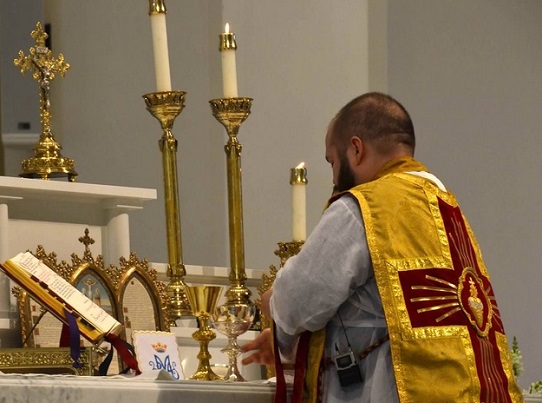
By Msgr. George W. Shea , S.T.D.
"The Mass has a fourfold purpose, and therefore a fourfold efficacy. It is offered, first and foremost, to adore God, whence it is called the "Sacrifice of Praise ". Secondly, it is offered to thank God for His great glory and for the benefits He has showered upon us, whence the Mass is called the "Eucharistic Sacrifice," that is the “Sacrifice of Thanksgiving ". Thirdly, it is offered to implore new benefits, notably grace, whence it is called an "lmpetratory Sacrifice ". Finally, it is a "Propitiatory Sacrifice", because it is offered to move the divine mercy to the pardon of sins.
Of these various effects of the Mass, the two which derive to men (the impetratory and the propitiatory) are usually termed the "fruits" of the Mass. Whereas the effects of the Mass insofar as it is a Sacrifice of Praise and of Thanksgiving are infinite, the “fruits" of the Mass are limited. The measure in which they are bestowed depends especially on the dispositions of those to whom they are given.
To whom are they given? To some degree or other the fruits of the Mass are bestowed upon the celebrant, upon those who serve or assist at the Holy Sacrifice, upon the person or persons for whom it is offered, upon all living, especially the members of the Church, and also upon the souls in Purgatory. The latter, however, are capable only of the propitiatory fruits of the Mass.
That the celebrant shares in the fruits of the Mass is readily understandable. No one more than he participates in the sacrifice. His active cooperation is necessary. He acts as the instrument of Christ, the High Priest, in virtue of the power received at Ordination. So he has a right to what is called the “most special fruit" of the Mass.
Sharing with him in this "most special fruit", but to a lesser degree, are the faithful who serve or assist at the Holy Sacrifice. The greater their devotion, the more plentiful are the graces God gives them through the Mass.
The person or persons for whom the priest celebrates the Mass in particular obtain what is termed the "special fruit" of the Mass. The priest may offer the Holy Sacrifice for any living person (although only privately for the excommunicated), and for the souls in Purgatory (although only privately for those to whom the Church has denied ecclesiastical burial). Since we have no way of knowing to what extent this special fruit is obtained by a soul in Purgatory for whom a particular Mass is offered, it is a pious practice to have the Holy Sacrifice celebrated repeatedly for the faithful departed.
Then, finally, there is the “general fruit" of the Mass. This comes to all the living, especially the members of the Church, and also to all the souls in Purgatory. At the Offertory of the Mass the celebrant prays that "the Sacrifice will be beneficial not only for himself and for all here present", but also for all faithful Christians, whether living or dead", not only for our own salvation," but also for that of the whole world ".
This is a most consoling thought because of our membership in the Church we share in a general way (but more intimately than those who are outside the Church) in the effects of every single Mass being offered up anywhere on earth Even when we are absorbed in our dally routine there accrue to us the beneficent effects of every Mass!
Source: The Catholic Advocate Vol 8 N17, 10 April 1959
Day 43. Lent with the Cure d'Ars: The Armed Crosses
by VP
Posted on Wednesday April 01, 2026 at 02:00AM in Lenten Sermons
"The sign of the cross is the most terrible weapon against the Devil. Thus the Church wishes not only that we should have it continually in front of our minds to recall to us just what our souls are worth and what they cost Jesus Christ, but also that we should make it at every juncture ourselves: when we go to bed, when we awaken during the night, when we get up, when we begin any action, and, above all, when we are tempted. We can say that a Christian who makes the Sign of the Cross with genuine religious sentiments, that is to say, when fully aware of the action which he is performing, makes all Hell tremble. But when we make the Sign of the Cross, we must make it not by habit but with respect, with attention and thinking of what we are doing. Ah, dear Lord, with what devout awe we should be filled when we make the Sign of the Cross upon ourselves and recall that we are pronouncing all that we hold holy and most sacred in our religion."
Source: The Sermons of the Cure d'Ars 1960 (Public Domain)
Prayer for Lent: O Lord who, for our sake, didst fast forty days and forty nights; give us grace to use such abstinence that, our flesh being subdued to the spirit, we may worthily lament and acknowledge our wretchedness, and may obtain perfect remission and forgiveness of Thee, the God of all mercy, who livest and reignest with the Father and Holy Ghost, one God, world without end. Amen
Source: Lent with the Cure d'Ars Compiled by the CAPGMonth of April: The Holy Spirit
by VP
Posted on Wednesday April 01, 2026 at 02:00AM in Monthly Devotion
April: Month of the Holy Spirit
Virtue: Patience
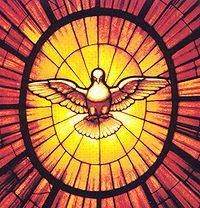
O Holy Spirit, Creator, be propitious to the Catholic Church; and by Thy heavenly power make it strong and secure against the attacks of its enemies; and renew in charity and grace the spirit of Thy servants, whom Thou has anointed, that they may glorify Thee and the Father and His Only-begotten Son, Jesus Christ, our Lord. amen.
Manual of prayers to the Holy Ghost by Very Rev. Fr. Felix of Jesus 1941
Prayer to the Holy Ghost for Priests
O Holy Ghost, Thou Friend of priests, send them daily Thy seven gifts, that they may live
worthy of their calling, and become all to all in order to win souls for heaven. Give them
patience with children, pity for the sick, humility toward the poor, and generosity toward
the enemies of Thy holy Church. Make them active in teaching, untiring in the tribunal of
penance, and zealous in distributing Holy Communion. Let them be terrible to the demons
of hell and messengers of peace to all who are of good will.
May Thy blessing accompany
them wherever they may go; may Thy peace enter with them in the dwellings they may
visit; mayest Thou bless all whom they may bless. Make them true apostles and saints. Amen.
Come Holy Ghost, a compilation of prayers in honor of the Divine Spirit.
1932 Fr. Lester Martin Dooley.
Prayer to the Holy Spirit by Cardinal Désiré-Joseph Mercier (1851-1926)
"I am going to reveal to you the secret of sanctity and happiness. Every day for five minutes control your imagination and close your eyes to the things of sense and your ears to all the noises of the world in order to enter into yourself Then, in the sanctity of your baptized soul (which is the Temple of the Holy Spirit), speak to that Divine Spirit, saying to Him:
Oh, Holy Spirit, beloved of my soul, I adore You.
Enlighten me, guide me, strengthen me, console me.
Tell me what I should do; give me your orders.
I promise to submit myself to all that You desire of me
and to accept all that You permit to happen to me.
Let me only know Your will. Amen.
If you do this, your life will flow along happily, serenely, and full of consolation, even in the midst of trials. Grace will be proportioned to the trial, giving you the strength to carry it, and you will arrive at the gate of Paradise, laden with merit. This submission to the Holy Spirit is the secret of sanctity."
Tenebrae
by VP
Posted on Wednesday April 01, 2026 at 12:00AM in Tradition

THE TRIANGULAR CANDLESTICK AT THE TENEBRAE.
Question: What is the meaning of the fifteen candles which are extinguished one by one during the chanting of the Psalms at the Matin Office (Tenebrae) during the last three days of Holy Week? The Office of Holy Week (Baltimore edition), which gives the liturgical text, with the rubrics in English, says: "When about to celebrate this part of the office, they place in front of the altar a large triangular candlestick containing several lighted candles, one of which is extinguished after each psalm." De Herdt, I am told, mentions the number of candles as fifteen, but gives no definite explanation of the mystic significance. Is the number essential, or is it merely optional, and expressive of the gradual darkness that came upon the world through sin from which Christ, symbolized by the light at the top which alone remains burning, has delivered us?
Resp. The most prevalent interpretation of the symbolic candlestick commonly called Herse (hersa, hearse, hercia)(1) during the Middle Ages, was that it signified the patriarchs and prophets, whose teaching served the world as a light leading up to Christ. who became the all-absorbing Light illuminating man to the end of time. There are seven lights on each side leading to the apex of the triangle. These fourteen candles were usually of unbleached wax, while the one on top was of white wax. They represent the patriarchal church from Adam to Joseph on one side, and the Mosaic church from Moses to the last of the prophets on the other, for the number seven, according to the Midrash, is the most perfect and representative number. They counted seven Fathers of tribes, the last of whom was to be Moses, their deliverer-Abraham, Isaac, Jacob, Levi, Kahath, Amram, Moses. Seven was the number of revelation (Ps. 96: 13).
Such was the fundamental idea. But since the Patriarchal and Mosaic revelations leading up to Christ might be variously represented by the principal agents of the divine purpose manifesting the coming of the Messiah, so the number of lights which were used to express the expectation of the nations for a Redeemer, and which were to disappear with His coming, varied. Adam, Noe, Abraham, and the succeeding leaders who inaugurated great revivals of the Messianic hope down to Esdras or Judas Maccabæus, might all be represented as lights. Hence there were sometimes as many as twenty-four candles. Feasey, in his Ancient Holy Week Ceremonial, writes: "This Tenebrae candlestick, called Herse or Hersa,' in English Cathedral statutes, is a large triangular candelabrum, or candlestick, or hearse of brass, latten or iron, upon which the tapers used in the Tenebrae office are set, and which is placed on the epistle or south side of the sanctuary and altar. . . . Calfhill says that in England it was called the Judas or Judas Cross.(2)" In some cases the lights were extinguished at once, or at two and three intervals. The six candles on the high altar which are extinguished during the signing of the Benedictus are usually taken to represent the light of Jewish righteousness passing between the birth of our Lord and His death and resurrection.
The upper light is not extinguished, but is hidden behind the altar, while the Miserere is recited in a low tone; after which it is restored to its place at the top of the candlestick, because God did not leave the soul of our Lord in darkness, but raised Him from the dead.
As stated above, the number of candles used in the Tenebrae office appears to have varied very much in the different churches: The Sarum Breviary says twenty-four; at Canterbury and York there were twenty-five; at Nevers there were nine; at Mans twelve; at Paris and Rheims thirteen; at Cambray and St. Quentin twenty-four; at Evreux twenty-five; at Amiens twenty-six; at Coutance forty-four. In some churches the candles corresponded to each psalm and lesson of the office.
--------------------------
1. The word "hearse" (Latin, hercia) is derived through the French herse, from hericius, ericius, ericeus or critius, a harrow, or hedgehog, from its appearance. It was ordinarily used at funerals over the coffin or catafalque.
2. Wordsworth in his Medieval Services in England, says: "One of the candles in the herce for Tenebrae in Holy Week represented the traitor, and is sometimes called the Judas Candle. The antiphon sung at Lauds on Maundy Thursday, when the last light was darkened, was 'He that betrayed Him had given them a token' (Brev. Sar. 783). But what appears a Judace or the Jewes light was the forerunner of these modern dummies and save-alls which are sometimes reprehensively painted to counterfeit the true natural wax." This is the wooden base of the paschal candle blessed on Holy Saturday.
American Ecclesiastical Review, Volume 26, erman Joseph Heuser Catholic University of America Press, 1902
St. Mary of Egypt, A.D. 421.
by VP
Posted on Wednesday April 01, 2026 at 12:00AM in Saints

St. Mary of Egypt by Jusepe de Ribera
"She was born in Egypt; and having left her father's house at the age of twelve years, she went to Alexandria, where she abandoned herself to all the liberties of a sinful life. But after some years, being touched by a wonderful grace of God, she resolved upon a new life, and doing penance for her sins. For this end, she retired into the desert beyond the river Jordan, with three loaves, and lived there in prayer and penance seven and forty years, without seeing any person in all that time. She was then discovered by a holy monk and priest, named Zosimus, to whom she gave an account of her life, and begged a share in his prayers. She desired him to return to the same place the following year on Maundy Thursday, and to bring with him the sacred Body and Blood of our Lord, and wait for her on the banks of the river. He did so; and at night she appeared on the other side, and making the sign of the cross over the river, she walked over as if it had been dry land. She received the Blessed Sacrament, and desired him to return the following Lent to the place where he first saw her. On his arrival at the appointed time, he found her dead; and being miraculously assisted by a lion, he dug a grave and buried her.
Pray for all those unhappy souls who live in sin, that they may hear the voice of God, who invites them to repentance. Let the mercy shewn to this sinner arm you against despair. But then let her penance instruct you what you are to do upon your change of life. For if ill habits are strong, they will scarcely yield to resolutions without some more penitential method. There will be a necessity of such a solitude at least as separates you from the occasions of sin, and gives you opportunity of recollection.
On this first day of the month make a sincere offering of yourself and all yours to God, and put all under his direction. Beg His blessing on all your undertakings, and offer yourself to all disappointments and troubles. Beseech God that you may make a right use both of His favors and scourges. Take a review of your past errors and evil habits which every month you resolve to amend. One month is to be your last; who knows but it may be this? Do now, at least, as if it were to be so." Source: The Catholic Year by Fr. John Gother
Prayer of St. Mary of Egypt: "O Holy Virgin, mother of the Word made flesh, so pure and humble and chaste, intercede for me. Procure for me, a vile creature, the grace to go in and venerate the Holy Cross on which thy Son shed His blood, and I promise no more to return to my bad life, but to do penance in any way that may be most pleasing to God"
Any girl who comes to confession with simplicity and earnestness as St. Mary did, no matter how much she may have sinned, will find it easy, as Mary did, and will receive from God graces similar to those that Mary received.
Let us thank God for this consoling Sacrament of Penance, and, when we return from it cleansed and strengthened, say, with the Blessed Virgin: "My soul doth magnify the Lord, and my spirit exult in God my Savior, who hath had regard to the humility of His handmaid. For He wo is powerful hath done great things for me: Blessed be His holy name." (St. Luke i.46)
Source: Guide for Catholic Young women, Especially for Those who Earn Their Own Living By Rev. Fr. George Deshon · 1893: Example of St. Mary of Egypt page 106
Spy Wednesday: the betrayal of Judas
by VP
Posted on Wednesday April 01, 2026 at 12:00AM in Tradition
The Wednesday of Holy Week is popularly known as Spy Wednesday. On this day Judas played the spy and signed the traitor's contract for thirty pieces of silver. The Maine Catholic Historical Magazine, Volume 2, 1914.

Judas Goes to Find the Jews (Judas va trouver les Juifs) - James Tissot
Sermons de Saint Jean Marie Vianney:
- On the Prayer of a Sinner Who Does Not Wish to Abandon Sin: If Judas—Judas the traitor—instead of giving way to despair, had earnestly prayed to God to forgive his sin, the Lord would have absolved him of his fault. From the French Sermons of the Venerable Jean Marie Vianney, 1883 Vol. 1, 3rd Sunday after the Epiphany, p. 194.
- On Hope: If Judas had thrown himself at the feet of Jesus Christ to beg Him for forgiveness, Jesus Christ would have remitted his sin just as He did for Saint Peter. From the French Sermons of the Venerable Jean Marie Vianney, 1883 Vol. 2, IV Sunday after Pentecost, p. 216 .
- On Absolution: Jesus Christ Himself - God though He was, and Master of Grace - granted forgiveness only to true penitents: He received the Good Thief, whose conversion was sincere, but He rejected the wicked one because of his impenitence. He forgave Saint Peter, whose repentance He knew to be genuine, but He abandoned Judas, whose penitence was false. From the French Sermons of the Venerable Servant of God, Jean-Baptiste-Marie Vianney, 1883 Volume 3, XIII Sunday after Pentecost, p. 90.

Tissot: Judas Leaves the Cenacle

Judas Returns the money, Jacques Tissot
Delay of conversion: "Ah,
my friend! I wish I could lead you to the very brink of despair, so
that—struck by the dreadful state in which you find yourself—you might
at least seize the means that the good Lord still offers you today to
escape it.
-But, you might say, surely there are those who have
converted at the hour of death—the Good Thief, after all, converted at
that very moment.
The Good Thief, my brethren—to begin with, he
had never known God. As soon as he came to know Him, he gave himself
over to Him; and indeed, he is the only example Holy Scripture offers
us, lest we fall utterly into despair in such a moment.
-"But surely there are many others who have converted, even though they lived for a long time in sin."
My
friend, take great care—I believe you are mistaken. You might tell me
that many have repented, but to be *converted*—that is quite another
matter. That is precisely what you will do, and indeed what you have
already done during your illnesses: for you summoned a priest simply
because you were vexed at suffering from your ailment. Well then! For
all your repentance, were you truly converted by it? In all likelihood,
you became only the more hardened.
Alas, my brethren! All this mere
repentance signifies but very little. Saul truly repented, for he
wept over his sins; yet he is damned. Cain truly repented, for he let
out dreadful cries of anguish for having slain his brother;
nevertheless, he is in hell. Judas truly repented, for he went to return
his money, and his sorrow was so great that he went and hanged
himself.
If you now ask where all this repentance led them, I
will tell you... to hell. I will always return to my conclusion: if you
live in sin, and die in it, you will be damned; but I hope that this
will not be the case—that you will not come to such an end."
Source: From the French Sermons du bienheureux Jean-Marie Vianney By Jean-Marie Vianney. IV Sunday of Lent, 1909, p389-390 published By Bishop Etienne Delaroche et Dom Marie Augustin Delaroche.

