#12 Acts of Adoration Jesus Christ in the Blessed Sacrament in reparation for all the offenses committed against Him by mankind
by VP
Posted on Thursday April 23, 2026 at 01:00AM in Thursday Reparation

12. We adore Thee, O amiable Jesus, and revere the sacred mystery of the Blessed Eucharist, revealed by Thy divine word, taught by the Church, and proved by miracles; And to repair the doubts which men have had of Thy real presence in the Holy Sacrament, we offer up to Thee the due submission shown by the Prophets to Thy divine oracles. Eternal praise and thanksgiving be to the Most Holy and Most Divine Sacrament.
O Queen of heaven and earth, hope of mankind, who adores thy Divine
Son incessantly! We entreat thee, that, since we have the honor to be of
the number of thy children, thou would interest thyself in our behalf
and make satisfaction for us, and in our name, to our Eternal Judge, by
rendering to Him the Duties which we ourselves are incapable of
performing. Amen.
St. George, Martyr, Patron of England, A.D. about 303.
by VP
Posted on Thursday April 23, 2026 at 12:00AM in Saints

St. George was a martyr. Pray for all those who suffer for their faith, that they may be strengthened from above. Pray for all others under whatever kind of trouble, that God would give them patience, and be their comfort.
Authentic history
furnishes us with very few particulars relating to this martyr, besides
his being a soldier in Cappadocia, and being put to death under
Dioclesian for the Christian faith. But the extraordinary devotion of all Christendom to this saint, is an authentic proof how glorious his triumph and name have always been in the Church. According to the best accounts, he was born in Cappadocia, of noble Christian parents. After the death of his father, he went with his mother into Palestine. Having embraced the profession of a soldier, he was made a tribune, or colonel in the army. For his courage and conduct, he was soon preferred to higher stations by the Emperor Dioclesian. When that Prince waged war against the Christian religion, St. George laid aside the marks of his dignity, threw up his commission and posts of honor, and complained to the emperor himself of his severe and cruel edicts. He was immediately cast into prison, and tried, first by promises, and afterwards by the rack, and tortured with great cruelty; but nothing could shake his constancy. The next day he was led through the city and beheaded. St. George is usually painted on horseback,
and tilting at a dragon under his feet; but this representation is no
more than an emblematical figure, purporting that by his faith and
Christian fortitude he conquered the Devil, who is called the dragon in the Apocalypse. The general opinion of his
courage in his military profession, and great constancy in his
suffering for justice and truth, has been a motive to our forefathers to
choose St. George for the patron of this nation. They hoped by his charity to obtain of God
a plentiful benediction in all public affairs, and success to their
arms. The same considerations may be motives to us this day to enquire into
ourselves, and see how much we want his charitable assistance, in order
to obtain those so necessary qualifications, which rendered him so
eminent to the Christian world, his courage
and constancy. Without these, we can neither do what we are commanded,
nor suffer what Providence has ordained for us. One that was a soldier
is a proper patron for Christians. For, whatever their sex or condition be, they are soldiers of Christ, their whole life is a warfare upon earth, they have many battles to fight, they are to meet very powerful enemies in the field; and without great courage and perseverance, they can never hope for victory.
Courage is necessary in the discharge of our common duties; because of the great opposition we meet with, from the general corruption of those with whom we live and converse. Custom and practice have given such authority to sinful liberty and neglect, that a compliance seems expected from all: and those who refuse to go along with the stream, must look to be charged with pride, singularity, and bigotry. Now while this seems to concern our reputation, those who have not courage to bear the stroke, surrender and yield; and by joining in what they disapprove, show that it is fear that carries them on; and that they would be virtuous, if they were but bold enough to be so. This fear puts numbers upon complying with all the extravagances of fashion and the age: and though sensible how disagreeable, and even opposite many of these are to the spirit of the gospel, yet awed by what the world will say, they choose to follow what they condemn, and become children of the world, because they dare not be the disciples of Christ.
The priest as one chosen from among men
by VP
Posted on Wednesday April 22, 2026 at 12:00AM in Tradition

Blessed Noël Pinot, Priest and martyr: (1747-1794)
"We recognize the priest as one chosen from among men to serve men in the affairs of God. He is the minister of reconciliation with God, the teacher of the truth, and one who offers the sacrifice, who administers the sacraments, who prays for the people. We distinguish in him that double character of man and priest; we recognize the divine character of the priesthood which forces us to bend the knee to him for the forgiveness of sins and to receive from his hands the holy sacrifice of the Eucharist. His ordination has conferred upon the man the character of the priesthood of Jesus Christ. In the parish he is the ambassador of God, the administrator of the sacraments, the guardian of the sacred deposit of faith, the defender of the people's rights, and the unselfish friend of everyone. From the cradle to the grave, he touches intimately the lives of his people and brings to them in all the circumstances of life the blessing of the Divine Savior of whom he is the commissioned minister. The people feel that in the true priest there is no taint of selfishness, and that he is willing to sacrifice his life in order that the spiritual interests of his people may not suffer " Source: Bishop James Conaty, Our Young People, 1912
Prayer to Blessed Noel Pinot for Priests under Persecution:
Blessed Noel Pinot, who shared in the Sacred Priesthood of Jesus, the Sovereign Priest, deign to show us, your servants, the power of your intercession. Enlighten and strengthen priests; render them, like you, invincible in their defense of the Faith. Foster priestly and religious vocations in our parishes; fill those aspiring to the priesthood and the religious life with an ardent zeal. Obtain for the faithful the grace to better know and practice their religion. Ensure that families are faithful in carrying out their duties and grant that they be humble and respectful towards their pastors.
Preserve children and the youth from the many perils which threaten their beliefs and virtues; undo the plots of those who wish to tear them away from the maternal bosom of the Church. As you did during your life, aid the sick and the infirm; strengthen those who suffer and struggle. Finally, bless and crown with success the apostolic labors of the ministers of Christ and of all the Church militant, with the aim of restoring to our dear France (country) the reign of the Sacred Heart of Jesus. Blessed Noel Pinot, pray for us.
General Vicar A. Oger, Angers, France (July 10th, 1944)
SS. Soter and Caius, Pope and Martyrs, A.D. 177 and 296
by VP
Posted on Wednesday April 22, 2026 at 12:00AM in Saints

" Saint Soter was raised to the papacy, upon the death of St. Anicetus in 173. By the sweetness of his discourses, he comforted all persons with the tenderness of a father, and assisted the indigent with liberal alms, especially those who suffered for the faith. He liberally extended his charities, according to the custom of his predecessors, to remote churches, particularly to that of Corinth, to which he addressed an excellent letter, which was read for edification on Sundays at their assemblies to celebrate the divine mysteries, together with the letter of St. Clement, pope. St. Soter vigorously opposed the heresy of Montanus, and governed the Church to the year 177, when he was put to death for the Christian faith, under Marcus Aurelius.
St. Caius succeeded St. Eutychian in the apostolic see, in the year 283. The Church then enjoyed a calm, but was soon after disturbed by a tumultuous persecution for two years, on the death of Carinus. St. Caius encouraged St. Sebastian and the other martyrs and confessors. However, to preserve himself for his flock, he withdrew for a time to avoid the fury of the storm. Having sat twelve years, he died on the 21st of April, 296; his great sufferings having obtained him the title of martyr.
Pray for the present bishop of the holy see of Rome, and for all bishops and pastors of Christ's Church; that whether in peace or persecution, they may ever bear testimony to the truth.
Their lives are powerful persuasives to virtue, if they live up to
their character: and to licentiousness, if they give countenance to it.
If they are unfaithful, let not this make you question the truth of what you profess. Your faith is built on the truth of God, and the promises of Christ: and however individuals may fail, these can never fail. Let the ill conduct therefore of others make you fear and tremble, and humbly distrust yourself, but not God's power, His goodness, or His truth. Learn the value of crosses and sufferings. Those Christian heroes, of whom the world was not worthy, all suffered, and were persecuted in many ways. These crosses ensured to them their greatest crowns" The Catholic Year by Fr. John Gother
St. Anselm, Arbishop of Canterbury, Confessor, A.D. 1109.
by VP
Posted on Tuesday April 21, 2026 at 12:00AM in Saints
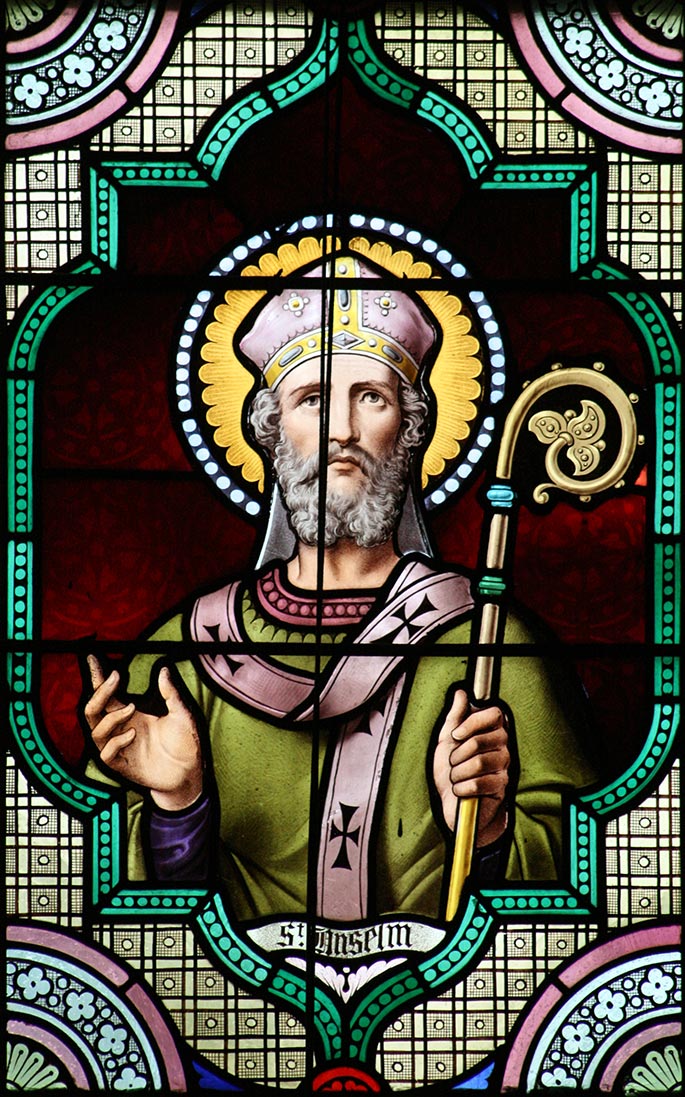
"Saint Anselm was born in Piedmont, and reclaimed from the disorders of his youth by the piety of the famous Lanfranc. By his advice, and that of the archbishop of Rouen, he became a religious, and made such advancement in all virtue, that he was soon chosen prior, and then abbot. He was all to all, by courtesy and charity, that he might find occasions of giving every one some suitable instructions to promote their salvation. Going afterwards to England to consult Lanfranc, then archbishop of Canterbury, his virtue so much recommended him to King William II., that after the death of Lanfranc, he obliged him to fill up that vacancy. His zeal however raised up so many enemies against him, and brought upon him so severe a persecution from the king, that he was forced to leave the kingdom. After three years, the king being dead, St. Anselm returned, but met with fresh opposition from the new king, Henry I. Amidst his troubles and public distractions, he often retired to his devotions, and watched long in them during the night. Leaving England to consult Pope Paschal II., he was forbidden by the king to return, unless he would comply with his unjust demands. Soon after, the king himself invited him to return; and he was received with great joy by the whole kingdom. But he survived only three years; and happily expired, laid on sackcloth and ashes, at Canterbury, in the year 1109, in the seventy-sixth of his age.
Let his eminent virtues arm you against despair in regard of those, whose disorderly youth gives you little hopes of good. God often shows his power in their conversion, and makes of them vessels of honour. Upon the same grounds despair not of yourself, whatever your present weakness be; but still continue on your endeavours for amendment, under the conduct of a director, whose prudence, piety, and patience may support you under the delays of your obstinate evil. Zeal is not only commendable, but necessary, amidst the general corruptions of the world; but if it gives up at the displeasure of men, it is not the zeal of the Gospel. He must have courage to suffer for justice and truth, who undertakes their cause." The Catholic Year by Fr. John Gother
Eighth Meditation: The Penitent's Address to God His Father. St. Anselm's book of meditations and prayers, tr. by M.R. By Saint Anselm (Archbishop of Canterbury)
(...) "Rescue me, O Lord my God, and snatch me out of the hands of my enemies; for they too are Thine, they are the subjects of Thy almighty power; and they hate nothing of good works in me except what Thou hast given me. There is nothing in me that they hate, but only that I love Thee. And they scheme with all their endeavours, with all their might, with all their craft, to prevent my loving Thee, glorifying Thee, and ever seeking Thee. Therefore let not the enemies of Thy glory be too strong for me; but let them be the more confounded as they see that I, bent on praising Thee and glorifying Thee, am seeking with all best endeavours that peace and glory of Thine, which they are intent upon diminishing."
A Prayer to Christ for my Enemies. By Saint Anselm
LORD Jesus Christ, Lord of all power and goodness, whom I pray to be gracious to my friends. Thou knowest what my heart desireth for mine enemies. For Thou, O God, who triest the very hearts and reins,Thou knowest the secrets of my heart within me. For it
is not hidden from Thee. If Thou hast sown in the soul of Thy servant
what he may offer to Thee, and if that enemy and I have sown there
likewise what is to be burned with fire, that also is before Thine eyes.
Despise
not, most gracious God, that which Thou hast sown, but cherish it and
give it increase and bring it to perfection and preserve it for ever. For as
I could begin no good thing without Thee, so can I neither finish it
nor keep it in safety except by Thy help. Judge me not, O merciful God,
according to that which displeaseth Thee in me, but take away what Thou
hast not planted, and save my soul which Thou hast created. For I cannot amend myself without Thee, because if we be good it is Thou that dost make us and not we ourselves. Neither can my soul endure Thy judgment, if Thou wilt judge her according to her wickedness. Thou therefore, O Lord, who alone art mighty, whatsoever Thou makest me to desire for mine enemies, be that Thy gift unto them, and Thine answer to my prayer. And if I at any time ask for them
anything which transgresseth the rule of love, whether through
ignorance or through infirmity or through wickedness, neither do that to
them, nor fulfil my petition therein.
Thou who art the true Light, enlighten their blindness. Thou who art supreme Truth, amend their error. Thou art the true Life, quicken their souls. For Thou hast said by Thy beloved Disciple, He that loveth not his brother, abideth in death.1 I pray therefore, O Lord, that Thou grant to them so much love of Thee and of their neighbour as Thou commandest us to have, lest they should have sin before Thee concerning their brother.
Forbid it, O good Lord, forbid it that I should be to my brethren an occasion of death, that I should be to them a stone of stumbling and rock of offence. For it is enough and more than enough that I should be an offence unto myself; mine own sin is sufficient for me. Thy servant entreateth Thee for his fellow-servants that they should not on my account offend so great and good a Master, but be reconciled to Thee, and agree with me according to Thy will for Thy sake. This is the vengeance which my inmost heart desireth to ask of Thee upon my fellow-servants, mine enemies and fellow-sinners. This is the punishment which my soul asketh upon my fellow-servants and enemies, that they should love Thee and one another, according to Thy will and as is expedient for us, so that we may satisfy our common Master both as concerning ourselves and as concerning one another and serve our common Lord in unity by the teaching of charity to the common good. This vengeance I, Thy sinful servant, pray may be prepared against all those that wish me evil and do me evil. Do Thou prepare this also, most merciful Lord, against Thy sinful servant likewise.
Come then, O my good Creator and merciful Judge, and by Thy mercy which passeth all reckoning, forgive me all my debts as I in Thy presence forgive all my debtors. And if not yet, because hitherto my spirit doth not so forgive perfectly according to Thy measure but willeth so to do and accomplisheth by Thy help what it can, doing violence to itself, this imperfect forgiveness I offer to Thee as it is, that Thou mayest be pleased perfectly to forgive me my sins and according to Thy power, be gracious unto my soul.
Hearken unto me, hearken unto me, O great and good Lord, with desire for the love of whom my soul is fain to feed herself, but cannot satisfy her hunger for Thee, to call upon whom my mouth findeth no name that sufficeth my heart. For there is no word that expresseth unto me that which by Thy grace my heart conceiveth concerning Thee. I have prayed, O Lord, as I could, but my will was greater than my power.
Hearken unto me, hearken unto me, according to Thy power, who canst do
whatsoever Thou dost will. I have prayed as one weak and sinful, hear
me, O hear me, as one mighty and merciful; and grant unto my friends and unto mine enemies not only what I have prayed, but what Thou knowest to be expedient for each
one, and agreeable to Thy will. Grant to all, both living and dead, the
help of Thy mercy; and ever hear me not according to the desires of my heart or the requests of my lips,
but as Thou knowest and willest that I ought to will and to ask, O
Saviour of the world, who with the Father and the Holy Ghost livest and
reignest God, world without end. Amen.
The Miracle of the Loaves and Fishes
by VP
Posted on Tuesday April 21, 2026 at 12:00AM in Tradition

The Miracle of the Loaves and Fishes (La multiplication des pains) by James Tissot
"Q. Did Christ make any particular promise, as regards the Eucharist, before he instituted it?
A. Yes, a very clear promise, in St. John's Gospel, Chapter 6.
Q. Does this chapter regard the Eucharist?
A. Yes; even the learned Mr. Johnston, a Protestant, in his "Unbloody
Sacrifice," shows, at large, that the primitive Fathers understood this
chapter as referring to the Eucharist.
Q. Is there any thing remarkable in the first part of this chapter?
A. Yes; the astonishing miracle which Christ performed in feeding five
thousand persons, with only five loaves and two fishes, is here related;
and such a miracle was truly a suitable prelude to the introduction of
that miracle of miracles: the Holy Eucharist, by which He was, with
heavenly bread - that is, with His own Body and Blood - to feed all His
faithful followers. The very fact, that He wrought this astonishing
miracle, before introducing the subject of the Eucharist, shows that He
was about to speak on a matter that required strong faith in His
followers and audience. If He had merely to announce to them, that He
was going to give them common bread and wine, is it likely He would have
introduced it by such a tremendous miracle?" Source: Controversial catechism; or, Protestantism refuted, and catholicism established by Rev. Stephen Keenan 1874
- Was Jesus’ feeding of the 5,000 really a miracle of sharing?
- The Heresy of Denying a Miracle (A non-miraculous explanation for Christ’s feeding the 5,000 ignores the plain text of Scripture and does away with a host of Catholic beliefs)
St. Theotimus, Bishop and Confessor, A.D. about 400.
by VP
Posted on Monday April 20, 2026 at 12:00AM in Saints
"He was bishop of Tomes in Scythia, in the fifth century. He had been brought up to a monastic life, and lived with great frugality, eating only when necessity required it. The Huns in the vicinity of the Danube so much admired his virtue, that they called him the God of the Romans. He was a man of so great sanctity and wonderful meekness, that he seemed fitted by heaven to deal with barbarous people, like the Huns, who often gave him disturbance, and with his own flock, whose natural roughness made his charge difficult enough. He was several times assaulted, and as often miraculously delivered; God manifested the sanctity of his servant by his particular protection of him. One day as he was walking in the territory of the Huns, he met some of them, who were going by the same road to Tomes, where he resided. His companions began to cry out, and give themselves up for lost: but he dismounted from his horse, and betook himself to prayer. The barbarians passed by without even seeing him, his attendants, or their horses. As they ill-treated the Scythian by their frequent incursions, he softened their barbarous nature by giving them food and making them presents. This made one of the barbarians imagine that he was rich. He sought to take him prisoner, and having prepared a rope with a slip-knot, he leaned upon his shield, and raising his arm to throw the noose over the saint, his hand remained stretched out in the air, nor could he move it till the holy man had prayed for him.
External Honors
by VP
Posted on Monday April 20, 2026 at 12:00AM in Articles

HNJ Cathedral, Raleigh NC. ©CAPG
"The external honors rendered by the Catholic Church to our Lord in the Holy Eucharist, have been the subject of constant attack from protestant writers, and their objections have been principally founded on these ceremonies and practices being unknown to the primitive Church; nor even introduced till at a comparatively recent period. But those who argue thus, lose sight of the great principle, that the Church is a body directed by the Spirit of God, constantly abiding with it, and acting according to circumstances; hence, whenever a particular heresy arises, some counteracting means is used to arrest its progress.
For this reason the Nicene Creed was framed and introduced in the service of the Church as a test of Arianism; and it is a well-known fact that it was not sung at Rome, during the celebration of Mass, for some centuries after it was used throughout the rest of Europe, on account of the orthodoxy of the people not requiring it. For the same reason the Elevation was introduced in the Mass as a test whereby the followers of Berengarius might be distinguished; and the solemn processions to honor the Holy Eucharist have been designed to compensate in some measure for the irreverence and sacrileges of the last few centuries.
Had the Christians retained their primitive fervor, daily Communion, and purity of heart and conduct, there would have been no occasion for the introduction of these rites; but under the state of things which have existed for the last few centuries, it ought to be a subject of infinite consolation to all sincere Christians that the scoffs and blasphemies of modern infidels may be in some measure atoned for, by the solemnities instituted in especial honor of this great Mystery of love. Had we no other rule but that of mere antiquity, the Catholic Ritual would be reduced to a level with the Mahometan Koran. A rite instituted by a Council of the sixteenth century, has not a less claim on the obedience and the reverence of the faithful that one of an older date." Source: Glossary of Ecclesiastical Ornament and Costume, by Augustus Welby Northmore Pugin 1868 page 164
Bearing Injustice
by VP
Posted on Sunday April 19, 2026 at 12:00AM in Sunday Sermons

Let Him Be Crucified (Qu'il soit crucifié) - James Tissot
'Who, when he was reviled, did not revile: when he suffered, he threatened not: but delivered himself to him that judged him unjustly."— Epistle I. St. Peter ii. 22.
" One of the hardest trials, my dear brethren, to which we can be exposed; indeed, perhaps the hardest one of all, is to be condemned unjustly. And the condemnation need not be pronounced in court, and published to the world. It need not even be given by public opinion; no, there may be only a few who share in it, perhaps only one, and that may be one whose judgment is not of much weight; still, to be falsely judged, to be accused of what we have not done, to have even our motives misinterpreted, is a pretty heavy cross to bear. How often will you hear people alleging as a reason for a permanent breach of friendship with someone, that one has belied them? It is of little use to point out that the person who is or seems to be a false accuser, may really not intend to be guilty of falsehood, nor be conscious of rash judgment, but may in his or her heart actually believe the charge, and feel not only justified, but even under an obligation of conscience in making it, and thus be guiltless before God. No, the sting is perhaps even greater, that he should believe a thing about us that we feel is not true, and could not be.
Nor is it enough to say that there are many things which we ought to be judged guilty of, but are not; and that so we can afford to take some punishment that we do not deserve, as we escape a good deal that we do. No, we say to ourselves: "I would not mind it so much if it were true; I would rather take the burden of all the many wrong things that I have done, than of one that I have not." Perhaps that would not really be the fact, but we feel as if it were.
I think, then, that to find a real cure for our heartache about matters of this kind, we must take the one which St. Peter gives us in this Epistle of today. We must take refuge under the shadow of the cross of Him who, as the Apostle says, suffered for us, leaving us an example, that you should follow His steps. The Cross of Christ is the only remedy in the last resort for all the pain and misery of the world, as well as for its sins; and we may as well come to it at once as wait till other consolations have failed.
Let us, then, lay to heart our Lord's example in this matter, as St. Peter tells us; let us keep it always by us, to be ready for use at the first moment. Let us consider how slight and insignificant are all the false judgments that can be made about us, miserable sinners that we are, compared with that which was passed on Him, the Saint of saints; on Him who was not merely holy, but holiness itself, the source of all sanctity, the Giver of every virtue that we can have. Let us consider how He was reckoned with the malefactors, how He was condemned not merely to death, but to the shameful death of a criminal; and how not merely one or two, but the crowds of His own people, whom He had come to save, turned against Him and believed all the false charges which His accusers made.
And let us not imagine that, being in truth God, His human nature was made insensible to all this outrageous injustice by its essential sanctity, or by the homage of the angels, or of those on earth who really knew and loved Him and remained faithful to Him. No; it was no more rendered in this way insensible to the pain of the false charges than it was to the sharp piercing of the nails driven through His hands and feet. Indeed, that He could much better have borne. His infinite purity and sensitiveness to sin only made these suspicions and accusations of it the more intolerable; physical suffering was little in comparison.
Yet, as the Apostle says, in this He did not defend Himself. He was willing to drink this bitter chalice to the dregs. When He was reviled, He reviled not again. He neither cleared Himself, which He could easily have done, nor took the poor remedy which we sinners are too apt to take, of accusing His accusers.
Let us then, when thus tried in our poor way, ask Him to give us the grace to do as He did, and even, if it be possible, to rest for a time at least under accusations which we might remove, when the honor of God is not concerned. And let us remember not to be guilty of rash judgment in our turn, but make, as He did, every possible excuse for those who belie us; let us believe that, so far as they are wrong, they know not what they do. And, lastly, let us take the greater pains to abstain from uncharitable thoughts or words about our neighbors, thus exposing them to a trial which we have found so hard to bear." 2nd Sunday after Easter - Five minute Sermons by the Paulist Fathers, 1893
Sunday for Priests
by VP
Posted on Sunday April 19, 2026 at 12:00AM in Tradition
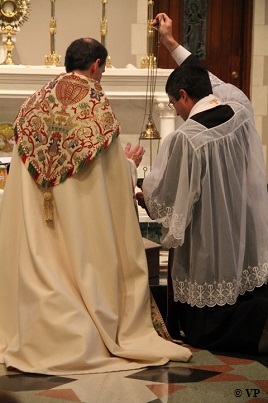
O Holy Spirit, Creator, be propitious to the Catholic Church; and by Thy heavenly power make it strong and secure against the attacks of its enemies; and renew in charity and grace the spirit of Thy servants, whom Thou has anointed, that they may glorify Thee and the Father and His Only-begotten Son, Jesus Christ, our Lord. amen.
Manual of prayers to the Holy Ghost by Very Rev. Fr. Felix of Jesus 1941
