St. John of Egypt, Hermit, A.D. 394.
by VP
Posted on Friday March 27, 2026 at 03:00AM in Saints
"At twenty-five years of age he forsook the world, and put himself under the direction of an ancient holy anchoret with such humility and simplicity as struck the venerable old man with admiration. By him he was inured to obedience and other virtues during about twelve years, when the venerable old man died. When St. John was about forty years of age, he retired to the top of a rock, where he walled up his cell, leaving only a little window, through which he received what was brought him for his support, and spoke to those who visited him for their spiritual comfort and edification. He was reverenced by all of his time, and particularly by the Emperor Theodosius the Great, to whom he foretold his victory over Eugenius. He never eat bread, or any thing prepared by fire. His only food was the fruits of the earth; he never eat till sunset, and then very sparingly. During five days in the week he conversed with God alone: but on Saturdays and Sundays all but women had free access to him for his instructions and spiritual advice. In this manner did he live from about the fortieth to the ninetieth year of his age. He was illustrious for miracles, and a wonderful spirit of prophecy, with the power of discovering to those that came to see him their most secret thoughts and hidden sins. And such was the fame of his predictions, and the lustre of his miracles, which he wrought on the sick, by sending them some oil which he had blessed, that they drew the admiration of the whole world upon him. Having been favoured with a foresight of his death, he would see nobody for the last three days. At the end of this term he sweetly expired, being on his knees at prayer, towards the close of the year 394, or the beginning of 395.
You can more easily admire the saints
than imitate them; but ought not this example to be some direction for
this time as to recollection and fasting? Can you cut off nothing of your usual dissipations, so to apply your mind to a serious examination of your state, and to the means necessary for your amendment? Can you practice nothing of his solitude and recollection? Solitude is the dwelling of a seraph upon earth, whose sole employment is to correct the disorders of his soul, to forget the world, and converse, as far as possible, with God alone." The Catholic Year by Rev. Fr. John Gother
Day 38. Lent with the Cure d'Ars: It is necessary to be converted
by VP
Posted on Friday March 27, 2026 at 02:00AM in Lenten Sermons
"No, my dear brethren, let us never forget that in order to receive Holy Communion, it is necessary to be converted and strong in a true resolution to persevere.
When Jesus Christ desired to give His Adorable Body and His Precious Blood to His Apostles, in order to teach them how pure one should be before receiving It, He even went so far as to wash their feet. By that He wishes to show us that we can never be purified enough of our sins, even our venial sins. It is true that the venial sin does not make our Communions unworthy, but it is a cause of our profiting hardly at all by such a great blessing and happiness. The proof of that is very clear when you consider how many times we have received Holy Communion during the course of our lives. And have we become any better? .... No, not at all, and the real cause of that is that practically all the time we are holding onto our bad habits; we do not break ourselves of any one of them more than another. We have a horror of the big sins which kill our souls, but all those little fits of impatience, those grumblings when some worries or troubles befall us, or some disappointments or setbacks -- these mean nothing to us.
You will admit that in spite of so many Confessions and Holy Communions, you are always the same, that your Confessions are nothing else, nor have they been for years, than a repetition of the same sins, which, although venial, are none the less damaging to the merit of your Holy Communions. You have been heard to say, with good reason, that you are no better one day than another, but who is stopping you from correcting your faults?
If you are always the same, it is simply because you do not want to make even small efforts to improve yourself. You do not want to endure anything or to be opposed in anything. You would like everyone to be fond of you and to have a good opinion of you, which is a difficult enough thing. Let us try hard, my dear brethren, to destroy all that could be in the smallest way displeasing to Jesus Christ, and we shall see how our Communions will help us to make great strides towards Heaven. And the more we do this, the more we shall feel ourselves becoming detached from sin and inclining towards God.... This is what I desire for you."
Source: The Sermons of the Cure d'Ars 1960 (Public Domain)
Prayer for Lent: O Lord who, for our sake, didst fast forty days and forty nights; give us grace to use such abstinence that, our flesh being subdued to the spirit, we may worthily lament and acknowledge our wretchedness, and may obtain perfect remission and forgiveness of Thee, the God of all mercy, who livest and reignest with the Father and Holy Ghost, one God, world without end. Amen
Source: Lent with the Cure d'Ars Compiled by the CAPGPassion Friday: Our Lady Mother of Sorrows
by VP
Posted on Friday March 27, 2026 at 12:00AM in Prayers
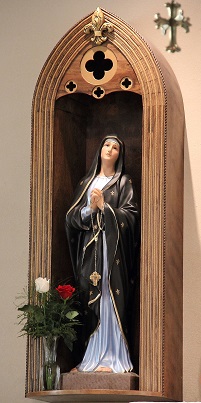
Our Lady of Sorrow, Sacred Heart Dunn, NC ©CAPG
Our Lady’s Compassion in Passiontide (National Catholic Register)
Prayer: Our Lady, Mother of Sorrows pray for Priests, your special sons. Strengthen their faith and love of Jesus in the Most Blessed Sacrament, so that they may turn to Him for the grace they need to live a life faithful to their calling. Bring comfort, consolation and courage to those who are suffering under the weight of the Cross. Give them the love of your Son and zeal for the honor and glory of God, and the salvation of souls. Amen
Friday in Passion Week: the Seven Dolours of the Blessed Virgin Mary
"The Easter Cycle tells us how the mother of the Savior co-operated in the Mystery of the Redemption.
It shows her in this season of the Passion at the foot of the Cross
where Christ is dying (Introit, Sequence, Gospel). "An ineffable union
is established between the oblation of the Incarnate Word and that of
Mary; the divine blood and the tears of the Mother flow together and are
mixed for the redemption of the human race." (The Liturgical Year by
Dom Gueranger: Friday in Passion Week).
"The prophecy of Simeon is realized: a sword of grief pierces the most gentle soul of the glorious Virgin Mary: (collect), who by her unequaled love becomes the Queen of Martyrs (Communion).
As Judith had delivered Israel by killing Holofernes (Epistle), the Virgin is our deliverer with Jesus. Wherefore the Gospel shows us, at the foot of the tree of Passion, in a scene which recalls the tree of prevarication, the maternity of Mary with regard to the Church personified by St. John.
"Let us venerate the Transfixion of the glorious Virgin Mary at the foot of the cross, in order to gather the happy fruit of the Passion of her son" (Collect.) Daily Missal with Vespers for Sundays & Feasts by Dom Gaspar Lefebvre, O.S.B. 1925
"Our Lady of the Seven Sorrows. Devotion to the sorrows of the Blessed Virgin Mother - the seven chief occasions of Mary's sorrow being the prophecy of Simeon - that a sword should pierce her heart; the flight into Egypt; the loss of the Child Jesus for three days; Mary's meeting with Our Lord when He bore the Cross; the Mother's presence at the Crucifixion and death of the Son; the time when Jesus' sacred body was placed in Mary's arms after His death, and the burial of Jesus-is undoubtedly of ancient standing, since the Order of the Servites of Mary, an order especially consecrated to Our Lady and to the honoring of her sorrows, was founded in Florence, Italy, as early as 1233." Our Faith and the Facts: Religion's Story, what Catholics Believe.1927
Chaplet of the Seven Sorrows:
Act of Contrition: O, most loving Redeemer, humbly prostrate at the foot of the Cross, I beg pardon from the bottom of my heart for all my sins which were the cause of Thy bitter Passion, and the overwhelming sorrow of Thy most afflicted Mother. O good Jesus, let not Thy Precious Blood be shed for me in vain. Let the sight of Thy Five Sacred Wounds plead ever to Thy Eternal Father, in behalf of my misery: and through the infinite merits of Thy sacred death and the bitter anguish of Thy holy Mother, grant me grace, dearest Lord, to atone for the past, and to persevere in Thy love and friendship for the future. Amen.
1. Let us meditate with profound humility on the first Sorrow of our Lady, when presenting her Son in the Temple, she heard the words of Holy Simeon, that this Child would be a sword to pierce her soul; a prophecy which clearly announced the Passion and Death of Christ our Redeemer.
one Our Father and seven Hail Marys.
2. Let us meditate with profound humility on the second Sorrow of our Lady, when in order to escape the murderous designs of cruel Herod, she was obliged to fly with her Divine Child into Egypt, and remain in exile there seven years.
one Our Father and seven Hail Marys.
3. Let us meditate with profound humility on the third Sorrow of our Lady, when returning from Jerusalem, with her spouse St. Joseph, to her poor dwelling, she lost her beloved Jesus, and wept His absence for three successive days.
one Our Father and seven Hail Marys.
4. Let us meditate with profound humility on the fourth Sorrow of our Lady, when she met her Divine Son crowned with thorns, and fainting under the load of the Cross.one Our Father and seven Hail Marys.
5. Let us meditate with profound humility on the fifth Sorrow of our Lady, when she beheld the Crucifixion of her Most Holy Son.one Our Father and seven Hail Marys.
6. Let us meditate with profound humility on the sixth Sorrow of our Lady, when the body of her Divine Son being taken down from the Cross, she received It into her arms.one Our Father and seven Hail Marys.
7. Let us meditate with profound humility on the seventh Sorrow of our Lady, when with deep grief she accompanied to the Sepulcher the body of her Son.one Our Father and seven Hail Marys.
Let us now say three Hail Marys in honor of the tears shed by our Blessed Lady, to beg she will obtain for us, from our Lord, the grace of a like grief for our sins and offenses.Let us pray:
Grant, we beseech Thee, O Lord Jesus Christ, that the most blessed Virgin Mary, Thy Mother, whose most holy soul was transfixed with the sword of sorrow in the hour of Thy Passion, may intercede for us before the throne of Thy mercy, now and at the hour of our death, through Thee Jesus Christ our Lord. Amen.
Source: Manual of Devotions of the Sorrows of our Blessed Lady, 1868
Compassion of Our Lady (The Month, 1915)
Water and blood-in clear and crimson tideDrawn by a soldier from His open side
When on the Calvary the Saviour died,
Upon the Rood:
Now in one Cup the water and the wine
Mingle together as a mystic sign,
Union of natures human and divine-
Water and Blood.
Water and Blood-the sorrows that transfix
Her heart with His, well from her soul's pure pyx
In anguish lachrymal and whitely mix
With that red flood:
Now wheresoe'er the Holy Mass is said,
Within one Chalice evermore is wed
Her passion white unto His Passion red-
Water and Blood.
M. S. J.
Saint Irenaeus, Bishop of Sirmich, (died 304 A.D.)
by VP
Posted on Thursday March 26, 2026 at 03:00AM in Saints
"The Obligation of Good Example: St. Irenaeus was bishop of Sirmich, in Pannonia, when the edict of Dioclesian's persecution overwhelmed the Church and spread terror abroad. The bishop having been conducted before Probus, governor of the province, gave proof of a courage unequaled, not only in resisting the threats launched against him, but still more in contemning the flattering promises made to him if he would consent to sacrifice to idols. He was beaten with rods, and afterwards sentenced to be thrown into the river after being beheaded. The holy martyr joyfully stripped off his clothing, and uttered this prayer: "I thank Thee, my God, for having deigned to let me suffer death for the glory of Thy name and for the safeguarding of the Christian people of Sirmich. Vouchsafe to receive me in Thy mercy, and by my example fortify The people in the faith."
Moral Reflection: Good example is one of the main duties of every one invested with a dignity, or exercising any spiritual authority whatever. Every one is responsible toward his inferiors for the bad example he gives, and the good example which he should have afforded: "For a most searching judgment shall be for them that bear rule." (Wisdom 6. 6.)" Source: Pictorial half hours with the saints by Rev. Fr. Auguste Lecanu
Prayer for Holy Bishops (Saint John Fisher)
Lord, according to Your promise that the
Gospel should be preached throughout the whole world, raise up men fit
for such work.
The Apostles were but soft and yielding clay till they were baked hard
by the fire of the Holy Ghost.
So, Good Lord, do now in like manner again with Thy Church Militant;
change and make the soft and slippery earth into hard stones;
set in Thy Church strong and mighty pillars, that may suffer and endure
great labors, watching, poverty, thirst, hunger, cold and heat;
which also shall not hear the threatenings of princes, persecution,
neither death but always persuade and think with themselves to
suffer with a good will, slanders, shame, and all kinds of torments,
for the glory and laud of Thy Holy Name. By this manner, good Lord,
the truth of Thy Gospel shall be preached throughout all the world.
Therefore, merciful Lord, exercise Thy mercy, show it indeed upon Thy
Church. Source
Saint John Fisher (Sermon in 1508) from Saint John Fisher Forum
Biography of St. Irenaeus by St. Alphonsus Liguori:
"It is believed that St. Irenaeus was born in the city of which he was afterwards bishop; and, although it is probable that his parents were pagans, he professed the faith of Jesus Christ from his childhood. He married at an early age, and had many children, whom he left young behind him at the time of his martyrdom. This saint gave such extraordinary examples of virtue, that he deserved to be made Bishop of Sirmium while yet a young man; and from the time he received that charge, he ceased not to combat the enemies of the faith, and to defend his flock from their artifices, until he terminated a brilliant career in the glory of martyrdom.
The edicts of the Emperor Diocletian against the Christians were published in Sirmium in the year 304, and Probus, the governor of Lower Pannonia, was most indefatigable in putting them into execution. The ecclesiastics, and particularly the bishops, were the first objects of his unholy zeal; for he thought that by striking the pastors he could the more easily disperse the flock of Jesus Christ.
Irenaeus was accordingly arrested, and brought before Probus, who said to him : "Obey the imperial edicts, and sacrifice to the gods." The saint replied: ''The Scripture saith that whosoever sacrifices to false gods shall be exterminated."
Probus: "The princes have commanded that all Christians shall sacrifice to the gods, or shall be tortured."
Irenaeus: " But I have been commanded to suffer all tortures rather than deny my God, and sacrifice to demons."
Probus: "Either sacrifice, or I will put thee to the torture."
Irenaeus: " In doing so, thou shalt please me; for thus shall I be made a participator of the Passion of my Savior."
Hereupon the governor commanded that he should be tortured; and, seeing that he suffered much, said: " What dost thou now say, Irenaeus ? Wilt thou now sacrifice?" The saint replied: "I sacrifice, by my confession, to my God, to whom I have always sacrificed." During the torments of St. Irenaeus, his father, his wife and children, his domestics and friends, came to implore of him to obey the emperors. His children embraced his feet, crying out: " Father, if thou hast no pity for thyself, have pity, at least, on us." The wife, with many tears, besought him not to leave her disconsolate; while his friends exhorted him not to throw away his life in his youth. But the saint, like an immovable rock upon which the waves lose their strength, armed himself against their assaults with the words of the Savior: But he that shall deny me before men, I will also deny him before my Father who is in heaven. To their importunities he returned not a single word of reply, but sighed only for the consummation of his martyrdom. Probus then said to him: "Irenaeus, abandon this thy folly; sacrifice to the gods, and destroy not thyself in the prime of life." The saint answered: " It is that I may not destroy myself for all eternity, that I refuse to sacrifice." He was then taken down and sent to prison, where he had to endure various tortures for several days. After some time, Probus, seated upon his tribunal, ordered that the holy bishop should be again brought before him, and, upon his appearance, said: "Irenaeus, now at length sacrifice, and free thyself from the torments which otherwise await thee." The saint replied: " Do that which thou art commanded to do, and do not at all imagine that I am likely to obey thee." Probus, enraged at this answer, caused him to be scourged in his presence, during which infliction the saint said: " From my childhood I have adored the one only God, who has always assisted and comforted me, and I can not adore gods made by the hands of men."
Probus: " Let the torments which thou hast already suffered suffice thee; free thyself from death."
Irenaeus: " I do free myself from death, when, by the pains which I suffer, I gain eternal life."
The governor then asked him, whether he had a wife, children, or parents alive; but Irenaeus answered that he had not, adding: "I say I have not, because Jesus Christ hath declared that whosoever loveth father or mother, wife or children, more than Him, is not worthy of Him."
Probus: "Sacrifice at least for thy children's sake."
Irenaeus: "My children have God to provide for them."
Probus: " Do not oblige me to put thee again to the torture."
Irenaeus: "Do thy pleasure; but thou shalt see what constancy my Lord Jesus Christ will give me to overcome all thy arts."
Probus then ordered Irenaeus to be cast into the river; but the saint, hearing the sentence, exclaimed: " I thought, that, after so many threats, thou wouldst have caused me to suffer many tortures, and to be cut to pieces; I beseech thee to do so, that thou mayest perceive how Christians, who have faith in God, despise death."
Probus, enraged at these words, ordered that the saint should be beheaded, and then cast into the river. The holy bishop, perceiving that his end was approaching, returned thanks to Jesus Christ for having given him the necessary fortitude, and for calling him, by such a death, to the participation of his glory. When he arrived at the bridge of Diana, which was the place selected for the execution, he threw off his garments, and prayed thus: "O Lord Jesus Christ! who didst vouchsafe to die for the salvation of the world, I beseech Thee that Thy angels may receive my soul; since I most willingly suffer death for the honor of Thy name, and the edification of Thy Church. Receive me into Thy glory for Thy mercy's sake, and strengthen my flock in Thy holy faith." His head was then struck off, and his body thrown into the river Save. "
Day 37. Lent with the Cure d'Ars: When you go back home
by VP
Posted on Thursday March 26, 2026 at 02:00AM in Lenten Sermons
"On her return to her kingdom, the queen of Sheba could never weary of relating all that she had seen in the temple of Solomon; she talked of it unceasingly, with fresh pleasure.
The same thing should happen to the Christian who has assisted properly at holy Mass. When he comes back to his house, he ought to have a talk with his children and his servants and ask them what they have retained of it and what touched them most.
Alas! Dear God, what am I going to say? .... How many fathers and mothers, masters and mistresses are there who, if someone wanted to talk to them about what they had heard at Mass, would laugh at all that and say that they were tired of it, that they knew enough about it....
Although generally speaking it seems that people still listen to the holy word of God, the moment they come out of church, they fall into all sorts of careless and frivolous ways. They get up with a sudden rush. They hurry. They jostle at the door. Often the priest has not even come down from the altar when they are already outside the door, and there they give themselves up to discussions upon all sorts of secular subjects.
Do you know what the result of this kind of thing is, my dear brethren? This is it. People derive no profit and gain no benefit from what they have heard and seen in the house of God. What graces have been lost! What means of salvation trodden underfoot! What a misfortune that is, to turn to our loss what should have helped so much to save us!
You can see for yourselves how many of these services are a burden to the majority of Christians! For those few moments, they stay in the church as if it were some kind of prison, and as soon as they are out, you will hear them shouting at the door, like prisoners who have been given liberty. Are we not quite frequently obliged to close the door of the church in order not to be deafened by their continual noise? Dear God, are these really Christians, who ought to leave Your holy temple with minds filled only with all kinds of good thoughts and desires? Should not they be seeking to engrave these in their memory, that they may never lose them and that they may put them into practice as soon as the opportunity presents itself?
Alas! The number of those who assist at the services with attention and who try to profit from them is a little like the number of the elect: ah, how small it is!"
Source: The Sermons of the Cure d'Ars 1960 (Public Domain)
Prayer for Lent: O Lord who, for our sake, didst fast forty days and forty nights; give us grace to use such abstinence that, our flesh being subdued to the spirit, we may worthily lament and acknowledge our wretchedness, and may obtain perfect remission and forgiveness of Thee, the God of all mercy, who livest and reignest with the Father and Holy Ghost, one God, world without end. Amen
Source: Lent with the Cure d'Ars Compiled by the CAPG#8 Acts of Adoration Jesus Christ in the Blessed Sacrament in reparation for all the offenses committed against Him by mankind
by VP
Posted on Thursday March 26, 2026 at 01:00AM in Thursday Reparation

8. We adore Thee, Sovereign Lord of the universe, to Whom all knees both in heaven and earth should bend, all reverence be paid! And in order to repair the many blasphemies against thy honor, we offer up to Thee the praises and homage of the Principalities. Eternal praise and thanksgiving be to the Most Holy and Most Divine Sacrament.
O Queen of heaven and earth, hope of mankind, who adores thy Divine Son incessantly! We entreat thee, that, since we have the honor to be of the number of thy children, thou would interest thyself in our behalf and make satisfaction for us, and in our name, to our Eternal Judge, by rendering to Him the duties which we ourselves are incapable of performing. Amen
Source: CAPG
Annunciation of the Blessed Virgin Mary
by VP
Posted on Wednesday March 25, 2026 at 03:00AM in Tradition

"THIS being the day on which the Son of God became incarnate, and took flesh of the Blessed Virgin Mary, give thanks to Almighty God for this his infinite mercy in sending his only Son for the redemption of man. Offer yourself for his servant for ever, who for your sake stoops below the degree of a servant. Admire and honour the humility of the Blessed Virgin; who being chosen Mother of Christ, styles herself only his handmaid: and let her humility be your pattern.
The mercy of this day, when God sent his only Son, to become man for our salvation, ought to imprint so lively an idea in the hearts of all Christians, as to lay a foundation of perpetual praise, adoration, and thanksgiving; and oblige them to be faithful in his service for ever. To be wanting in these duties, is a sufficient conviction that they either do not think, or do not believe. For what less can it be than insensibility, to behold this goodness, and not to adore it; to receive such mercies from the hand of God, and to remain cold and ungrateful under them? An eternal homage and fidelity are therefore the indispensable obligations of every Christian; and those who dispense with themselves, do in fact renounce this sacred character. Are we thus to live on, stupid and unthinking, and be sensible of no other effect of these mercies, but that of our greater condemnation, which we shall draw upon ourselves by our neglect, ingratitude, and contempt? While we see the Almighty do so much on his part, something certainly ought to be done on ours. And what can we do better, than follow the pattern before us?
The second Person of the Blessed Trinity this day assumes our human nature, and becomes man. By this ineffable union of God and man, he has taught us that man may be united to God. This then ought to be the concern of our whole lives, to extend in some manner the Incarnation of the Son of God: that as he is made man, so we by putting on Christ, may be so closely united to him, as to become divine. This union is consummated in heaven, where the blessed souls are wholly absorbed in God: but it is begun, and may be much advanced on earth, whilst Christians being made the adopted children of God, by a participation of the divine nature, may be able to say: We live, and not we, but Christ lives in us. Happy those Christians, who arrive at this point: and happy we, could we this day effectually embrace the method of coming to it.
This can be done only by our constant endeavours to crucify within us the old man, with all its corrupt inclinations and desires, which carry us with violence to sin, to the earth and creatures; and to follow those new impressions, which we receive from God, which separate us from all earthly affections, and raise us to the love of God, and seeking heavenly things. This is taking part with Christ, who, coming to remedy the dismal effects of Adam's fall, teaches his followers to renounce and make war against all that concupiscence, pride, and perverseness, which they inherit from the sin of Adam. For, since Christ and the life which he gives are contrary to Adam, and to the impressions received from him; Christians who put on the new man, and have the spirit of Christ abiding in them, must manifest this new life by stifling all sinful inclinations, and bringing forth the fruits of his Holy Spirit.
In this manner, Christ being the light, which directs their judgment and reason, he being the rule, by which they govern their will and affections; and the source of all that they undertake and do; Christ lives in them, and their life becomes the life of Christ. And though they are still sensible of many corrupt inclinations and natural suggestions in favour of flesh and the world; yet inasmuch as they carefully watch over these, and labour to suppress them, they serve only for their exercise, and daily afford them new matter of triumph. But it cannot be said that they live by them, but rather that they are dead to the world, and have crucified their flesh with its vices and concupiscences." The Catholic Year by Fr. John Gother
Prayer to Mary for the Holy Church
Queen of heaven, thy immense love for God maketh thee likewise love His Church. We pray thee, come to its help amidst the ills under which it is now suffering, rent asunder as she is by her own children. Thy prayer, being a mother's, can obtain all from that God Who loveth Thee so well. Pray then, pray for the Church; ask for enlightenment for so many unbelievers who are persecuting it, and obtain for faithful souls the necessary strength to resist being caught in the snares of the unbelievers who would drag them down into their own ruin.
Source: St. Alphonsus' prayer-book, 1888The Salvation of Souls is the Great Work of Priests
by VP
Posted on Wednesday March 25, 2026 at 02:00AM in Meditations
"To all foregoing considerations permit me to add that the salvation of souls is the great work of priests, whose holy office was founded simply for man's salvation. How weighty are the obligations of priests! What a burden is laid upon their shoulders! Listen to the words of the Prophet Ezechiel, " I will seek that which was lost; and that which was driven away, I will bring again. And I will bind up that which was broken and I will strengthen that which was weak, and that which was fat and strong I will preserve: and I will feed them in judgment." (Ezech. 34, 16). Five things must be observed to discharge these sacerdotal obligations.
The first is for the priest to conduct himself so that his life may be a model of priestly devotion. "Be Thou an example of the faithful in word, in conversation, in charity, in faith, in chastity." (1 Tim. 4, 12). "In all things shew thyself an example of good works, in doctrine, in integrity, in gravity." (Titus 2, 7). A priest should be such that he may say at all times, " For we are the good odour of Christ unto God" (2. Cor. 2, 15). Thus, he should be a living example of charity, purity, sobriety, humility and patience. He should be like John the Baptist, " A voice of one crying in the wilderness" (Luke 3, 4) that is, crying to sinners in the wilderness of the world: "Do penance".
Do you not know that the robe of the Great High Priest was adorned with little bells to show, as st. Jerome explains, that the priest should be totus vocalis, all voice, and that everything about him should be a tongue preaching and instructing those who come in contact with him.
Nothing is so potent as the example given by the priest be it good or bad. Thus, St. Gregory says that priests deserve eternal damnation as often as they give bad example to those confided to their care.
The priest should be "a burning and shining light". (St. John 5, 35), burning before God, shining before men; burning in prayer, shining in action; burning by example, shining by doctrine. "Let your light shine before men that they may see your good works, and glorify your Father who is in heaven," says St. Matthew (5, 16). And St. Bernard says that "the light shed by a priest must be so strong and so bright that the wind of vanity will not extinguish it."
The second thing that the priest must do is to instruct the faithful on their Christian obligations.. He must teach them to know and love God, to fear and serve Him through obedience to His Commandments. He must lead them to know their Savior, His principal mysteries, Jesus and Mary, the Church and the Sacraments. They must be made to pray in gratitude and petition for pardon and help. They should learn to recite their daily prayers with utmost care, the Lord's Prayer, the Hail Mary, the Creed and the Confiteor. Through exhortations from the pulpit and in catechism classes, the priest should encourage the faithful to cooperate to the fullest extent in their own salvation.
Thirdly, he should eradicate spiritual disorders from the lives of the flock. To do this he must know this people and their conduct. He should be unsparing in his pains to track down and root out evils which may exist; he should frequently visit the schools to instruct and guide the young in the way of salvation. He should enjoin great respect for the church and all holy places, insisting on proper deportment there at all times. He should keep everything pertaining to the altar in good order and see that the liturgical functions are carried our with the dignity becoming the King of heaven and earth.
Fourthly, the priest should practice charity. He should be affable and kind to all without distinction. He should be assiduous in visiting the sick, especially those in danger of death. He should console the afflicted and the needy, and be ever kind to the poor. He should advise those who seek his fatherly counsel, correct those who are wayward and seek to put an end to any quarreling among his parishioners.
Fifthly, he must administer the Sacraments with holiness, for the glory of God and becomingly lest though carelessness he neglect any requisite. Above all else, he should apply himself heartily to the administration of the Sacrament of Penance, for though it he will know the state of his people, their spiritual needs and weaknesses. Through it he will find the means of curing the ailments of their souls. He will open to them unexplored avenues of grace, will spread before them in his instructions and encouragements a banquet of heavenly delicacies.
These are the chief obligations of the priest and he must be ever vigilant lest even one souls be neglected or lost for the Sovereign Pastor will hold him responsible, and the price of Christ's Blood will be visited upon him: "I will require his blood at thy hand." ( Exech. 3, 20). I mention neglect for this makes him a murdered in God's eyes, a murdered of souls committed to his charge.
St. John Chrysostom observes that when priest allow themselves to fall into sin, the people quickly follow. Every soul will be held to a strict accounting of his misdeeds, but the priest will also be held responsible for those of his flock who fall because of his example.
"If each individual soul will find it difficult to render an account of his works on judgment Day, " says St. Augustine, "What must be said of priests, who must give an accounting of the souls committed to their care?"
Source: The Priest His Dignity And Obligations St John Eudes
Day 36. Lent with the Cure d'Ars: Clear your minds
by VP
Posted on Wednesday March 25, 2026 at 02:00AM in Lenten Sermons
"If you desire the worship that you give to God to be pleasing to Him and valuable for the salvation of your soul, put it properly into practice.
Begin by preparing for holy Mass as soon as you are awake, uniting yourself to all the Masses which are being said at that moment. When the bell rings to call you to the house of God, consider the fact that it is Jesus Christ Himself calling you. Start out immediately, so that you will have a moment to meditate upon the tremendous act at which you are about to assist.
Do not say, like those people who have no religion, that you have plenty of time, that you will be there soon enough. But say, rather, with the Holy Prophet: "I rejoice when I am told that we are going into the house of the Lord." When you come out from your home, think about what you are going to do and what you are going to ask of God.
Begin by clearing your mind of earthly matters so that you will be thinking of God only. Avoid all sorts of unnecessary conversations which serve no other purpose than to make you hear Mass badly. When you enter the church, recall to yourself what the holy patriarch Jacob said: "How awesome is this place! How holy it is! It is truly the house of God and the gateway to heaven!" When you get to your place, humble yourself profoundly as you think of your own unworthiness and the greatness of your God, Who, nevertheless, in spite of your sins, wishes to suffer you in His holy presence.
Make an act of faith with all your heart. Ask God to give you the grace to lose none of the many favors which He grants to those who come here with good dispositions. Open your heart so that the word of God may enter it, take root in it, and bear fruit there for eternal life.
Before leaving the church, do not fail to thank God for the graces He has just given you and go straight home, fully occupied with the thoughts of what you have seen and heard.
Yes, my dear children, if we conducted ourselves in this manner, we should never come away from the services of the Church without being filled with a fresh desire for heaven and a new disgust for ourselves and the things of this earth. Our hearts and our minds would be given over altogether to God and not at all to the world. Then the house of God would truly be for us the gateway to Heaven. That is what I desire for you"
Source: The Sermons of the Cure d'Ars 1960 (Public Domain)
Prayer for Lent: O Lord who, for our sake, didst fast forty days and forty nights; give us grace to use such abstinence that, our flesh being subdued to the spirit, we may worthily lament and acknowledge our wretchedness, and may obtain perfect remission and forgiveness of Thee, the God of all mercy, who livest and reignest with the Father and Holy Ghost, one God, world without end. Amen
Source: Lent with the Cure d'Ars Compiled by the CAPGSaint Gabriel the Archangel
by VP
Posted on Tuesday March 24, 2026 at 03:00AM in Saints
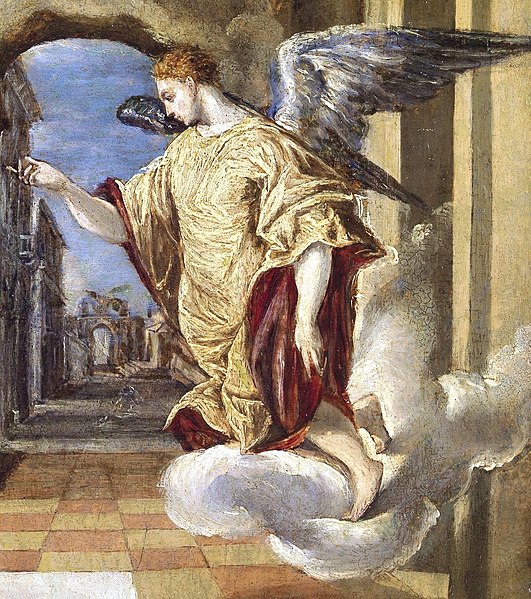
Saint Gabriel, the Archangel, El Greco
"The name Gabriel signifies the strength of God, and well becomes the holy archangel, whose feast we celebrate this day; inasmuch as he was the chosen ambassador of God, in the greatest of mysteries, the Incarnation of His divine Son. He had been sent long before to the prophet Daniel, to announce to him the mysterious period of seventy weeks, which were to elapse from the going forth of the decree for rebuilding Jerusalem, to the coming of the world's Redeemer. Thus this holy archangel was sent early to announce the great mystery of the Incarnation.
Again we find St. Gabriel appearing to Zachary in the temple, to bring him the good tidings of the approaching birth of St. John the Baptist. He was the great precursor of the Messias; and St. Gabriel was sent to announce his nativity, on account of the intimate connexion between that event and the Incarnation of the Son of God.
But the greatest and most solemn embassy of the archangel Gabriel, was at the Annunciation of the Blessed Virgin Mary; when he was sent to declare the adorable counsels of God to her, and solicit her consent to become the mother of the incarnate Son of God. He was sent to the city of Nazareth, to the Blessed Virgin, to declare to her the joyful tidings that she was chosen to be the Mother of the Son of God, and to bring forth the long-expected and promised Messias. The heavenly messenger, entering her house, saluted her with great reverence, and said to her: "Hail full of grace, the Lord is with thee." Having removed her trouble and surprise at this salutation, he told her of the great mystery to be performed in her, and that she should conceive, and bring forth the Son of God. Having delivered this message, and received her consent, he departed: and by the ineffable operation of the Holy Ghost, she conceived the Saviour of the world. The most exalted commission was here given to St. Gabriel; and he was sent to treat of the most important affair which the world had ever witnessed.
Beseech this holy archangel to obtain for you to be duly penetrated with these sacred mysteries, of which he was the august messenger from God to man. Pray that you may faithfully accomplish the will of God, and be at all times sweetly united to Him. Pray that you may ever walk in His holy presence, and lead the lives of angels on earth, that so you may be associated with those pure spirits hereafter." The Catholic Year by Rev. Fr. John Gother
"’Twas you, Gabriel, that taught us the salutation with which we should greet Mary full of grace. You were the first to pronounce these sublime words, which you brought from Heaven. The children of the Church are now, day and night, repeating these words of yours. Pray for us that we may say them in such a manner as that our Blessed Mother may find them worthy of her acceptance.
Angel of Strength, Friend of Mankind, relent not in your ministry of aiding us. We are surrounded by terrible enemies. Our weakness makes them bold. Come to our assistance, get us courage. Pray for us during these days of conversion and penance. Obtain for us the knowledge of all we owe to God in consequence of that ineffable mystery of the Incarnation of which you were the first witness. We have forgotten our duties to the Man-God, and we have offended Him: enlighten us, that so, henceforth, we may be faithful to His teachings and examples. Raise up our thoughts to the happy abode where you dwell. Assist us to merit the places left vacant by the fallen Angels, for God has reserved them for His elect among men.
Pray, Gabriel, for the Church Militant, and defend her against the attacks of Hell. The times are evil. The spirits of malice are let loose, nor can we make stand against them unless with God’s help. It is by His holy Angels that He gives victory to His Spouse. Be thou, Strength of God, foremost in the ranks. Drive heresy back, keep schism down, foil the false wisdom of men, frustrate the policy of the world, arouse the well-minded from apathy that thus, the Christ whom you announced may reign over the Earth He has redeemed, and that we may sing together with you and the whole angelic choir: Glory be to God! Peace to men!" Dom Gueranger
Prayer to the Holy Angels for Parishes
All you legions and choirs of Angels,
please make haste to come to the aid and defense of our One Holy Roman
Catholic Church. Led by St. Michael, may She be protected from
destruction within by all modernistic attempts that try to diminish the
true presence of God and take away His proper and due respect! In
particular, come to the aid of my parish (name your parish) that it may
remain or be remade to be a place of reverence and a stronghold from
which the One True Triune God may continue to lead and strengthen us.
Amen.
