Saint Paul
by VP
Posted on Saturday January 24, 2026 at 11:00PM in Saints
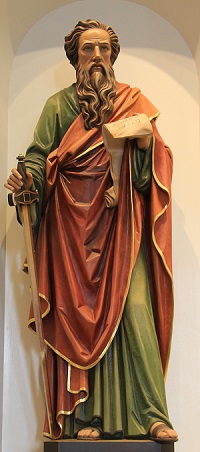
Saint Paul, Holy Name of Jesus Cathedral, Raleigh NC.
Prayer to Saint Paul: O Glorious Saint Paul, after persecuting
the Church you became by God's grace its most zealous Apostle. To carry
the knowledge of Jesus, our divine Savior, to the uttermost parts of
the earth you joyfully endured prison, scourgings, stonings, and
shipwreck, as well as all manner of persecutions culminating in the
shedding of the last drop of your blood for our Lord Jesus Christ.
May your example inspire our parish priests today to be zealous in
their service to God's people. Obtain for our priests the grace to labor
strenuously to bring the faith to others and to accept any trials and
tribulations that may come their way. Help them to be inspired by your
Epistles and to partake of your indomitable love for Jesus, so that
after they have finished their course they may join you in praising him
in heaven for all eternity. Amen.
Saint Francis de Sales: How the ministers have violated this authority
by VP
Posted on Friday January 23, 2026 at 11:49PM in Books

Saint Francois de Sales, by Giovan Battista Lucini (Wikipedia)
"Under the ancient law the High Priest did not wear the Rational except when he was vested in the pontifical robes and was entering before the Lord. Thus we do not say that the Pope cannot err in his private opinions, as did John XXII.; or be altogether a heretic, as perhaps Honorius was. Now when he is explicitly a heretic, he falls ipso facto from his dignity and out of the Church, and the Church must either deprive him, or, as some say, declare him deprived, of his Apostolic See, and must say as St. Peter did: Let another take his bishopric.
When he errs in his private opinion he must be instructed, advised, convinced; as happened with John XXII., who was so far from dying obstinate or from determining anything during his life concerning his opinion, that he died whilst he was making the examination which is necessary for determining in a matter of faith, as his successor declared in the Extravagantes which begins Benedictus Deus. But when he is clothed with the pontifical garments, I mean when he teaches the whole Church as shepherd, in general matters of faith and morals, then there is nothing but doctrine and truth.
And in fact everything a king says is not a law or an edict, but that only which a king says as king and as a legislator. So everything the Pope says is not canon law or of legal obligation; he must mean to define and to lay down the law for the sheep, and he must keep the due order and form. Thus we say that we must appeal to him not as to a learned man, for in this he is ordinarily surpassed by some others, but as to the general head and pastor of the Church: and as such we must honor, follow, and firmly embrace his doctrine, for then he carries on his breast the Urim and Thummim, doctrine and truth. And again we must not think that in everything and everywhere his judgment is infallible, but then only when he gives judgment on a matter of faith in questions necessary to the whole Church; for in particular cases which depend on human fact he can err, there is no doubt, though it is not for us to control him in these cases save with all reverence, submission, and discretion. Theologians have said, in a word, that he can err in questions of fact, not in questions of right; that he can err extra cathedram, outside the chair of Peter, that is, as a private individual, by writings and bad example.
But he cannot err when he is in cathedra, that is, when he intends to make an instruction and decree for the guidance of the whole Church, when he means to confirm his brethren as supreme pastor, and to conduct them into the pastures of the faith, then it is not so much man who determines, resolves, and defines as it is the Blessed Holy Spirit by man, which Spirit, according to the promise made by Our Lord to the Apostles, teaches all truth to the Church, and, as the Greek says and the Church seems to understand in a collect of Pentecost, conducts and directs his Church into all truth: "But when that Spirit of truth shall come, he will teach you all truth, or, will lead you into all truth." And how does the Holy Spirit lead the Church except by the ministry and office of preachers and pastors? But if the pastors have pastors they must also follow them, as all must follow him who is the supreme pastor, by whose ministry Our God wills to lead not only the lambs and little sheep, but the sheep and mothers of lambs; that is, not the people only but also the other pastors: he succeeds St. Peter, who received this charge: "Feed my sheep". Thus it is that God leads his Church into the pastures of his Holy Word, and in the exposition of this he who seeks the truth under other leading loses it. The Holy Spirit is the leader of the Church, he leads it by its pastor; he therefore who follows not the pastor follows not the Holy Spirit.
But the great Cardinal of Toledo remarks most appositely on this place that it is not said he shall carry the Church into all truth, but he shall lead; to show that though the Holy Spirit enlightens the Church, he wills at the same time that she should use the diligence which is required for keeping the true way, as the Apostles did, who, having to give an answer to an important question, debated, comparing the Holy Scriptures together; and when they had diligently done this they concluded by the - It hath seemed good to the Holy Spirit and to us; that is, the Holy Spirit has enlightened us and we have walked, he has guided us and we have followed him, up to this truth. The ordinary means must be employed to discover the truth, and yet in this must be acknowledged the drawing and presence of the Holy Spirit. Thus is the Christian flock led, - by the Holy Spirit but under the charge and guidance of its Pastor, who however does not walk at hazard, but according to necessity convokes the other pastors, either partially or universally, carefully regards the track of his predecessors, considers the Urim and Thummim of the Word of God, enters before his God by his prayers and invocations, and, having thus diligently sought out the true way, boldly puts himself on his voyage and courageously sets sail. Happy the man who follows him and puts himself under the discipline of his crook! Happy the man who embarks in his boat, for he shall feed on truth, and shall arrive at the port of holy doctrine!
Thus he never gives a general command to the whole Church in necessary things except with the assistance of the Holy Spirit, who, as he is not wanting in necessary things even to second causes, because he has established them, will not be more wanting to Christianity in what is necessary for its life and perfection. And how would the Church be one and holy, as the Scriptures and Creeds describe her? for if she followed a pastor, and the pastor erred, how would she be holy; if she followed him not, how would she be one? And what confusion would be seen in Christendom, while the one party should consider a law good the others bad, and while the sheep, instead of feeding and fattening in the pasture of Scripture and the Holy Word, should occupy themselves in controlling the decision of their superior ?
It remains therefore that according to Divine Providence we consider as closed that which St. Peter shall close with his keys, and as open that which he shall open, when seated in his chair of doctrine teaching the whole Church.
If indeed the ministers had censured vices, proved the inutility of certain decrees and censures, borrowed some holy counsels from the ethical books of St. Gregory, and from St. Bernard's De Consideratione, brought forward some good plan for removing the abuses which have crept into the administration of benefices through the malice of the age and of men, and had addressed themselves to His Holiness with humility and gratitude, all good men would have honored them and favored their designs.
The good Cardinals Contarini the Theatine, Sadolet, and Pole, with those other great men who counseled the reformation of abuses in this way, have thereby deserved immortal commendation from posterity. But to fill heaven and earth with invectives, railings, outrages, - to calumniate the Pope, and not only in his person, which is bad enough, but in his office, to attack the See which all antiquity has honored, to wish to go so far as to sit in judgment upon him, contrary to the sense of the whole Church, to style his position itself anti-Christianism -who shall call this right? If the great Council of Chalcedon was so indignant when the Patriarch Dioscorus excommunicated Pope Leo, who can endure the insolence of Luther, who issued a Bull in which he excommunicates the Pope and the bishops and the whole Church? All the Church gives him (the Pope) patents of honor, speaks to him with reverence. What shall we say of that fine preface in which Luther addressed the Holy See: "Martin Luther to the most Holy Apostolic See and its whole Parliament, grace and health. In the first place, most holy see, crack but burst not on account of this new salutation in which I place my name first and in the principal place." And after having quoted the Bull against which he was writing, he begins with these wicked and vile words: "Ego autem dico ad papam et bullæ hujus minas, istud: qui præ minis moritur ad ejus sepulturam compulsari debet crepitibus ventris.” And when writing against the King of England, "Living," said he, "I will be the enemy of the papacy, burnt I will be thy enemy." What say you of this great Father of the Church? Are not these words worthy of such a reformer? I am ashamed to read them, and my hand is vexed when it lays out such shameful things, but if they are hidden from you, you will never believe that he is such as he is,—and when he says: "It is ours not to be judged by him but to judge him."
But I detain you too long on a subject which does not require great examination. You read the writings of Calvin, of Zwingle, of Luther: take out of these, I beg you, the railings, calumnies, insults, detraction, ridicule, and buffoonery which they contain against the Pope and the Holy See of Rome, and you will find that nothing will remain. You listen to your ministers; impose silence upon them as regards railings, detraction, calumnies against the Holy See, and you will have your sermons half their length. They utter a thousand calumnies on this point: this is the general rendez-vous of all your ministers. On whatever subjects they may be composing their books, as if they were tired and spent with their labor they stay to dwell on the vices of the Popes, very often saying what they know well not to be the fact. Beza says that for a long time there has been no Pope who has cared about religion or who has been a theologian. Is he not seeking to deceive somebody? for he knows well that Adrian, Marcellus, and these five last have been very great theologians. What does he mean by these lies? But let us say that there may be vice and ignorance: "What has the Roman Chair done to thee," says St. Augustine, " in which Peter sat and in which now Anastasius sits?
Why do you call the Apostolic Chair the chair of pestilence? If it is on account of men whom you consider to be declaring and not keeping the law - Did Our Lord, on account of the Pharisees, of whom He said: they say and do not do any injury to the chair in which they sat? Did he not commend that chair of Moses, and reprove them, saving the honor of their chair? For He says: Super cathedram, &c. (Matt. xxiii. 2). If you considered these things you would not, on account of the men you speak against, blaspheme the Apostolic Chair, with which you do not communicate. But what does it all mean save that they have nothing to say, and yet are unable to keep from ill-saying."
Saint Timothy, Bishop and Martyr 97 AD.
by VP
Posted on Friday January 23, 2026 at 11:00PM in Saints

Martyrdom of Saint Timothy. Pictorial Lives of the Saints: With Reflections for Every Day of the Year edited by John Dawson Gilmary Shea
"He was the beloved disciple and companion of St. Paul. His father was a Gentile, but his mother a Jewess. St. Augustine extols his zeal and disinterestedness in immediately forsaking his country, his house, and parents, to follow this apostle, and share in his poverty and sufferings. St. Paul regarded him not only as his disciple and most dear son, but as his brother and the companion of his labours. He calls him a man of God; and tells the Philippians that he found no one so truly united to him in heart and sentiments.
St. Timothy was ordained bishop by a prophecy, and a particular order of the Holy Ghost; and is always named the first bishop of Ephesus. Pray for all the bishops of Christ's Church; that as they receive their charge by succession from the apostles, they may faithfully acquit themselves in every part with the spirit of the apostles.
St. Timothy endeavoured with great zeal to withdraw the people from their abominable idolatry in offering sacrifices to Diana. But their obstinate blindness rendered his endeavours fruitless; and they rewarded his charity by stoning him to death. Pray to be delivered from all obstinacy and blindness: for these make the grossest errors appear as reasonable as truth; and nothing but the light of heaven, joined with an humble spirit, can prevent or remedy this evil. Pray therefore for both; that you may never unhappily mistake the charity of those who would be your best friends. If you cannot bear those who put you in mind of your faults, remember that these evils are at the root. It is something of the spirit of the Ephesians, and not a Christian spirit. Pray for a better. And if you feel resentment at such charity, consider it well, and you will see it to be akin to those stones which were thrown at St. Timothy. It is for fear of these that few have courage enough to run the hazard of them." The Catholic Year by Rev. Fr. John Gother
"REFLECTION.-St. Paul, in writing to Timothy, a faithful and well-tried servant of God, and a bishop now getting on in years, addresses him as a child, and seems most anxious about his perseverance in faith and piety. The letters abound in minute personal instructions for this end. It is therefore remarkable what great stress the apostle lays on the avoiding of idle talk, and on the application to holy reading. These are his chief topics. Over and over again he exhorts his son Timothy to "avoid tattlers and busy bodies; to give no heed to novelties; to shun profane and vain babblings; but to hold the form of sound words; to be an example in word and conversation; to attend to reading, to exhortation, and to doctrine." Pictorial Lives of the Saints: With Reflections for Every Day of the Year edited by John Dawson Gilmary Shea"The Church reads without ceasing the counsels which the Apostle gave to you and to all pastors through you for the election and the conduct of the clergy: pray that the Church may be blessed with Bishops, Priests and Deacons endowed with all those qualifications which he requires from the dispensers of the mysteries of God. Lastly, we beseech you, who ascended to Heaven decked with the aureola of martyrdom, encourage us who are also soldiers of Christ that we may throw aside our cowardice and win that kingdom, where our Emmanuel welcomes and crowns His elect for all eternity." Dom Gueranger, The liturgical Year
Jan 24. Conversion of the Jews (Day 7 of Church Unity Octave Prayer)
by VP
Posted on Friday January 23, 2026 at 11:00PM in Church Unity

"Those Sinai's thunders startled - thine Own race-
Who heard thy Prophets -saw thy miracles,
Who nailed thee to the Cross - despised thy grace:
From their veiled eyes, O Lord, remove the scales;
The Wandering Jew who owned thee not - now claim!
And Israel bend the knee to Jesus' Name.
"Ut omnes unum sint," O lord, we pray
That all be drawn within thy one, true fold,
Back to thy Church - from which the wand'rers stray
And the true Faith she keeps like saints of Old.
O bring them back, Good Shepherd of the sheep;
And rouse the heathen nations from their sleep. Amen"
Source: Catholic Hymns for the People, James Martin Raker 1919 -
Prayer intention: The Conversion of the Jews
(Form of prayer decreed by Pope Benedict XV: to be recited Daily during the Octave. + One decade (at least) of the Rosary for this particular intention, Holy Communion if possible.)
Ant. That they all may be one, as Thou, Father, in me and I in Thee, that they also may be one in us; that the world may believe that Thou has sent me.
℣. I say to thee, that thou art Peter,
℟. And upon this rock I will build my Church.
- Let us pray: Lord Jesus Christ, Who didst say to Thine Apostles: peace I leave with you, my peace I give unto you, look not upon my sins, but upon the faith of Thy Church; and vouchsafe unto Her that peace and unity which is agreeable to Thy will: Who livest and reignest God forever and ever. Amen.
- Lord Jesus, most gracious savior of the world, we humbly beg of Thee by Thy most Sacred heart, that all the sheep now wandering astray may be converted to Thee, the Shepherd and Bishop of their souls: Who livest and reignest through all eternity. Amen (Pius X, 26 Oct., 1905)
Source: The Church Unity Octave, 1939 American Ecclesiastical Review, Volume 100
Reflection:
"This
intention must appeal to Our Lady in a special way, for she, no less
than her Divine Son, was a member of the Jewish race. She knew the hopes
and desires of her people of their longing for the Savior who would
grant them freedom. Mary's pure lips could utter words that no other
creature dared to say: "My soul doth magnify the Lord...all nations
shall call me blessed because He that is mighty hath done great things
unto me."
One of the most poignant scenes from the Gospels shows
Mary and Joseph seeking their lost Son who had wandered from them when
they began their trip home from Jerusalem. Both thought the Child was
with the other, or with relatives. Then came the tragic realization that
He was with neither. Back to Jerusalem they hurried and sought Him in
the jungle of the dark narrow streets, heedless of fatigue or hunger or
of any need whatever - except that of finding Christ.
On the
third day they found Him in the temple. In its pillared halls the
teachers sat on low stools, while round them gathered those desiring to
hear the lectures. In the center was the Child, listening to their
statements and answering questions. Surprised and relieved, Mary asked
simply: "Son, why hast thou done so to us? Behold thy father and I have
sought thee sorrowing."
"...I have sought thee sorrowing." How
aptly the words apply to the members of the Jewish race of which Mary
was the purest flower. Mary is not only the Lily of Israel in the sense
of being the fairest of the chosen people, Immaculate, but because she
bears a special relationship to the Israelites and seeks with all a
Mother's love to bring them to the Church of her Son.
There is a
story told of a Jewish woman in Vienna who used to visit the Catholic
Church, but only because of its art; she was especially attracted to a
picture of the Sorrowful Mother. During the Nazi reign of terror in
1938, she was forced to clean a house occupied but the Storm Troopers.
Locked
in a room she had to scrub the floor with lye and steel wool. Soon her
hands began to smart and then to bleed. Suddenly she heard a piercing
scream, such a shriek as she never heard before - a creature crying for
freedom. At once she understood the meaning of that image of the
Sorrowful Mother: "I have sought thee sorrowing." She saw that in all
who are united to Christ, His life and Passion are reflected and
repeated so that all suffering borne of love makes the soul Christ-like
and serves in His redemptive work. The woman's hands were bleeding, but
her heart was full of joy. Grace had struck with marvelous force. The
next day she went to the Church of the Sorrowful Mother and asked to
become a Catholic.
The same glorious Mother of God, standing by
the Cross of Christ and interceding for the unity of all men, gives hope
and courage to all the world. Mary worked a miracle with blinding light
upon Alphonse Ratisbonne in Rome in the Church of Saint Andrea Della
Fratte in 1842 and brought him to his knees and to the priesthood of
Jesus. Though Our Lady does not work a miracle to remove the walled
obstacles to her love, still her influence is most effective. Mary is
the Mother of the Jewish people and with her there is neither bond nor
free, neither Jew nor gentile - all are one."
Source: Rev. Father Titus Cranny, S.A. Our Lady and The Unity Octave, page 9. The American Ecclesiastical Review, Volume 130, Herman Joseph Heuser Catholic University of America Press, 1954
Jan 23. Return of all Lapsed Catholics (Day 6 of Church Unity Octave Prayer)
by VP
Posted on Thursday January 22, 2026 at 11:00PM in Church Unity
"And then for those thy dearest and thy best
The prodigals from thine own Fold, dear Lord,
Whom thy strong arms held closely to thy breast,
Laved with thy Jordan, feasted at thy board:
Calling, go forth to meet them, Saviour dear;
Embrace them with the grace to persevere.
"Ut omnes unum sint," O lord, we pray
That all be drawn within thy one, true fold,
Back to thy Church - from which the wand'rers stray
And the true Faith she keeps like saints of Old.
O bring them back, Good Shepherd of the sheep;
And rouse the heathen nations from their sleep. Amen"
Source: Catholic Hymns for the People, James Martin Raker 1919 -
Prayer intention: Return of all Lapsed Catholics
(Form of prayer decreed by Pope Benedict XV: to be recited Daily during the Octave. + One decade (at least) of the Rosary for this particular intention, Holy Communion if possible.)
Ant. That they all may be one, as Thou, Father, in me and I in Thee, that they also may be one in us; that the world may believe that Thou has sent me.
℣. I say to thee, that thou art Peter,
℟. And upon this rock I will build my Church.
- Let us pray: Lord Jesus Christ, Who didst say to Thine Apostles: peace I leave with you, my peace I give unto you, look not upon my sins, but upon the faith of Thy Church; and vouchsafe unto Her that peace and unity which is agreeable to Thy will: Who livest and reignest God forever and ever. Amen.
- Lord Jesus, most gracious savior of the world, we humbly beg of Thee by Thy most Sacred heart, that all the sheep now wandering astray may be converted to Thee, the Shepherd and Bishop of their souls: Who livest and reignest through all eternity. Amen (Pius X, 26 Oct., 1905)
Source: The Church Unity Octave, 1939 American Ecclesiastical Review, Volume 100
Reflection:
"This
intention has a note of urgency and tragedy about it. These souls,
fallen from God's grace and living in sin, were born into the
supernatural life. They were once members of Christ who knew the power
and love of God in the sacraments, especially in the Eucharist, and
quickened under the inspiration of the Holy Spirit in Confirmation. They
once loved their spiritual Mother Mary who directed their paths and
heeded their lisping Aves.
But all that is past. Once heirs of
paradise, they have forsaken their destiny for the "mess of pottage" of
personal ambition, of material success, or of an unlawful marriage. But
just as the Divine Shepherd seeks for the lost, so Mary, the Divine
Shepherdess, by her prayers and love seeks for those who have separated
themselves from the Church. Mary longs to bring them back, she desires
to welcome them once more in their home.
How many souls have
returned to the practice of their faith by the persistent devotion of
some old mother, of a faithful wife, of a fervent religious? How many
have returned, after years of separation, because they were faithful,
for no reason they could explain, to some little practice of devotion to
Mary? Their number is legion; every soul that comes back in repentance,
every heart that is stung by remorse, every shoulder bowed with grief,
is a constant memorial to the mother love of the Blessed Virgin.
There
is a story of the Blessed Virgin Mary's influence over one of her
"straying children." A priest was called to the slum section of an
eastern city. Dirty-faced urchins met him on the sidewalk and led him to
the dank cellar of a foul-smelling tenement. There beside the furnace,
in a welter of soiled clothing, empty bottles, and cigarette butts, on a
rusty cot lay a woman wrapped in a man's overcoat. She groaned in
intense pain. The eldest of the children, a girl of eleven, said:
"Here's a priest to see you." The woman turned and screamed: "Get out of
here!" Then someone dragged over an empty beer case and the priest sat
on it beside the cot. He spoke kindly to the woman, telling her that she
was dying and it was time for her to make her peace with God. She
continued to call him the foulest names. Finally the priest knelt and in
a low voice began the Rosary. At first it was an odd combination of
prayer and blasphemy, but as the Hail Marys continued the woman became
silent; tears filled her bloodshot eyes. As she said later, when the
priest said the Rosary, memories came back to her - memories of her
girlhood in the mid-west, of her mother and father, of her brothers and
sisters.... of herself... all kneeling around the dining room table
saying the Rosary before the May shrine of Our Lady with a little white
candle burning before it. She had been so good then; she was so evil
now. At the last decade she answered the priest: "Holy Mary, Mother of
God, pray for us sinner now and at the hour of our death." She went to
confession, received the Eucharist, and died peacefully."
Source: Rev. Father Titus Cranny, S.A. Our Lady and The Unity Octave, page 9. The American Ecclesiastical Review, Volume 130, Herman Joseph Heuser Catholic University of America Press, 1954
NOVENA PRAYER FOR THE RETURN OF LAPSED CATHOLICS: O
Good Shepherd, You never cease to seek out the lost, to call home the
stray, to comfort the frightened, and to bind up the wounded. I
ask You to bring (mention names)….. back to the practice of the Faith,
and to remove all obstacles that prevent them from receiving Your
abundant mercy, which flows sacramentally through the heart of Your Holy
Church.
Through the intercession of Mary, the Mother
of God, their Guardian Angel(s), their Patron Saint(s) and the
ever-prayerful Saint Monica, may You pardon their sins and unshackle
them from whatever hinders their freedom to come Home. For You, O Good
Shepherd, loved us to the end and offered Yourself to the Father For the
salvation of all. Amen
January 23: Feast of the Espousal of Mary and Joseph
by VP
Posted on Thursday January 22, 2026 at 11:00PM in From the Past

Vitrail de Saint-Quiriace in Provins, Département Seine-et-Marne (Île-de-France)
"In this festival we are called upon to admire the wise disposition of divine Providence in preparing for the birth of the world's Redeemer. The blessed Virgin Mary was espoused to St. Joseph. This was decreed by heaven for several important reasons. By the genealogy of St. Joseph, which the evangelist St. Matthew has carefully recorded, the origin of the Blessed Virgin was also proclaimed. St. Joseph was given her from heaven to be the protector of her chastity; and that the honour and reputation of our Blessed Lady might be preserved when she became the mother of our divine Redeemer. He was also given to accompany and protect her when the holy family were obliged to fly into Egypt, as well as in her other journeys, fatigues, and persecutions. O how great was the purity and sanctity of that spouse, who was chosen to be the guardian of the most spotless Virgin! Another reason is assigned by St. Ignatius the Martyr, that the mystery of the birth of Christ might be concealed from the devil, who was not permitted to know that He was born of a virgin.
It was therefore the will of the Almighty that His divine Son should be born of a virgin, and yet that His holy mother should be espoused to St. Joseph. She did not demur, nor did she fear for her holy vow of perpetual virginity; because she had given herself up entirely to the disposal of God, and to His divine will. She never doubted that He would preserve her purity, when she was accomplishing His holy will. Suffer yourself in like manner to be governed and disposed of at all times as God pleases, and you will never incur any danger. You may well fear, when following your own will; but in doing the will of God you will always be secure.
Observe in this mysterious desponsation of the Blessed Virgin to St. Joseph, that one object of it was to conceal for a time the mystery of the Incarnation.
Learn hence to conceal your virtues by profound humility, till it be
necessary that they should appear for God's greater glory and the good of your neighbour. See how different is the judgment of God from the estimation of the world. God preferred in this holy couple, justice, sanctity, virginity, and humility; whereas the world
seeks after high birth, riches, and temporal advantages. Judge then
like God, and you will not be so enslaved to earthly goods. And beg the Blessed Virgin and her chaste spouse to intercede for you." The Catholic Year by Rev. Fr. John Gother
St. Raymond of Penafort, Confessor A.D. 1275
by VP
Posted on Thursday January 22, 2026 at 11:00PM in Saints

"He made so rapid progress in his studies, that at the age of twenty he taught philosophy. He was a perfect model to the clergy, by his innocence, zeal, devotion, and boundless liberalities to the poor. He took the habit of the Dominicans, eight months after the death of their holy founder. To the exercises of his solitude, he joined the functions of an apostolical life, by labouring without intermission in preaching, instructing, hearing confessions with wonderful fruit, and converting heretics, Jews, and Moors. Except on Sundays, he never took more than one small refection in the day. Amidst honours and applause, he was ever little in his own eyes.
Being informed that he was chosen general of his order, he was thunderstruck at the news; he wept and entreated, and acquiesced only through obedience. On one occasion, being unjustly detained by the king in the island of Majorca, full of confidence in God, he spread his cloak upon the sea, tied up one corner of it to his staff for a sail, and having made the sign of the cross, stepped upon it without fear, and was wafted with such rapidity, that in six hours he reached Barcelona, a distance of one hundred and eighty miles. He was received on the shore with great acclamations; but gathering up his cloak dry, he put it on, stole through the crowd, and entered his monastery.
Pray for all the religious of the order of St. Dominic. Pray for the charity of this saint, that you may not be wanting to whatever part of it falls within your power, whether in visiting, comforting, or relieving such as are in distress. It is the best reparation you can make for your past hardheartedness, idle visits, and time and money misspent. It is the surest way of obtaining mercy for yourself.
It was by means of this saint that was founded the order for the redemption of captives. Pray for all those who live captives to sin. Bless God if you are none of these, and fail not daily to put up your prayers in behalf of those who lie under this misfortune." The Catholic Year, by Rev. Fr. John Gother
Litany and Prayer to St. Raymond of Peñafort
(Used with Permission Litany and Prayer to St. Raymond of Peñafort)
Lord have mercy, Lord have mercy.
Christ have mercy, Christ have mercy,
Lord have mercy, Lord have mercy.
Christ, hear us. Christ, graciously hear us.
St. Raymond of Peñafort, pray for us.
Master of Preachers, pray for us
Patron of Lawyers, pray for us
Father of Confessors, pray for us
Counselor of Penitents, pray for us
Apostle to Gentiles, pray for us
Evangelist to Israelites, pray for us
Ransomer of Captives, pray for us
Teacher of the Learned and the Ignorant, pray for us
Friend of Princes and Paupers, pray for us
Protector of Sailors, pray for us
Comforter of the Aged, pray for us
Defender of Marriage, pray for us
Champion of Religious Rights, pray for us
Advocate of Reason, pray for us
Guardian of Justice, pray for us
Promoter of Freedom, pray for us
Worker of Miracles, pray for us
Son of the Blessed Virgin Mary, pray for us
Son of St. Dominic, pray for us
Son of the Church, pray for us
Holy Priest of Jesus Christ, pray for us
Lamb of God, Who takes away the sins of the world, Spare us, O Lord.
Lamb of God, Who takes away the sins of the world, Graciously hear us, O Lord.
Lamb of God, Who takes away the sins of the world, Have mercy on us.
Let us pray. Glorious Saint Raymond of Peñafort, wise and holy patron, come to the aid of those entrusted to your care, and all who flee to your protection. Intercede for us in our need, and help us through your prayers, example, and teaching,to proclaim the truth of the Gospel to all we meet. And when we have reached the fullness of our years, we beseech you to guide us home to heaven, to live in peace with you, Our Mother Mary, and Our Lord Jesus Christ. Amen.
Imprimatur: Most Reverend Michael F. Burbidge, Bishop of Arlington, June 22, 2018 (used with permission)
The Arrival in Palestine
by VP
Posted on Thursday January 22, 2026 at 11:00PM in Meditations for Christmas
"1. When Joseph arrived with Mary and her Divine Son in their own land, his first thought was to turn to Bethlehem, and to dwell in peace where he had dwelt so peaceably before. But to his sorrow he learned that the son of the impious Herod was ruling in his father's place. He was not going to expose to any risk the treasure committed to him, and at once he determined to turn his steps elsewhere. Notice his prudence, and beware of running any risk with the treasures of grace God has committed to you. One serious sin will lose them all.
2. Whither should he go? It was all one to St. Joseph, as long as he went whither God sent him. He was quite as ready to go to Nazareth as anywhere else, if God directed his steps thither. This should be my disposition, to be ready to go anywhere, and live in any place, where God may send me.
3. How did St. Joseph decide where he was to dwell? By prayer and by good counsel. He asked of God to turn his steps whither He willed, and he also did not neglect the rules of human prudence. This is St. Ignatius' advice: (1) Act with prudence, but never forget to consult God. (2) While you trust all to God, do not lose sight of the importance of using natural means."
Meditations for Christmas . By Rev. Richard F. Clarke S.J. The Catholic Truth Society, London 1891
The Return Home
by VP
Posted on Wednesday January 21, 2026 at 11:00PM in Meditations for Christmas
"I. At length, when it seemed as if God had almost forgotten His well-beloved Son, the summons came to return to the land of Israel. An angel appeared to Joseph with the welcome news that those who had sought the life of Jesus were dead, and that therefore they might go back in safety. Those who are willing to wait are sure to obtain their desires. It is impatience and the restless desire for immediate relief that leads to so many disappointments. In the things of God, as in all else, it is those who wait who win.
2. How full of joy were the hearts of Joseph and Mary as they neared once more their native land! Like all the saints, they had an intense love for their country and their people and their home. Holy indifference does not mean that we have no natural affections for kindred and for fatherland, but that those affections are entirely subordinate to the will of God.
3. If the people of Egypt knew not that their God was dwelling among them, they knew that they had amongst them those who were the special friends of God. Mary and Joseph had endeared themselves to all around by their gentleness, charity. Patience, courtesy, humility, and thoughtful kindness to all. To them how terrible a grief was the departure of the Holy Family! Do I endear myself to those among whom I live? "
Meditations for Christmas . By Rev. Richard F. Clarke S.J. The Catholic Truth Society, London 1891
Jan 22. Catholic Unity for all American Christians (Day 5 of Church Unity Octave Prayer)
by VP
Posted on Wednesday January 21, 2026 at 11:00PM in Church Unity
"Ten thousand times ten thousand - Who are these
Of every tongue and language gathered here
In our own land? Send forth thy quickening breeze
Which guided to these shores our Christopher
And thy strong grace in Pentecostal flame
To make all one in calling on thy Name.
"Ut omnes unum sint," O lord, we pray
That all be drawn within thy one, true fold,
Back to thy Church - from which the wand'rers stray
And the true Faith she keeps like saints of Old.
O bring them back, Good Shepherd of the sheep;
And rouse the heathen nations from their sleep. Amen"
Source: Catholic Hymns for the People, James Martin Raker 1919 -
Prayer intention: Catholic Unity for all American Christians (For the conversion of the Protestants of America)
(Form of prayer decreed by Pope Benedict XV: to be recited Daily during the Octave. + One decade (at least) of the Rosary for this particular intention, Holy Communion if possible.)
Ant. That they all may be one, as Thou, Father, in me and I in Thee, that they also may be one in us; that the world may believe that Thou has sent me.
℣. I say to thee, that thou art Peter,
℟. And upon this rock I will build my Church.
- Let us pray: Lord Jesus Christ, Who didst say to Thine Apostles: peace I leave with you, my peace I give unto you, look not upon my sins, but upon the faith of Thy Church; and vouchsafe unto Her that peace and unity which is agreeable to Thy will: Who livest and reignest God forever and ever. Amen.
- Lord Jesus, most gracious savior of the world, we humbly beg of Thee by Thy most Sacred heart, that all the sheep now wandering astray may be converted to Thee, the Shepherd and Bishop of their souls: Who livest and reignest through all eternity. Amen (Pius X, 26 Oct., 1905)
Source: The Church Unity Octave, 1939 American Ecclesiastical Review, Volume 100
Reflection:
"The object of prayer for this day should be especially dear to all
the faithful in the United States. Our own land, dedicated to the Mother
of God under the title of the Immaculate Conception, should be noted
for its love for Mary. To some extent, it is true, this love has been
shown, from the coming of Christopher Columbus in his Santa Maria to the
Rosary Rallies, the widespread Legion of Mary and Sodality
organizations of the present day. But such tribute is not complete. Mary
seeks the souls of all in America, of all the members of more than
three hundred sects cut off from the Church.
If the Catholic laity of
our nation were imbued with the dignity and glory of their vocation as
lay apostles, what tremendous strides the Church would make! If each
Catholic brought just one soul a year to the Church, in five years all
America would be Catholic. True, this is idealistic, but it is surely a
goal worthy of sacrifice and prayer.
There has been no appreciable change of attitude towards the Church in this country. The attacks today are fundamentally the same as they were a century ago, but here and there admiration bespeaks an interest in things Catholic and under the aegis of grace, admirable can lead to conversion. For example, a Methodist ministers in Brooklyn said two years ago (1952):
"I
like Roman Catholicism because it is the mother Church. The bulk of our
traditions have been preserved by this great institution. I like Roman
Catholicism because it is Catholic, it is a Church militant which always
has had a passion for souls. I like Roman Catholicism for its
discipline. In this day when we are discovering how important to health
and happiness is peace of mind, it is well to re-examine the basic
principles of confession. I like Roman Catholicism, most of all for its
realism. It is one Christian Church which takes itself most seriously.
When a Roman communicant comes to Mass, he comes to the presence of
Christ. There is no room in his faith for any doubt of this reality."
Unfortunately,
one of the chief difficulties for the Protestant mind is devotion to
the Mother of God. But even in this matter patience and charity can do
much to dispel the spiritual iron curtain with which so many have
surrounded themselves. The faithful must pray for those who are not
members of the Church and be ready apostles in explaining the faith
whenever they have the opportunity.
The forums, the trailer
chapels, the information centers, all are valuable means of bringing
souls to the faith; while the efforts, at times heroic, of priest,
Brothers, and Sisters laboring in the vast areas of the south and west
have wrought incalculable results. But these are not the only missions
to the non-Catholics. In our large cities there are thousands and
millions who do not have the true faith. How will they be converted?
When? By whom? In the providence of God it seems that the principal way
of bringing souls to Christ is the humble unheralded activity of lay
Catholics, conscious of their duty and dignity in spreading the faith.
Any sphere of activity, any walk of life, any circumstance can be
significant. There is a story told of a little Sister who won a convert
simply because she signed "God bless you" in a business letter.
Countless others awaken the first interest in the faith by a kind act, a
smile, a courteous gesture. There are so many possibilities of
apostolic action for those who love Christ and His mother."
Source: Rev. Father Titus Cranny, S.A. Our Lady and The Unity Octave, page 9. The American Ecclesiastical Review, Volume 130, Herman Joseph Heuser Catholic University of America Press, 1954

