Saint Brigid Patroness of Ireland
by VP
Posted on Saturday January 31, 2026 at 11:00PM in Saints

LOVE OF GOD AND YOUR NEIGHBOR.-St. Brigid, patroness of the Irish, who esteemed her as a second Mary, was born in the year of our Lord 453, and from an early period of her life devoted herself to the service of God. The sanctity of this consecrated maiden has been justly celebrated by the Venerable Bede and other great writers, who described her as having been constantly occupied in holy contemplation or the active exercise of charitable works. She founded the far-famed monastery of Kildare, where she lived as abbess, and died in the year 523, after having glorified God for long years by the many virtues and miracles recorded in her history. With the example of this holy virgin before them, the Irish youth of both sexes made rapid progress in the acquisition of all those eminent characteristics which secured for them, through many ages, the designation of children of the Saints.
Moral Reflection: -Let us always bear in mind that,
no matter what our state of life may be, we can sanctify ourselves by
communing with God, and contributing to our neighbour's edification.
"Thou shalt love the Lord thy God with thy whole heart, and with thy
whole soul, and thy neighbour as thyself." Pictorial half hours with the saints by Rev. Fr. Auguste François Lecanu LeCanu 1865
Prayer:
"O holy St. Brigid, thou who art the light, the ornament, and the glory of the Church of Ireland, be the heavenly patron of its people, and be the especial friend and the protectress of the priests of the sanctuary. Let those who offer sacrifice to the name of God, be worthy of their exalted duties.
Shew forth in their lives the form of all
perfection and cover them with the robe of holiness. Let them love
justice and hate iniquity. Let their prayer be like incense in the sight
of heaven. Let their doctrine be saving and salutary to the people, and
let the odor of their lives be the delight of the Church of God." Source: Ecclesiastical Meditations, page 254
Work for God (Septuagesima)
by VP
Posted on Saturday January 31, 2026 at 11:00PM in Sunday Sermons

Christian Wilhelm Ernst Dietrich: Parable of the Workers in the Vineyard
"Why stand you here all the day idle?"-Matt. xx.
"We are all called by God, my dear brethren, to labor in His vineyard. That is to say: we are called to serve God faithfully; to fulfil His Divine will; to observe His laws and precepts; to avoid the evil He forbids, and to do the good He prescribes. And we are not only called, but we are strictly bound to fulfil all that is included in this service of God. We are bound in justice, we are bound by gratitude to labor in God's vineyard for His honor and glory, for the salvation of our souls.
God has a supreme right to our service. We are His creatures. It is God who created us, who called us out of nothing. To God we owe our life; to Him we owe the preservation of that life during every moment of existence. And therefore does St. Paul say, "In Him we live and move and have our being." Thus we are entirely dependent on God: we belong to Him, and He has supreme jurisdiction over us; He has the right to prescribe how we should live, how we should serve Him. There can be no exception to this law; He has the sole right to require every one to labor in His vineyard. Where there is a right, there must also be a corresponding duty. It is God's right to command the service of every one; it is the duty of every one to obey.
Hence there can be no idlers in God's vineyard; no man can offer the excuse that he has not been hired.
Every act of neglect of God's service, every evasion of His law, is always an act of injustice. Every sin has, besides its specific malice, the malice of injustice. Every idler in the vineyard of the Lord is in a state of sin; if he says that he has not been hired, he is a liar. God hires every man who comes into this world.
Besides the claim God has on us in justice, He has also a claim on our service by reason of the Redemption. We belong to Him because of the price He has paid for our salvation. "He has redeemed us at the price of His Precious Blood." Justice makes us serve Him, but higher than justice is the claim of love. And His Love constrains us to obey Him. Love makes Him sovereign Lord and Master. We belong neither to the world, nor to the devil, nor to ourselves: we owe nothing to them; we owe everything to Him whose love for us has moved Him to buy us with His blood. And so it is, my brethren, that every act of rebellion against God's law is always an act of ingratitude as well as injustice; every sin, besides its special malice, has the malice of injustice and ingratitude.
What pitiful, what hardened creatures we are when we forget these plain truths: when we act as though we were a law unto ourselves, and practically act as though we are responsible to no one. How dull is our sense of justice, how hardened is our heart when we can forget or ignore God and the claims He has upon us. We let the devil rule us, we make passion our master, we lift up self in place of God.
Are there any amongst us here this morning who have forgotten what they owe to God? Are there any whose years of sin and neglect of God have made them so deaf that they cannot hear His call to them; who do not know that their place is in His vineyard? To such as these does God now say, "Why stand you idle?" You who have wasted the morning, the noon, perhaps the evening of life in idleness, in sin; "go you into my vineyard"; there is still a chance for you to redeem the wasted time. Wake up out of your lethargy. Shake off the stupor that unhallowed pleasure and secret sin have cast over you. Smash the chains that have bound you to the service of the devil, the slavery that has smothered within you every instinct of justice, every worthy prompting of the heart, every noble aim in life. "Why stand you here idle?" This is the call of God to you. Go you into the vineyard of His service. What though for years you have neglected His call, His mercy is still near you, and He will pay you what is just— will pay you with life eternal.
We are now on the threshold of Lent - the special season of prayer and penance. Be no longer idle. Enter upon God's service with courage, with honest zeal, with firm hope in God's mercy. Begin at once - begin with a good confession. God is now calling you; for many of you it is even now the eleventh hour; for many of you this call may be the last."
Source: Five minutes sermons for Low Masses for every Sundays of the Year by the Priests of the Congregation of Saint Paul 1893
Saint Ignatius of Antioch, Bishop and Martyr, A.D. 107
by VP
Posted on Saturday January 31, 2026 at 11:00PM in Saints
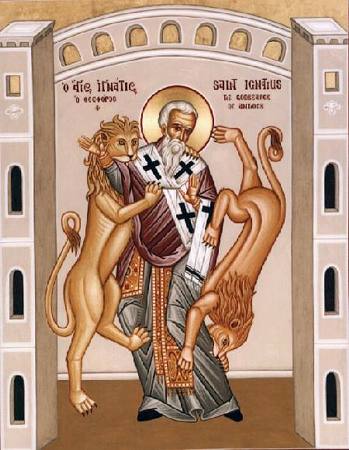
"16. Do not be deceived, my brethren. Those who ruin homes will not inherit the kingdom of God. Now, if those who do this to gratify the flesh are liable to death, how much more a man who by evil doctrine ruins the faith in God, for which Jesus Christ was crucified! Such a filthy creature will go into the unquenchable fire, as will anyone that listens to him.
17. The Lord permitted myrrh to be poured on His head that He might breathe incorruption upon the Church. Do not let yourselves be anointed with the malodorous doctrine of the Prince of this world, for fear he may carry you off into captivity, away from the life that is in store for you. Why do we not all become wise, having received knowledge of God, that is Jesus Christ! Why do we perish in folly, failing to appreciate the gift which the Lord has sent us in truth!" Source: St. Ignatius of Antioch Epistles To the Ephesians, 1946 p 66.
"He was the third bishop of Antioch after St. Peter and Evodius, and governed that Church above forty years with apostolic zeal and piety, which has rendered him eminent to all succeeding ages. Pray for all bishops of Christ's Church, that his spirit may be revived in them. Pray for the people of that city and diocese, now subject to the tyranny and errors of the Turks, that they may once more be the object of his mercy.
St. Ignatius was apprehended by order of the Emperor Trajan, and by him sentenced to be carried to Rome, there to be devoured by lions in the amphitheatre. He received his sentence with joy, having long desired to offer himself a sacrifice to Christ. Being shipped under the custody of ten soldiers, whom he calls leopards, he suffered very much by their cruelty but "their iniquity," says he, "was my instruction."
The spirit of this holy prelate, and the earnest desire he had of suffering for Christ, is plainly discovered in his epistle written to the Romans, which he sent before him. "I wish," says he, "I may come to those beasts, which are prepared for me; I hope they will be ravenous to devor me; I will provoke them to their prey, lest they should spare me, as they have done other martyrs. And if they will not seize me, I will force them; I will put myself upon them, that I may be devoured. Pardon me, my children, I know what advantage it will be to me. It is now I begin to be a disciple of Jesus Christ: I desire nothing upon earth, that so I may find Christ."
Being exposed in the theatre, and hearing the lions roar, he cried out: "I am the wheat of Christ, let the teeth of lions grind me, that I may become pure bread, fit to be offered to him." He was forthwith torn by the lions, and his relics were carried by his disciples to Antioch. Pray for the spirit of this holy man, and that love of God which inflamed his breast." The Catholic Year by Rev. Fr. John Gother
Foster Vocation
by VP
Posted on Saturday January 31, 2026 at 11:00PM in Articles

"The priest should attract others to the priesthood by his own personality. He should strive to live a life so truly Christ-like that his character will be manifest as being beautifully and delightfully Catholic. The young love to see realized in themselves an ideal. Hence there is no doubt that the number of those entering the priesthood would be doubled, even trebled, if we who are now living the priestly life would endeavor scrupulously and continually to live before God and man as "other Christs." Then the young would be filled with respect, reverence, and love for the priest and his sacred office; and, drawn by personal attraction, they would feel a yearning desire to become like unto us."
Source: The Sunday-School Director's Guide to Success by Rev. Patrick James Sloan 1909
