The Good Will of Christ
by VP
Posted on Saturday January 24, 2026 at 11:00PM in Sunday Sermons

Our Lord Jesus Christ (Notre-Seigneur Jésus-Christ) Tissot
“I will.”—MATT. 8. 3.
1. Christ's good Will exemplified.
2. Why so willing to help us? Because we are His by creation, His by redemption.
3. Remembrance of the good Will leads us to hope, repentance, and trustful confidence.
"God's Will is mercy. And twice in the Gospel just read, we hear our Blessed Lord say, "I will,” and immediately mercy followed. The leper besought Him, "Lord, if Thou wilt, Thou canst make me clean." And Jesus, stretching forth His hand, touched him, saying, "I will, be thou made clean." And forthwith his leprosy was cleansed. Again, when the centurion related how his servant was sick of the palsy and grievously tormented, Jesus said to him, "I will come and heal him."
Nothing can do our souls more good than to remember this ready Will of our Lord in showing mercy. The Book of Wisdom tells us the reason of this loving Will. "Thou sparest all, because they are Thine, O Lord, Who lovest souls" (11. 4). How vile of us oftentimes, without a thought of gratitude, to take God's mercies as if they were our due! There are people who may even say, How does God show His good Will and spare us? Our life is hard enough; our pleasures few; our miseries and pains and afflictions frequent. Are not such people a proof of our Lord's good Will?
They seek no mercy from Him, and yet He spares them. Do we not all provoke Him by our sins? Do not many remain careless and enthralled in bad habits for years, with no sorrow, or fear of God, or prayer on their lips? Yet the good Lord is waiting patiently for that prayer for forgiveness to be uttered, and then at once, as He answered the leper, He would say, "I will," and their soul would be cleansed.
But why, O Lord, is Thy good Will so patient and so ready to respond to the cry of a penitent heart? Because we are Thine." Yes, God created us, and He hateth nothing that He has made. God is our Father, we are His children; though often, alas! ungrateful, disobedient, rebellious children. Yet the infinitely good Father loves us still, simply because we are His children.
Moreover, O Lord, we are Thine because Thou hast purchased us by Thy precious Blood. By our sins we have sold ourselves to the devil, we have become his slaves, but Thy good Will has paid the ransom for us. And this not once, but perhaps many and many a time, when we have relapsed all through our own fault, through not seeking help and strength from above. Looking at our past life, who can doubt the patient, loving good Will of Christ our Lord?
We may well wonder how it is; what is the secret of this bearing with us so long, and this readiness to forgive. God loves us. That is the secret of it all. God loves us, for what else could account for such longsuffering patience towards us in sinfulness, and such readiness to forgive, when the grace of contrition, which is His gift, moves us to repent? And what else could account for the multitude of His graces, and the generosity that knows no bounds?
Let us try to learn to bear this remembrance of the good Will of our Lord in our hearts. Nothing could do us more good. We should never then doubt or despair; we should have hope of forgiveness however great our sinfulness, however long we might have abandoned our religious duties. Remembering it, hope would burst forth into love and gratitude. A new life would spring up in our souls: devout prayer, repentance, attending Mass, receiving Holy Communion.
Once that we felt that our leprosy had been cleansed, that the grievous torment of the sickness of our soul had been relieved and cured, could we help but be as grateful as the leper of the gospel was? We can picture him afterwards following Christ with His disciples, one of the faithful ones. And the faith that should animate us to do our utmost for God should be like that of the centurion, which our Lord marvelled at and commended. He had not found so great faith in Israel.
One of the great evils of sin is to prevent us remembering the mercy of God; whereas the miracles of our Lord and Saviour's kindness recorded in the gospels force us to recall and tenderly to meditate on the love of that Sacred Heart which is waiting to work on our souls the same marvellous cures. To remember the mercies of the Lord is a great grace, and awakens in our hearts a trustful confidence in His goodness. It is the first step of the penitent sinner returning to His outraged Redeemer. It makes us loathe the evil we have done against Him; it brings us to His feet, praying for pardon. We come like the leper, "Lord, if Thou wilt, Thou canst make me clean." And the same blessed answer is ready for us, "I will, be thou made clean." And we come forth from the confessional, filled with that blessed confidence that He has spared us, because He loves us. And unworthy though we are, at His loving invitation we draw near to the altar, longing for the Bread of Life, and we hear that divine voice saying, "I will come and heal you," and strengthen you and guard you, and "he that eateth this Bread shall live for ever." May we persevere loyal and faithful to the end, and that end will soon come. Then may our dying prayer be, "Lord Jesus, receive my soul !" and we may trustfully hope that the blessed answer will be, "I will." "Thou sparest all, because they are Thine, O Lord, Who lovest souls." Short Sermons on the Epistles & Gospels of the Sundays of the Year By Rev. Francis Paulinus Hickey, O.S.B. 1922 3rd Sunday after Epiphany
Saint Paul
by VP
Posted on Saturday January 24, 2026 at 11:00PM in Saints
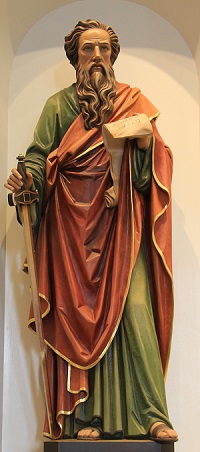
Saint Paul, Holy Name of Jesus Cathedral, Raleigh NC.
Prayer to Saint Paul: O Glorious Saint Paul, after persecuting
the Church you became by God's grace its most zealous Apostle. To carry
the knowledge of Jesus, our divine Savior, to the uttermost parts of
the earth you joyfully endured prison, scourgings, stonings, and
shipwreck, as well as all manner of persecutions culminating in the
shedding of the last drop of your blood for our Lord Jesus Christ.
May your example inspire our parish priests today to be zealous in
their service to God's people. Obtain for our priests the grace to labor
strenuously to bring the faith to others and to accept any trials and
tribulations that may come their way. Help them to be inspired by your
Epistles and to partake of your indomitable love for Jesus, so that
after they have finished their course they may join you in praising him
in heaven for all eternity. Amen.
Jan 25. Feast of the Conversion of St. Paul: Missionary Conquest of World (End of Church Unity Octave Prayer)
by VP
Posted on Saturday January 24, 2026 at 11:00PM in Church Unity

"O Persecutor of the Church of God,
Who when converted valiantly wrought
In Missionary labors for the Lord,
Preaching the Cross which our salvation bought:
Assist the missionaries - thou the first -
To gain the conquest of the world for Christ.
Then praise we God the Father, God the Son,
And God the Holy Spirit - Three in One,
That one in him and one together we
In unity may praise the Trinity
Till all the ransomed fall before His Throne
And give all glory to our God alone. Amen"
Source: Catholic Hymns for the People, James Martin Raker 1919
Prayer intention: Missionary Conquest of World (For the conversion of Muslims and the faithful of other religions)
(Form of prayer decreed by Pope Benedict XV: to be recited Daily during the Octave. + One decade (at least) of the Rosary for this particular intention, Holy Communion if possible.)
Ant. That they all may be one, as Thou, Father, in me and I in Thee, that they also may be one in us; that the world may believe that Thou has sent me.
℣. I say to thee, that thou art Peter,
℟. And upon this rock I will build my Church.
- Let us pray: Lord Jesus Christ, Who didst say to Thine Apostles: peace I leave with you, my peace I give unto you, look not upon my sins, but upon the faith of Thy Church; and vouchsafe unto Her that peace and unity which is agreeable to Thy will: Who livest and reignest God forever and ever. Amen.
- Lord Jesus, most gracious savior of the world, we humbly beg of Thee by Thy most Sacred heart, that all the sheep now wandering astray may be converted to Thee, the Shepherd and Bishop of their souls: Who livest and reignest through all eternity. Amen (Pius X, 26 Oct., 1905)
Source: The Church Unity Octave, 1939 American Ecclesiastical Review, Volume 100
Reflection
"On
this glorious feast of the Apostle our minds think of God's grace as it
fairly flung Saul to the ground on his way to Damascus, and of its
effect upon him and upon the entire Church. Miracles are unusual; they
are not the ordinary way. But the unmistakable lesson is here: God's
grace can overcome the proud intellect and the stubborn will, but
someone must pray. In the case of St. Paul perhaps Our Lady was praying
for him; surely she was praying for the good of the Church when the
voice from the clouds spoke to the stricken man: "Saul, Saul, why
persecuteth thou Me?"
When we consider the millions of souls who
have absolutely no contact with Christianity, even in its most distorted
forms, who do not know the mercy of Christ or the Mother-love of Mary,
we are appalled by the difficulty of converting them. But in words
adapted from the votive Mass of the Propagation of the Faith, we must
pray: "O Mother of God, who willest that all men should be saved and
come to a knowledge of the truth, send, we beseech thee, laborers to the
the harvest of thy Son; grant them to speak the truth with all
confidence, that the message of God may spread and be made known and
that all people may know thee and thy Son..." Missioners in foreign lands
report the devotion of many non-Catholic people to Our Lady. It is not a
Catholic veneration, of course, but it is genuine and sincere. Perhaps
in the Providence of God this respect for Our Lady will be the bridge
whereby millions will enter the Church of Christ. At the boundaries of
Nepal in India three thousand Hindus and Moslems joined three hundred
Catholics to honor the Pilgrim Statue of Our Lady of Fatima, as four
elephants carried the statue to the church for the Rosary and
Benediction. At Rojkot, with practically no Catholics, unbelieving
ministers of the state and other officials came to venerate the statue.
The mayor of Nadiad read a speech of welcome and declared how proud he
was to be present. For twelve hours crowds passed through the church,
crowds that were mostly non- Christian. As one old Indian expressed it:
"She has shown us that your religion is sincere; it is not like ours.
Your religion is a religion of love; ours is one of fear." (Bishop
Fulton J. Sheen, The world's First Love pp193)
The passing of the
Pilgrim Statue was like a triumphant march. At Patna, the Brahman
governor visited the Catholic Church and prayer before the statue. In
the tiny village of Kesra Mec more than twenty-five thousand people came
to view the statue and the Rajah sent 250 rupees and his wife a
petition of prayers. In other parts of India, and in Africa too, Moslems
crowded the churches to render homage to the Mother of God. Moslemism
has, in fact, many references to Mary. In the Koran there are several
mention so Mary, the Annunciation, the Visitation, and the Nativity.
Angels are shown accompanying the Virgin and saying: "Oh Mary, God has
chosen you and purified you and elected you above all the women of the
earth." It is said too that the Moslems believe in the Immaculate
Conception and the Virgin Birth.
Many other instances might be cited which seem to indicate the "The Age of Mary" of which Grignion de Montfort spoke
has begun. Surely the increased societies and works in her honor, the
new theological studies, the emphasis given to her role in the economy
of salvation and sanctification lead one to believe that this era has
been initiated. St. Grignion spoke of the glorification of Mary in these
terms:
"Mary must shine forth more than ever in mercy, in might, and in grace in these latter times; in mercy, to bring back and lovingly receive the poor strayed sinners who shall be converted and shall return to the Catholic Church; in might, against the enemies of God...who shall rise in terrible revolt against God to seduce all who shall be contrary to them, and to make them fall by promises and threats; and finally she must shine forth in grace, in order to animate and sustain the valiant soldiers and faithful servants of Jesus Christ who shall battle for His interests. (True Devotion pp33)"
Source: Rev. Father Titus Cranny, S.A. Our Lady and The Unity Octave, page 9. The American Ecclesiastical Review, Volume 130, Herman Joseph Heuser Catholic University of America Press, 1954
"I know that ravening wolves will enter among you, not sparing the flock"
by VP
Posted on Saturday January 24, 2026 at 11:00PM in Books
The hardship is great, because the enemy has long been prowling around the flock and with subtle cunning has endeavored to bring havoc upon it, succeeding to such and extent that more than every, what the Apostle wrote to the ancients of the Church of Ephesus, seems to be realized: "I know that ravening wolves will enter among you, not sparing the flock" (Acts XX. 29)
Those among us who are prompted by zeal for the glory of God and who seek the reasons for the present decay of religion, ascribe it to various causes; and each, according to his own views, adopts different methods in the endeavor to protect and restore the kingdom of God on earth.
To Us, Venerable Brethren, without rejecting the opinions of others, it seems that we must agree with the judgment of those who attribute the remissness, or rather the intellectual debility of our times, as the condition from which such grave evils arise, chiefly to ignorance of divine things. There seems to be in our day a recurrence of what God said by the mouth of the Prophet Oseas: " There is no knowledge of God in the land. Cursing and lying and killing and theft have overflowed, and blood hath touched blood. Therefore shall the land mourn, and every one that dwelleth in it shall languish" (Osee iv. 1-3)
Source: On the Teaching of Christian Doctrine, Pope St. Pius X
