How to Pray
by VP
Posted on Sunday May 03, 2026 at 12:00AM in Sunday Sermons

The Miraculous Draught of Fishes (La pêche miraculeuse) - James Tissot
"Launch out into the deep."—St. Luke v. 6.
"IN this account of the miraculous draught of fishes which we have just heard in the Gospel we see a striking illustration of what real prayer should be, and how it is rewarded. Suppose we devote these few moments this morning to the subject of Prayer.
We know that prayer is an absolute necessity of the spiritual life. We are strictly bound to pray, if we would save our souls. The manner and the matter of our prayers are, within certain limits, left to our own judgment. There are no conditions of length or place or time. Long prayers are not necessarily the best ones; on the contrary, the Publican said only seven words, and the Penitent Thief nine; and we have yet to hear of prayers more promptly efficacious. We need not come to church in order to have our prayers heard; God will hear us anywhere and any time—as He heard Jeremias in the mire, Ezechias on his bed of death, Daniel in the den of lions, the Three Children in the fiery furnace, Peter and Paul in prison... Note that our Lord first desired Peter to "thrust out a little from the land," and afterwards to 'launch out into the deep." So with our prayers. We must thrust out a little from the land—that is, from attachments and affections of earth, before we can fully launch ourselves into the deep of perfect spiritual union with God. Do we "thrust out from the land" when we pray? And have we Jesus Christ in the vessel of our heart when we make the launch? Our prayers, to be good for anything, should have four characteristics: they should be recollected, detached, definite, and persevering.
1. Before we begin to pray, we must place ourselves in God's presence. We must collect all the powers of our minds and hearts, and set them on the one supreme object. The Memory must be called away from every-day affairs, and used to furnish food for our meditation; the Understanding summoned from its ordinary musings on worldly things, to reason and reflect on what we pray for, and Whom we pray to; the Will steadily fixed on God--striving to conform itself to the divine will, producing affections and forming resolutions suitable to our present needs.
2. Without detachment there can be no recollection. We must thrust out from the land." And how can we do this if the vessel of our soul is moored to the shore by a thousand and one little cords of earthly desire, and worry and care, and anxiety and passion? All these cords must be cut away, and we must "launch out into the deep," if we would pray aright and have God's blessing in ourselves.
3. Let us have a clear, definite idea of what we are going to pray for. Vague, meaningless generalities are out of place in such a serious business. Let us make up our minds beforehand about what we want, and then pray for that. It will not profit us much to ask for all the Cardinal Virtues and allthe Gifts of the Holy Ghost at one time. It will be quite sufficient, and decidedly more profitable, to single out some one virtue of which we stand in special need, and make that the particular burden of our prayers and thoughts and efforts for weeks, and months and years, if necessary, until we gain it.
4. And this, after all, is the true test of a genuine prayer-perseverance. 'We have labored all the night, and have taken nothing; but at Thy word I will let down the net." "Never despair" is the Christian's motto. Never mind how long we may have labored and prayed in vain; never mind how weary the spirit, or how weak the flesh; never mind how little seems our progress and how far away the "mark of the prize of our supernal vocation." God will, as He has promised, finally and gloriously reward our perseverance. Him that overcometh I will give to eat of the tree of life, which is in the paradise of My God." Five minute Sermons for Sunday by the Paulist Fathers, 4th Sunday after Pentecost 1893
Finding of the Holy Cross.
by VP
Posted on Sunday May 03, 2026 at 12:00AM in Tradition
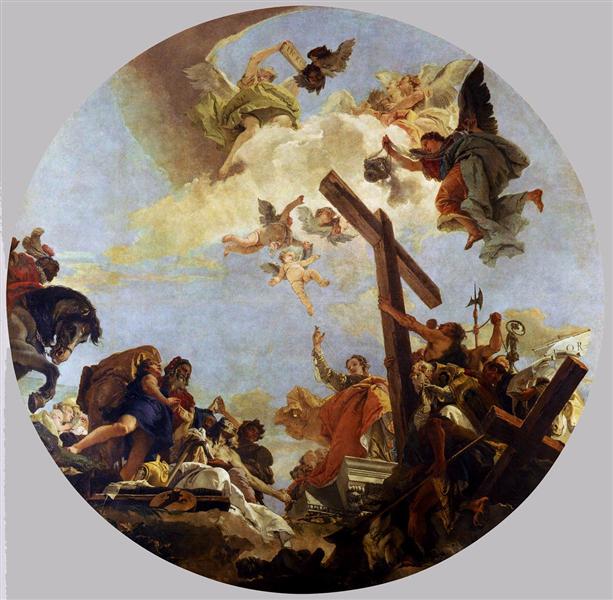
The Discovery of the True Cross and St. Helena Giovanni Battista Tiepolo 1745
"A FESTIVAL in memory of that day, when St. Helen, mother of Constantine the Great, found the cross, on which our Blessed Saviour had suffered, in the year 326, after it had laid buried by the heathens 180 years. Adore Christ crucified, and give God thanks for the memory of His Passion, renewed in the miraculous discovery of His cross. Pray that you may be partaker of His sufferings, and through the merits of His Passion obtain all the divine helps necessary for your salvation.
Pray that you may effectually find the cross of Christ in your soul, by the sincere love of Him who was crucified, and the practice of those lessons, which he has taught you on the cross; by dying to the world and sin, and removing all those earthly and corrupt passions, by which the knowledge of Christ crucified has been so long hidden from your eyes.
Detest the wickedness of those infidels, who, to destroy the memory of Christ's passion, had erected a statue of Venus in the place where the cross had stood; and resolve not to imitate their sacrilegious impiety, by establishing in your heart the love of the world and its sinful pleasures, instead of the love of your crucified Redeemer.
It ought to be a principal business of all Christians, to find the cross of Christ; first by a firm act of faith, professing the belief of Christ crucified; that the second Person of the Blessed Trinity, consubstantial to His Father, was made man, and died on the cross, for the salvation of man.
Secondly, by an act of hope, placing their whole confidence in the merits of Christ's Passion, in virtue of which alone they are to have expectation of grace and glory. This they are to renew every day, as often as they repeat the creed; not running it over without attention, but accompanying what they say with express and lively acts of this their faith and hope, and reflecting on those great obligations, which this mercy of their redemption brings upon them.
Thirdly, they are to find the cross of Christ, by often making the sign of the cross; that as in this they are baptized, so by the same they may consecrate the day, and all the actions of it, to the honour of Christ crucified, and obtain His blessing on all that they do. It is therefore a good practice, and recommended by the primitive Christians, not only to begin and end the day with the sign of the cross, but to make the same at our going abroad, and returning home, at eating and drinking, at our prayers, in time of danger, in the beginning of any occupation, as often as we do perceive any passion growing upon us, or are assaulted with temptations. Thus we are taught by St. John Chrysostom, and other ancient fathers; that by this means, putting ourselves under the conduct of Christ, and desiring His assistance, we may experience the effect of His sufferings, and truly find the cross in that grace and protection, which our Redeemer has purchased for us. For it cannot be doubted, that if upon repeating this action, we as often renew our faith and hope in Christ, and at the same time raise up our hearts to Him with a dependence on Him, and confidence in His assistance, we shall find very good effects of it in abundance of heavenly succours.
Fourthly, Christians are to find the cross, by labouring to bring their hearts to the holy dispositions of Christ crucified. And this ought to be the principal part of this day's devotion; without which all the rest can be but of little advantage to us. For, however we profess a faith and hope in Christ, and by often making the sign of the cross, seem to be solicitous for His help; yet if we advance not so far, as to find the spirit and dispositions of the cross in our hearts, we cannot expect that the rest, without this, will avail us to salvation. Now, to find the spirit of the cross in our hearts, is to find there the humility of the cross, the patience of the cross, the charity of the cross, the resignation, the mortification, and self-denial of the cross, that is, of Christ
crucified. And this cannot be, unless we make a vigorous opposition to
all that corruption and perverseness, which is contrary to the spirit of the cross." The Catholic Year by Fr. John Gother
Superstition
by VP
Posted on Sunday May 03, 2026 at 12:00AM in Sunday Sermons

“Thou shalt not have strange gods before me.”—Exod. XX. 2.
"There are some sinful practices forbidden in these words which it is well to consider to-day, beside fortune-telling and the observing of dreams and omens. These are the use of charms, and the consulting of spirits, or seeking of the truth from the dead.
First, then, with regard to charms, amulets, and the like. Christians are unfortunately to be found, even at the present day, who use, in a superstitious way, and it may be for sinful purposes, things which can have no natural power to accomplish the end desired, but must derive any efficacy which they can be supposed to have from the devil, whose aid is therefore implicitly invoked by those who possess such things. Let every one, then, understand that the use of these charms and amulets, though it might be even for a good object, as the preservation of one's life, is a great sin, and will bring a curse instead of a blessing on any one who perseveres in it. If any one, then, has any such object which he has been told will keep him from danger, give him success in his undertakings, or anything of that kind, let him cast it aside or burn it up without delay. Doubly sinful, of course, is it to keep or use such objects with the hope of working harm to others, or of exciting evil passions in them; and the sin will in no case be avoided by the absurd character of the things employed in this way.
"But how," it may be asked, "about holy things, such as relics, medals, Agnus Dei, gospels, scapulars, and the like? Surely you would not call it superstitious or sinful in any way to keep or wear such things as these, or to think that they might do us some good, not only spiritually but even in the temporal order?" No, you are right about this. It is not sinful even to ask for miracles by the aid of things like those, which are either sacred by their nature or by the blessing of the Church. And the reason why it is not sinful is very plain. It is because God is invoked by means of them, and that any favors which are obtained by them will be for His honor and glory. Still that this should be so, they must be used with piety and devotion. To wear a scapular, for instance, simply as a sort of charm, without any desire or intention of honoring the Blessed Virgin by it, or to invoke her aid to escape from sin, would be not only useless but highly displeasing to her Divine Son. Almost every one feels this; few dare to profane holy objects of this kind by such. use of them; those who have really given themselves up to the devil seldom try to protect themselves in his service by such means.
Well now, to pass to the other subject, that of consulting spirits, or seeking, as the Jewish law has it, the truth from the dead. You see it is no new thing, this spiritism, though the rapping and table-tipping business is rather a new form of it in these days. It has been and is still very common among us, though it may be losing ground somewhat lately. But I do not think that Catholics have at any time been much interested in it compared with some other people. With regard to the next life, we have our faith to instruct us and are not inclined so much as others to ask the spirit-rappers to give us information. But still many Catholics have gone to their meetings, and would have little scruple in going now, just, as they say, from curiosity. They think there is nothing in it; that it is only a more or less clever piece of jugglery. Now, in this they should understand that they are likely to be greatly mistaken. Jugglery and trickery it is sometimes, no doubt; but there is the gravest reason to suspect that in many cases the spirits actually have a hand in the matter. Not, it is true, the spirits of the departed who are invoked, but evil and lying spirits who personate them, and wish by information seeming to come from them to weaken or destroy our belief in the truth of revelation. It is, then, no joking matter, but a very serious and dangerous one, to put one's self in the power and under the influence of these spirits from hell; and this is what one who goes to these spiritual seances, as they are called, may probably do. Remember, then, to have nothing to do with them if you value your immortal soul." Fourth Sunday after Easter Five Minute Sermons by the Paulist Fathers, 1893
Resources:
Reiki:
Bishops’ new guidelines condemn Reiki therapy as ‘superstition’ (CNA)
Guidelines for evaluating Reiki and Alternative Therapy (USCCB)
Reiki, not for Catholics. Not now, not ever by Mary Ellen Barrett (Amazing Catechists)
Yoga
Yoga Isn’t an Exercise, it’s a Spiritual Practice: Why Catholics Shouldn’t Practice Yoga. Jenny Dubay (Missio Dei)
Demonic Possession from Yoga, Reiki, and the New Age with Adam Blai (Divine Intimacy Radio)
Q. Crystal Energy and Healing Stones? My Catholic Life! A journey of personal conversion!
Can Shamanism Be Compatible With Christianity? (Women of Grace)
Intergenerational curses, sin, healing, Family Tree
‘Intergenerational healing’ has no basis in Catholic doctrine, Spanish bishops affirm (World Report)
Superstition! Healing Your Family Tree (Australian theologian, Fr Peter Joseph)
Korean Bishops Condemn 'Family Tree' Healing Practice (2007, UCANews)
Healing the family tree, ancestral curses debunked (2025,
Sins Passed Through Generations (
