Good Friday
by VP
Posted on Friday April 03, 2026 at 12:00AM in Meditations
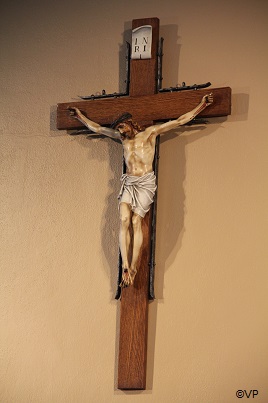
Mother of Mercy, Washington NC.
"On this solemn and sacred day, consider your Blessed Redeemer on Mount Calvary. Being arrived at the holy mount, Jesus is forthwith stretched out upon the cross. His hands and feet are pierced with nails, and with them fastened to the wood: and thus, with shouts and cries of the insulting multitude, He is raised up into the air, and in this manner He offers Himself a bleeding sacrifice to the eternal Father, a propitiation for our sins, and those of the whole world. Who can comprehend what He suffered here, in having His wasted, torn and tormented Body now stretched out upon a cross, His hands and feet fastened to it with nails; and then raised up with shouts into the air between two thieves, with the weight of his whole body now resting only on His wounds? Who will give us a heart to adore our Redeemer, and tears to lament His sufferings, and our sins, which are the occasion of them, and are the very nails, which have bored His sacred hands and feet, and nailed him to the cross?
The first words which our Blessed Saviour uttered, when raised up upon the cross, were: "Father, forgive them, for they know not what they do". Adore the charity of your crucified Redeemer. He prayed for those who treated Him with the utmost cruelty. This shows that it was an excess of love, that brought Him to this ignominious death, since He offered His blood for those who shed it. Beg of Him to open your breast to that divine charity, of which He has here given you so great an example, and to teach you the practice of forgiving all injuries, and even the worst of enemies.
They that passed by reviled Him and mocked Him. But He was pleased to suffer even to His last breath. We are sensible how great a trial it is to be despised in time of affliction; and yet contempts and insults are His entertainment in His greatest humiliation. Bless the humility and patience of your Saviour, who suffered all this for your sake from the hands of sinners. Pray that being His disciple, you may inherit some portion of His spirit, and then remember what is your duty when you are in affliction, or under contempt.
That the Scripture might be fulfilled, Jesus said:"I thirst". How great must our Saviour's thirst have been, when He complained of that, after going through so many torments without opening His mouth! Bless your Redeemer for whatever He suffered in this His last hour, and beg that this His thirst may be the expiation of your intemperance, as likewise of all your niceness and self-love. Beseech Him on this day of mercy to give you a better spirit; that by the merit of His adorable thirst, all self-love may be moderated in you, and such a change be wrought, that you may no more thirst after the false goods of the world, nor be distracted with those vain desires, which have so often wasted your spirit, and taken your heart from the solicitude of more substantial goods.
About the ninth hour, Jesus cried with a loud voice: "My God my God! why hast thou forsaken me?" How great must His suffering have been, for Him thus to cry out ! This is the complaint of nature, which thus expresses its uneasiness under the cross, which the spirit had chosen. It is rather an instruction from the sacred mouth of our Redeemer, to put us in mind of the greatness of His torments, of the rigour of His divine justice, and of the cause for which He is exposed to this extremity. It is to lead us to consider and ask why He suffers all this. It is for the redemption of man: for us poor worms, wretched sinners, enemies of God, captives of hell. Blessed be this His mercy for ever!
And Jesus crying again with a loud voice, yielded up the ghost. Thus all is accomplished; the great sacrifice is offered for the sins of the world, in the death of Jesus on the cross on this day. Let it be a memorial to you; a memorial of the humiliations
of Jesus, of His torments, and of His death. Let it be a day of
thanksgiving, a day of humiliation, of patience, of contrition, and
penance. On this day, lament your Saviour's sufferings, and your own
sins; and do nothing on it, but what may be agreeable to the spirit
of an humble penitent and if anything painful happens, bear it with
patience, after His example. And let this be your method in proportion,
on every Friday through the whole course of the year." The Catholic Year by Rev. Fr. John Gother
Hail Rabbi!
by VP
Posted on Thursday April 02, 2026 at 11:53PM in Quotes

Four causes there were, right courteous reader, which first moved me to explicate unto thee, according unto my small capacity, the mysteries and ceremonies of the Holy Mass.
(…)
3. The third was, the deep, mortal, and cankered malice of wicked heretics, their most execrable blasphemies, together with many most fearful wild,, and damnable facts, done and committed by them, in hatred and contempt of this divine Sacrifice: and what good Christian is there that will not, to the uttermost of his power, defend a treasure so inestimable from the savage assaults of such wicked miscreants?
Day 44. Lent with the Cure d'Ars: The Beloved Crosses
by VP
Posted on Thursday April 02, 2026 at 02:00AM in Lenten Sermons
"The saints, my dear brethren, all loved the Cross and found in it their strength and their consolation. But, you will say to me, is it necessary, then, always to have something to suffer? .... Now sickness or poverty, or again scandal or calumny, or possibly loss of money or an infirmity? Have you been calumniated, my friends? Have you been loaded with insults? Have you been wronged? So much the better! That is a good sign; do not worry; you are on the road that leads to Heaven.
Do you know when you ought to be really upset? I do not know if you understand it, but it should be precisely for the opposite reason -- when you have nothing to endure, when everyone esteems and respects you. Then you should feel envious of those who have the happiness of passing their lives in suffering, or contempt, or poverty.
Are you forgetting, then, that at your Baptism you accepted the Cross, which you must never abandon until death, and that it is the key that you will use to open the door of Heaven? Are you forgetting the words of our Savior: "If any man will come after me, let him deny himself, and take up his cross daily, and follow me." Not for a day, not for a week, not for a year, but all our lives.
The saints had a great fear of passing any time without suffering, for they looked upon it as time lost. According to St. Teresa, man is only in this world to suffer, and when he ceases to suffer, he should cease to live. St. John of the Cross asks God, with tears, to give him the grace to suffer more as a reward for all his labors.
What should we conclude, my dear children, from all that? Just this: Let us make a resolution to have a great respect for all the crosses, which are blessed, and which represent to us in a small way all that our God suffered for us. Let us recall that from the Cross flow all the graces that are bestowed upon us and that as a consequence, a cross which is blessed is a source of blessings, that we should often make the sign of the Cross on ourselves and always with great respect, and, finally, that our houses should never remain without this symbol of salvation.
Fill your children, my dear brethren, with the greatest respect for the Cross, and always have a blessed cross on yourselves; it will protect you against the Devil, from the vengeance of Heaven, and from all danger. This is what I desire for you."
Source: The Sermons of the Cure d'Ars 1960 (Public Domain)
Prayer for Lent: O Lord who, for our sake, didst fast forty days and forty nights; give us grace to use such abstinence that, our flesh being subdued to the spirit, we may worthily lament and acknowledge our wretchedness, and may obtain perfect remission and forgiveness of Thee, the God of all mercy, who livest and reignest with the Father and Holy Ghost, one God, world without end. Amen
Source: Lent with the Cure d'Ars Compiled by the CAPG#9 Acts of Adoration Jesus Christ in the Blessed Sacrament in reparation for all the offenses committed against Him by mankind
by VP
Posted on Thursday April 02, 2026 at 01:00AM in Thursday Reparation

9. We adore Thee, Savior of the world, to Whom all fidelity and glory is due! And to repair the sacrilegious communions and treacheries of so many false consciences, we offer up to Thee the fervent and faithful zeal of the Archangels. Eternal praise and thanksgiving be to the Most Holy and Most Divine Sacrament.
O Queen of heaven and earth, hope of mankind, who adores thy Divine
Son incessantly! We entreat thee, that, since we have the honor to be of
the number of thy children, thou would interest thyself in our behalf
and make satisfaction for us, and in our name, to our Eternal Judge, by
rendering to Him the duties which we ourselves are incapable of
performing. Amen.
St. Francis of Paola, Confessor, A.D. 1508.
by VP
Posted on Thursday April 02, 2026 at 12:00AM in Saints

Bartolomé Esteban Murillo, St. Francis of Paola
"From his youth he seemed inflamed with the Holy Spirit; for, retiring into a desert, he spent six years in great austerity, with almost continued prayer and divine contemplation. Pray especially for young persons, that God would diminish in them excessive fondness for the world and themselves, and give them a true sense of their eternal state, that they may not admire and adore vanity, but God alone. And if any are under your care, reflect on your obligation both to God and them. See that they want no instruction, keep them to their hours of prayer and reading, teach them to employ themselves, oblige them to order and discipline, examine their company and conversation, study to make them easy in a regular life, allow them innocent diversions, but see that they are not fond of what is vain, extravagant, and foolish. By these degrees you may teach them to love God, to have a true esteem for virtue, and to live as becomes Christians. But by following a contrary method, in giving them liberty to gratify corrupt nature, you will concur to their ruin, and find too late their flattered innocence to end in professed vice.
St. Francis being prevailed upon to leave his solitude, for the encouragement of many who desired to follow his example, procured a church to be built near Faula, in Calabria, the place of his birth, and there laid the first foundation of a religious order. He obliged his followers to perpetual abstinence, to go barefoot, and to lie on the ground. And that they might be ever mindful of that humility, which, above all, he recommended to them as the ground of all Christian virtues, he called them Minims, that is the least and most contemptible of all the servants of God. In this method he lived to the ninety-first year of his age, and made a happy end in the year 1508.
Pray for all of this holy Order, that they may truly practice what they profess; that they may
keep up the spirit of their founder, and be an example to all others of
the true spirit of the Gospel. Learn something of it for yourself. The
corruption of your nature can have no better remedy than in a discreet
abstinence from such things as are too favorable to it, in being either
vicious, or disposing that way. Learn never to despise others, but
judge yourself the least and most contemptible of all." The Catholic Year by Rev. Fr. John Gother
Maundy Thursday and the Altar of Repose
by VP
Posted on Thursday April 02, 2026 at 12:00AM in Tradition
Institution of the Holy Eucharist and of the Christian Priesthood.
"As in the cenacle there is something more than a repast, so there is also something more than a sacrifice - there is the institution of the new priesthood. Our Savior would not have said to men: "Unless you eat the flesh of the Son of man and drink His Blood, you shall not have life in you," had He not thought of instituting a ministry through which He would renew to the end of time what He had now accomplished in presence of these twelve men. Now these are His words to these men whom He hath chose: "Do this in commemoration of Me." By those words He gives power to them also to change the bread into His Body, and the wine into His Blood, and this sublime power shall be transmitted through Holy ordination in the Church to the end of time. Through the ministry of mortal, sinful men, Jesus will continue to work out the miracle He performed in the cenacle, and while He endows His Church with the only one and immortal sacrifice, He gives us according to His promise, through the bread of heaven the means to abide in Him, and for Him to abide in us." Dom Gueranger Annee Liturgique
The Liturgy of Maundy Thursday is full of memories of the Redemption. It provided formerly for the celebration of three Masses: the first for the reconciliation of public Penitents, the second for the conservation of the Holy Oils, and the third for a special commemoration of the Institution of the Holy Eucharist at the Last Supper. This last Mass is the only one that has been preserved, and at it the Bishop, attended by twelve priests, seven Deacons and seven Subdeacons, blesses the Holy Oils in his Cathedral Church.
- The Reconciliation of Public Penitents: Sinners who had undergone a course of penance were granted on this day "the abundant remission of their sins," "which were washed away in the Blood of Jesus." Dying with Christ, they were "cleansed of all their sins, and clad in the nuptial robe they were admitted once more to the banquet of the Most Holy Supper."
- The Blessing of the Holy Oils: This blessing took place with a view to the baptism and confirmation of the Catechumens during Easter night. The Bishop exorcised the oils, praying God "to instill into it the power of the Holy Ghost," so that " the Divine gifts might descend on those who were about to be anointed."
- The oil of the sick, which is the substance of the Sacrament of Extreme Unction, is the first to be blessed, before the Pater. Formerly this used also to be blessed on other days.
- The Holy Chrism, which is the matter of the Sacrament of Confirmation, is the noblest of the Holy Oils, and the blessing of it takes place with greater pomp after the Clergy have communicated. It is used for the consecration of Bishops, in the rite of Baptism, in the consecration of churches, altars and chalices, and in the baptism or blessing of bells.
- The third Holy oil, which is blessed immediately after, is that of the Catechumens. It is used to anoint the breast and between the shoulders of the person to be baptized, for the blessing of baptismal fonts on Holy Saturday and on Whitsun Eve, at the Ordination of Priests and for the coronation of kings and Queens.
3. Mass for Maundy Thursday: The Church, which, by placing the Mass of the Catechumens in juxtaposition with the Mass of the Faithful, commemorates throughout the year in the Holy Eucharist all the mysteries of the life of Christ, celebrates today in a special manner the institution of that Sacrament and of the Catholic Priesthood (Secret). [The Eucharist and Priesthood are inseparable, for Jesus instituted them both at the Last Supper. After for the first time changing the bread and wine into His Body and Blood. He at once added, addressing only the Apostles present: "Do this for the commemoration of Me." In those words He charged the Apostles and all their successors, Bishops and Priests, to continue the Eucharistic Sacrifice, thus subordinating its perpetuation to the permanence of His priesthood on earth.]
This Mass then realizes eminently the command laid by Jesus on His Priests to renew the Last Supper, at which Christ, at the very moment of His death was being plotted, instituted His immortal presence among us. And the Church, forgetting for the moment her mourning, celebrates the Holy Sacrifice today with holy joy. The Crucifix is covered with a white veil, her Ministers are vested in festal robes, and the Gloria is sung to the ringing of all the bells. And after this Hymn the bells remain silent till Holy Saturday.
Certain abuses which had crept in owing to the Eucharistic banquet
being partaken of after another meal, following the example set by
Christ, having been abolished, st. Paul tells us in the Epistle that the
Mass is a "memorial of the death of Jesus." The Sacrifice of the Altar
is necessary if we are to communicate in the Victim of Calvary and share
in His merits. And the Eucharist, which derives all its virtue from the
Sacrifice of the Cross, makes it universal as regards time and space in
a sense unknown so far. To love the Blessed Sacrament is "to glory in
the Cross of our Lord Jesus Christ" (introit). Christ takes on Himself
to perform the ablutions prescribed by the Jews during the supper
(Gospel), to evidence the purity and charity that God requires of those
who desire to communicate, for, as in the case of Judas (collect),
"Whosoever eats this bread unworthily is guilty for the body and of the
blood of the Lord (Epistle).
After the Mass the altar is stripped in order to show that the Holy
Sacrifice is interrupted and will not be offered up again to God until
Holy Saturday. The Priest therefore has consecrated two hosts, for on
Good Friday the Church refrains from renewing on the altar the Sacrifice
of Calvary." Source: Daily Missal with Vespers for Sundays & Feasts By Dom Gaspar Lefebvre, 1925.

Institution of the Holy Eucharist, ©CAPG
"Jesus having loved His own, who were in the world, He loved them unto the end. This love He expressed in a more particular manner in the institution of the Holy Eucharist on this day. Being now about to depart out of the world, He left us His sacred Body and Blood under the forms of bread and wine; that so, being ascended to His Father, He might not leave us orphans, but still abide with us for the food and nourishment of our souls in their spiritual life, for the support of our banishment, and the comfort of our pilgrimage. He gave Himself to us in this Blessed Sacrament, to be our security in dangers, our strength in temptations, our physician in all distempers, our counsel in difficulties, our encouragement in troubles, and our help in infirmities. In fine, He gave Himself to us, to be all to us that can be necessary for carrying us through the evils of this life, to the possession of that eternal happiness, which He has purchased for us with the price of His Blood.
This was the pure effect of His mercy and love to us: for if we look upon ourselves, what do we see there? Nothing but ingratitude, monstrous self-love, pride, sensuality, stubbornness, and sin. That He should stoop to that humiliating expedient of becoming our food, is the work of His mercy and love to us. It is this love that we are called upon this day to acknowledge and adore: and it must be a reproach to us of insensibility, if we are wanting in this duty.
This is performed in part, by preparing a place for the Blessed Eucharist, which the faithful are accustomed to call the Sepulchre,
where it is deposited after Mass on this day, and surrounded with
lights, flowers, and other ornaments. As far as these are
acknowledgments of our respect and gratitude, they will be acceptable to Him whom we thus honour. But we must pour forth our hearts to God, as
we devoutly visit this sepulchre, in the confession of His power and goodness; we must return Him our love for His love to us: and beseech Him to complete the mercy of this day, by teaching us worthily to praise Him, and sincerely to love Him." Maundy Thursday, The Catholic Year by Rev. Fr. John Gother

The Office of Holy Week, 1870 (Washing of the Feet, Holy Mass, Blessing of the Oils) Daily Missal, Dom Gaspar 1925
"It is not uncommon to hear Maundy Thursday referred to as Holy Thursday. This is a mistake. Holy Thursday is a name belonging absolutely from time immemorial to the Feast of the Ascension. Maundy is a significant name and ought therefore to be jealously guarded. Enough of that element of religion which serves to make it popular has been lost in the course of past centuries.
The word Maundy is derived, through the French maundier, from the Latin mandatum: "Mandatum novum do vobis," (a new commandment I give unto you) John, 13:34. The Mandatum or Maundy was the ceremony of the washing of the feet and almsgiving observed on this day, both of which were performed as a token of that brotherly love which Christ so earnestly inculcated at the last supper.
The ceremony of the washing of the feet was and is part of the liturgy. It was performed by Pope, Bishop, and priest, and kings, nobles and peasants imitated their example. Twelve poor men were selected to be the recipients of the dignitaries' favor.
The Maundy is observed in the ceremonies of the church, and in many religious communities even at the present time.
Visiting the repositories is a custom as popular of old as it is today. It is indeed edifying to Catholic and non-Catholic alike to witness the spontaneous demonstration of devotion to the Blessed Sacrament, and deeper than we are aware of is the impression produced on the multitude of unbelievers around us by this and similar acts of faith." Source: Maine Catholic Historical Magazine, 1914

Altar of Repose, Institute Christ the King, ©DC
" To draw his people more effectually to the holy Eucharist, the Cure d'Ars had endeavoured to communicate to them a taste for all holy things, and his efforts were not in vain. Sunday after Sunday these good people feasted their eyes on beautiful banners and vestments.
("In the minutes of the pastoral visitation held at Ars by the Bishop of Belley, on Monday, June 11, 1838, we read as follows: "After saying Mass and giving confirmation, His Lordship contented himself with giving Benediction of the Blessed Sacrament and reciting the prayers for the departed. He deemed it unnecessary to examine the interior of the church, the chapels, vestments and sacred vessels, because everything is so beautiful and so rich that the beholder is filled with admiration" Msgr. Convert. Le Frere Athanase.)
For a long time the saint himself trained the altar boys, and achieved wonderful results. He carried out with gravity, dignity, and the utmost care all the ceremonies of the rite of Lyons, which at that time was likewise in use in the diocese of Belley. Nor was the behaviors of the altar servers less admirable when, in 1849, Frere Athanase undertook the functions of master of ceremony.
He had so fine a liturgical spirit, and he drilled the children with so much precision and good taste, that Mgr. de Langalerie, during a clergy retreat, held him up as a pattern to the clergy of the diocese. "Do you wish to see a church where all the ceremonies are carried out to the letter? Go to Ars; Frere Athanase is a living and unerring ceremonial. His example will show you what you can achieve yourselves if you will only take the means."
There were days when the people of Ars gave special edification to the pilgrims. On Maundy Thursday, in order to commemorate the institution of the Holy Eucharist, M. Vianney insisted on providing a splendid altar of repose, and his heart rejoiced at sight of the decorations which enhanced the majesty of the tabernacle. The whole of the chancel, which had been considerably enlarged in 1845, was draped with banners. Numerous and tastefully arranged lights transfigured the scene. However, he took every precaution lest these decorations should be a hindrance instead of a help to the interior recollection of the people."
Source: The Cure d'Ars, Abbe TrochuThe Fruits of the Mass
by VP
Posted on Wednesday April 01, 2026 at 11:02PM in Articles
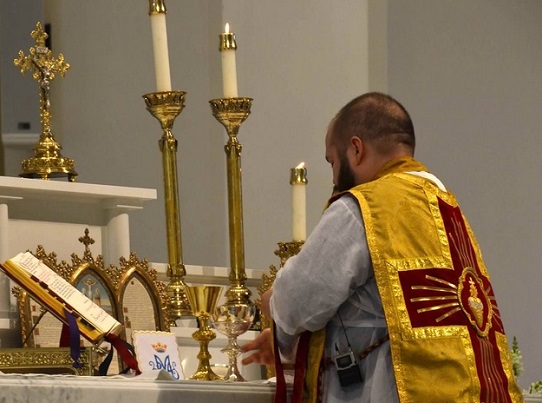
By Msgr. George W. Shea , S.T.D.
"The Mass has a fourfold purpose, and therefore a fourfold efficacy. It is offered, first and foremost, to adore God, whence it is called the "Sacrifice of Praise ". Secondly, it is offered to thank God for His great glory and for the benefits He has showered upon us, whence the Mass is called the "Eucharistic Sacrifice," that is the “Sacrifice of Thanksgiving ". Thirdly, it is offered to implore new benefits, notably grace, whence it is called an "lmpetratory Sacrifice ". Finally, it is a "Propitiatory Sacrifice", because it is offered to move the divine mercy to the pardon of sins.
Of these various effects of the Mass, the two which derive to men (the impetratory and the propitiatory) are usually termed the "fruits" of the Mass. Whereas the effects of the Mass insofar as it is a Sacrifice of Praise and of Thanksgiving are infinite, the “fruits" of the Mass are limited. The measure in which they are bestowed depends especially on the dispositions of those to whom they are given.
To whom are they given? To some degree or other the fruits of the Mass are bestowed upon the celebrant, upon those who serve or assist at the Holy Sacrifice, upon the person or persons for whom it is offered, upon all living, especially the members of the Church, and also upon the souls in Purgatory. The latter, however, are capable only of the propitiatory fruits of the Mass.
That the celebrant shares in the fruits of the Mass is readily understandable. No one more than he participates in the sacrifice. His active cooperation is necessary. He acts as the instrument of Christ, the High Priest, in virtue of the power received at Ordination. So he has a right to what is called the “most special fruit" of the Mass.
Sharing with him in this "most special fruit", but to a lesser degree, are the faithful who serve or assist at the Holy Sacrifice. The greater their devotion, the more plentiful are the graces God gives them through the Mass.
The person or persons for whom the priest celebrates the Mass in particular obtain what is termed the "special fruit" of the Mass. The priest may offer the Holy Sacrifice for any living person (although only privately for the excommunicated), and for the souls in Purgatory (although only privately for those to whom the Church has denied ecclesiastical burial). Since we have no way of knowing to what extent this special fruit is obtained by a soul in Purgatory for whom a particular Mass is offered, it is a pious practice to have the Holy Sacrifice celebrated repeatedly for the faithful departed.
Then, finally, there is the “general fruit" of the Mass. This comes to all the living, especially the members of the Church, and also to all the souls in Purgatory. At the Offertory of the Mass the celebrant prays that "the Sacrifice will be beneficial not only for himself and for all here present", but also for all faithful Christians, whether living or dead", not only for our own salvation," but also for that of the whole world ".
This is a most consoling thought because of our membership in the Church we share in a general way (but more intimately than those who are outside the Church) in the effects of every single Mass being offered up anywhere on earth Even when we are absorbed in our dally routine there accrue to us the beneficent effects of every Mass!
Source: The Catholic Advocate Vol 8 N17, 10 April 1959
Day 43. Lent with the Cure d'Ars: The Armed Crosses
by VP
Posted on Wednesday April 01, 2026 at 02:00AM in Lenten Sermons
"The sign of the cross is the most terrible weapon against the Devil. Thus the Church wishes not only that we should have it continually in front of our minds to recall to us just what our souls are worth and what they cost Jesus Christ, but also that we should make it at every juncture ourselves: when we go to bed, when we awaken during the night, when we get up, when we begin any action, and, above all, when we are tempted. We can say that a Christian who makes the Sign of the Cross with genuine religious sentiments, that is to say, when fully aware of the action which he is performing, makes all Hell tremble. But when we make the Sign of the Cross, we must make it not by habit but with respect, with attention and thinking of what we are doing. Ah, dear Lord, with what devout awe we should be filled when we make the Sign of the Cross upon ourselves and recall that we are pronouncing all that we hold holy and most sacred in our religion."
Source: The Sermons of the Cure d'Ars 1960 (Public Domain)
Prayer for Lent: O Lord who, for our sake, didst fast forty days and forty nights; give us grace to use such abstinence that, our flesh being subdued to the spirit, we may worthily lament and acknowledge our wretchedness, and may obtain perfect remission and forgiveness of Thee, the God of all mercy, who livest and reignest with the Father and Holy Ghost, one God, world without end. Amen
Source: Lent with the Cure d'Ars Compiled by the CAPGMonth of April: The Holy Spirit
by VP
Posted on Wednesday April 01, 2026 at 02:00AM in Monthly Devotion
April: Month of the Holy Spirit
Virtue: Patience
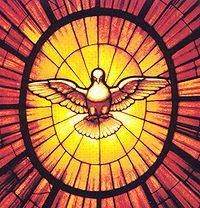
O Holy Spirit, Creator, be propitious to the Catholic Church; and by Thy heavenly power make it strong and secure against the attacks of its enemies; and renew in charity and grace the spirit of Thy servants, whom Thou has anointed, that they may glorify Thee and the Father and His Only-begotten Son, Jesus Christ, our Lord. amen.
Manual of prayers to the Holy Ghost by Very Rev. Fr. Felix of Jesus 1941
Prayer to the Holy Ghost for Priests
O Holy Ghost, Thou Friend of priests, send them daily Thy seven gifts, that they may live
worthy of their calling, and become all to all in order to win souls for heaven. Give them
patience with children, pity for the sick, humility toward the poor, and generosity toward
the enemies of Thy holy Church. Make them active in teaching, untiring in the tribunal of
penance, and zealous in distributing Holy Communion. Let them be terrible to the demons
of hell and messengers of peace to all who are of good will.
May Thy blessing accompany
them wherever they may go; may Thy peace enter with them in the dwellings they may
visit; mayest Thou bless all whom they may bless. Make them true apostles and saints. Amen.
Come Holy Ghost, a compilation of prayers in honor of the Divine Spirit.
1932 Fr. Lester Martin Dooley.
Prayer to the Holy Spirit by Cardinal Désiré-Joseph Mercier (1851-1926)
"I am going to reveal to you the secret of sanctity and happiness. Every day for five minutes control your imagination and close your eyes to the things of sense and your ears to all the noises of the world in order to enter into yourself Then, in the sanctity of your baptized soul (which is the Temple of the Holy Spirit), speak to that Divine Spirit, saying to Him:
Oh, Holy Spirit, beloved of my soul, I adore You.
Enlighten me, guide me, strengthen me, console me.
Tell me what I should do; give me your orders.
I promise to submit myself to all that You desire of me
and to accept all that You permit to happen to me.
Let me only know Your will. Amen.
If you do this, your life will flow along happily, serenely, and full of consolation, even in the midst of trials. Grace will be proportioned to the trial, giving you the strength to carry it, and you will arrive at the gate of Paradise, laden with merit. This submission to the Holy Spirit is the secret of sanctity."
Tenebrae
by VP
Posted on Wednesday April 01, 2026 at 12:00AM in Tradition

THE TRIANGULAR CANDLESTICK AT THE TENEBRAE.
Question: What is the meaning of the fifteen candles which are extinguished one by one during the chanting of the Psalms at the Matin Office (Tenebrae) during the last three days of Holy Week? The Office of Holy Week (Baltimore edition), which gives the liturgical text, with the rubrics in English, says: "When about to celebrate this part of the office, they place in front of the altar a large triangular candlestick containing several lighted candles, one of which is extinguished after each psalm." De Herdt, I am told, mentions the number of candles as fifteen, but gives no definite explanation of the mystic significance. Is the number essential, or is it merely optional, and expressive of the gradual darkness that came upon the world through sin from which Christ, symbolized by the light at the top which alone remains burning, has delivered us?
Resp. The most prevalent interpretation of the symbolic candlestick commonly called Herse (hersa, hearse, hercia)(1) during the Middle Ages, was that it signified the patriarchs and prophets, whose teaching served the world as a light leading up to Christ. who became the all-absorbing Light illuminating man to the end of time. There are seven lights on each side leading to the apex of the triangle. These fourteen candles were usually of unbleached wax, while the one on top was of white wax. They represent the patriarchal church from Adam to Joseph on one side, and the Mosaic church from Moses to the last of the prophets on the other, for the number seven, according to the Midrash, is the most perfect and representative number. They counted seven Fathers of tribes, the last of whom was to be Moses, their deliverer-Abraham, Isaac, Jacob, Levi, Kahath, Amram, Moses. Seven was the number of revelation (Ps. 96: 13).
Such was the fundamental idea. But since the Patriarchal and Mosaic revelations leading up to Christ might be variously represented by the principal agents of the divine purpose manifesting the coming of the Messiah, so the number of lights which were used to express the expectation of the nations for a Redeemer, and which were to disappear with His coming, varied. Adam, Noe, Abraham, and the succeeding leaders who inaugurated great revivals of the Messianic hope down to Esdras or Judas Maccabæus, might all be represented as lights. Hence there were sometimes as many as twenty-four candles. Feasey, in his Ancient Holy Week Ceremonial, writes: "This Tenebrae candlestick, called Herse or Hersa,' in English Cathedral statutes, is a large triangular candelabrum, or candlestick, or hearse of brass, latten or iron, upon which the tapers used in the Tenebrae office are set, and which is placed on the epistle or south side of the sanctuary and altar. . . . Calfhill says that in England it was called the Judas or Judas Cross.(2)" In some cases the lights were extinguished at once, or at two and three intervals. The six candles on the high altar which are extinguished during the signing of the Benedictus are usually taken to represent the light of Jewish righteousness passing between the birth of our Lord and His death and resurrection.
The upper light is not extinguished, but is hidden behind the altar, while the Miserere is recited in a low tone; after which it is restored to its place at the top of the candlestick, because God did not leave the soul of our Lord in darkness, but raised Him from the dead.
As stated above, the number of candles used in the Tenebrae office appears to have varied very much in the different churches: The Sarum Breviary says twenty-four; at Canterbury and York there were twenty-five; at Nevers there were nine; at Mans twelve; at Paris and Rheims thirteen; at Cambray and St. Quentin twenty-four; at Evreux twenty-five; at Amiens twenty-six; at Coutance forty-four. In some churches the candles corresponded to each psalm and lesson of the office.
--------------------------
1. The word "hearse" (Latin, hercia) is derived through the French herse, from hericius, ericius, ericeus or critius, a harrow, or hedgehog, from its appearance. It was ordinarily used at funerals over the coffin or catafalque.
2. Wordsworth in his Medieval Services in England, says: "One of the candles in the herce for Tenebrae in Holy Week represented the traitor, and is sometimes called the Judas Candle. The antiphon sung at Lauds on Maundy Thursday, when the last light was darkened, was 'He that betrayed Him had given them a token' (Brev. Sar. 783). But what appears a Judace or the Jewes light was the forerunner of these modern dummies and save-alls which are sometimes reprehensively painted to counterfeit the true natural wax." This is the wooden base of the paschal candle blessed on Holy Saturday.
American Ecclesiastical Review, Volume 26, erman Joseph Heuser Catholic University of America Press, 1902

