Easter Sunday: The Joy of Penance
by VP
Posted on Sunday April 20, 2025 at 01:00AM in Sunday Sermons

Touch me not by Jacques Tissot
"I WISH all of you, my brethren, the joys of this day. It is the day of our Lord's victory over death and hell. Many of you have received Him in Holy Communion either this morning or during the preceding week. To such He has found a way to communicate something of the vast ocean of love and joy which inundates His own soul. A good Communion, following a humble confession of sin, is indeed the nearest way to that tomb, riven and empty, and streaming with the light of heavenly joy, about which the Church gathers her children this morning. How well chosen is Eastertime for the annual Communion of all good Christians. "I have seen the tomb of Christ, who has risen from the dead," may we well say with Mary Magdalen. God grant that not one of you all may pass beyond Trinity Sunday without attending to what is so appropriately called the Easter duty.
It seems to me that this feast is a great day for sinners - meaning, of course, repentant sinners. For look at the facts? Who is the saint of the Resurrection by excellence? Certainly dear Mary Magdalen, the type of all the penitent. She stood beneath the Cross when Jesus died, comforting Him and His Mother in that dreadful hour of His doom and of that Mother's woe. And when the dead corpse was lowered down, Mary Magdalen pressed His limbs and feet and hands to her bosom while our sorrowful Mother clasped His heart to her own and kissed His pallid face a thousand times. Mary Magdalen helped to lay Him in His grave. She watched then; when driven away by the soldiers she bought spices and came again to embalm Him. And whose words are those repeated to-day all round the world as the dawn greets the watching glances of the faithful. "They have taken away my Lord! I know not where they have laid Him"; and again the amazed and ecstatic exclamation when she saw Him in the garden: "Rabboni! Master."
What a great store of love, says St. Gregory the Great, was in that woman's heart, who, when even His disciples were gone away, could not tear herself from the grave of the Lord!
See, then, my brethren, the reward of the love which is in true sorrow for sin; it is given a singular kind of pre-eminence; it is selected above that of innocence and placed on guard at the post of honor to receive the first public greeting from the Immortal King of Glory, triumphant over sin for ever. I say public greeting, for doubtless Jesus visited and greeted His Mother in private first of all; but this is not written down for our edification, and Mary Magdalen's privilege is. Sinners need encouragement, and certainly they get it today in the honor paid to their glorious patron, to the woman who had many sins forgiven her because she loved much.
I say again that sinners need encouragement. In truth, there is no shame so deadly as that which conscious guilt brings to the human soul. There is no degradation like vice - in fact, there is none other but vice. Hence many sinners are met with who do not turn to God and who hold back from confession and communion because they are ashamed and afraid. It is not so much love of sin as want of confidence that now hinders them. They have felt the force of passion as the slave feels the whip of the slave-driver; or they have repented before and fallen again, and this fills them with distrust in themselves; or their surroundings are a constant source of temptation; or they have been so long away that the very process of reconciliation to God, the very practice of the simplest acts of religion, have grown strange to them. These, and other reasons, varying from mere timidity to utter despair, show the need of a strong word of encouragement to sinners. This is the day for giving sinners courage to repent. Oh! let every man and woman partake of Christ's courage today. All who are sinners, let them loath and detest their sins, and let them feel that if our Lord is with them they can conquer any passion, resist any temptation, and persevere to the end.
It is a singular thing that not only the first recorded words of our Lord after His resurrection were addressed to His favorite child, the great penitent woman of the Gospel, but that the first interview He had with His disciples was begun by the institution of the Sacrament of Penance, the open door of that city of refuge our Lord's Sacred Heart. Now is the time, therefore, most appropriate for the return to God of all sinners among us. May our risen Savior give you that joy if you have it not, and if you have it, may He confirm it to you for ever! Amen." Five minutes sermons by the Paulist Fathers
Holy Saturday: "He descended into hell, the third day he rose again from the dead.”
by VP
Posted on Saturday April 19, 2025 at 01:00AM in Tradition

James Tissot - Holy Saturday
"The Savior of the world, having expired on the cross, and by His death paid the ransom due to the divine justice for the sins of men, descended into Limbo, to deliver thence those just souls who were waiting for their Redeemer, and were prepared to enter with Him into glory. Inexpressible was the joy of those holy souls at the presence of their Redeemer, who having conquered death and hell, came down in the happy character of a deliverer, and demanded them from their long confinement, to take part in his triumphs. It was the Messias whom they expected; and He being come, they think all the time of their banishment to have been as nothing, beginning now to enjoy Him, whom they had so long desired, and whom no time can ever more take from them. The same will be the happiness of every one that dies well. Whether the evils of life have been great or inconsiderable, long or short, they all disappear at the hour of a happy death, and are lost in eternity.
Our Blessed Redeemer was pleased to be taken down from the cross, and laid in a sepulchre, so to confirm to all generations the truth of His death for us, and of His resurrection from the dead. Pray that by a firm faith of what He has suffered for us, you may plentifully partake of His mercies, and daily increase in that hope and love, which are to bring you to the possession of Him. From His sacred body being laid in the sepulchre, you may learn the mystery which is taught you this day, that you also ought to be buried together with Him; that you are not only to labour that in the likeness of His death the old man may die in you, but that he may be buried also; so that he be altogether hidden from the world, and that nothing may appear in us but the new man, who is renewed in us by his death.
What happy fruit of Christ's passion would it be to us, could we obtain this mercy! We are convinced of the folly of sin, and the vanity of all that pleases for a moment; we are tired of our corruption; but who will deliver us from the body
of this death? None can do this but Jesus. Wherefore apply yourself to Him: sit at His sepulchre, and by His sacred passion beseech Him to have
compassion on you, to help you in the relief of your necessities, and give you the victory which you desire." The Catholic Year by Rev. Fr. John Gother
St. Alphege, Bishop and Martyr A.D. 1012.
by VP
Posted on Saturday April 19, 2025 at 01:00AM in Saints

"He was born of noble and virtuous parents; but renounced the world whilst he was yet very young. He served God first in the monastery of Derhurste in Gloucestershire; but after some years, he built himself a cell in a desert place of the abbey of Bath, where he shut himself up, unknown to men, but well known to God, for whose love he made himself a voluntary martyr of penance. His eminent virtues invited many to be his followers. But some of them falling from their first fervour, contented themselves with deceiving their superior with pretended exactness, while out of his sight they took very scandalous liberties, particularly in sitting up in the night to feast and drink, and fasting in the day with the rigour of the strictest hermits. But though they imposed upon this good man; yet God's justice soon discovered their hypocrisy in the punishment of it. St. Elphege in a short time reclaimed them; and God, by the sudden death of one, opened the eyes of all the rest. See that you imitate not these unhappy men, but observe discipline exactly. It is the practice of too many to transgress it, and their glory is to deceive those under whose care they are, by unduly going abroad, and unseasonable meetings at home. Break off all such customs: for there is so much folly, injustice, and deceit in them, that they cannot fail of proving your scourge in bringing mischief upon you.
The see of Winchester
falling vacant, St. Dunstan was admonished in a vision to oblige St.
Elphege to receive episcopal consecration. After he had governed the see of Winchester twenty-two years, he was chosen archbishop of Canterbury. The Danes landing in England took the city of Canterbury, seized the holy
prelate, laid him in irons, and confined him for several months in a
filthy dungeon. He was then released, but soon after cruelly martyred in
the year 1012.
Pray for all the bishops of Christ's Church;
and in particular for him, under whose charge you are. Pray for this
nation, that God would in His mercy preserve it from atheism and
infidelity; and not let these be the punishment of its vice, but make it zealous for virtue, justice and truth." The Catholic Year by Fr. John Gother
St. Apollonius, MARTYR, A.D. 186.
by VP
Posted on Friday April 18, 2025 at 01:00AM in Saints
"The Emperor Marcus Aurelius had persecuted the Christians from principle, being a bigoted Pagan: but his son Commodus, who succeeded him in the empire, after some time, shewed himself favorable to them. During this calm, the number of the faithful exceedingly increased, and many persons of the first rank enlisted under the banner of the cross. Of this number was Apollonius, a Roman senator. He was very well versed both in philosophy and the Holy Scriptures. In the midst of the peace, which the Church enjoyed, he was publicly accused of Christianity by one of his own slaves, named Severus. St. Apollonius was ordered to renounce his religion, as he valued his life and fortune; for though Commodus had forbidden any one to accuse the Christians, he had not repealed the former laws against them. The saint courageously rejected such terms, and obtained leave to give an account of his faith in full senate. This he did in an excellent discourse, which has not come down to our times. But it not being in the power of his brethren to overrule the law, he was beheaded; and thus sealed the truth with his blood.
Good Friday
by VP
Posted on Friday April 18, 2025 at 01:00AM in Meditations
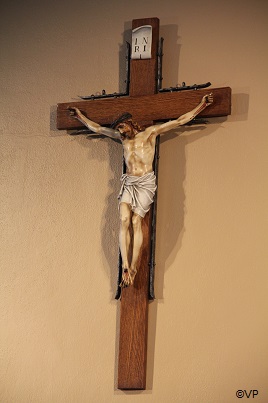
Mother of Mercy, Washington NC.
"On this solemn and sacred day, consider your Blessed Redeemer on Mount Calvary. Being arrived at the holy mount, Jesus is forthwith stretched out upon the cross. His hands and feet are pierced with nails, and with them fastened to the wood: and thus, with shouts and cries of the insulting multitude, He is raised up into the air, and in this manner He offers Himself a bleeding sacrifice to the eternal Father, a propitiation for our sins, and those of the whole world. Who can comprehend what He suffered here, in having His wasted, torn and tormented Body now stretched out upon a cross, His hands and feet fastened to it with nails; and then raised up with shouts into the air between two thieves, with the weight of his whole body now resting only on His wounds? Who will give us a heart to adore our Redeemer, and tears to lament His sufferings, and our sins, which are the occasion of them, and are the very nails, which have bored His sacred hands and feet, and nailed him to the cross?
The first words which our Blessed Saviour uttered, when raised up upon the cross, were: "Father, forgive them, for they know not what they do". Adore the charity of your crucified Redeemer. He prayed for those who treated Him with the utmost cruelty. This shows that it was an excess of love, that brought Him to this ignominious death, since He offered His blood for those who shed it. Beg of Him to open your breast to that divine charity, of which He has here given you so great an example, and to teach you the practice of forgiving all injuries, and even the worst of enemies.
They that passed by reviled Him and mocked Him. But He was pleased to suffer even to His last breath. We are sensible how great a trial it is to be despised in time of affliction; and yet contempts and insults are His entertainment in His greatest humiliation. Bless the humility and patience of your Saviour, who suffered all this for your sake from the hands of sinners. Pray that being His disciple, you may inherit some portion of His spirit, and then remember what is your duty when you are in affliction, or under contempt.
That the Scripture might be fulfilled, Jesus said:"I thirst". How great must our Saviour's thirst have been, when He complained of that, after going through so many torments without opening His mouth! Bless your Redeemer for whatever He suffered in this His last hour, and beg that this His thirst may be the expiation of your intemperance, as likewise of all your niceness and self-love. Beseech Him on this day of mercy to give you a better spirit; that by the merit of His adorable thirst, all self-love may be moderated in you, and such a change be wrought, that you may no more thirst after the false goods of the world, nor be distracted with those vain desires, which have so often wasted your spirit, and taken your heart from the solicitude of more substantial goods.
About the ninth hour, Jesus cried with a loud voice: "My God my God! why hast thou forsaken me?" How great must His suffering have been, for Him thus to cry out ! This is the complaint of nature, which thus expresses its uneasiness under the cross, which the spirit had chosen. It is rather an instruction from the sacred mouth of our Redeemer, to put us in mind of the greatness of His torments, of the rigour of His divine justice, and of the cause for which He is exposed to this extremity. It is to lead us to consider and ask why He suffers all this. It is for the redemption of man: for us poor worms, wretched sinners, enemies of God, captives of hell. Blessed be this His mercy for ever!
And Jesus crying again with a loud voice, yielded up the ghost. Thus all is accomplished; the great sacrifice is offered for the sins of the world, in the death of Jesus on the cross on this day. Let it be a memorial to you; a memorial of the humiliations
of Jesus, of His torments, and of His death. Let it be a day of
thanksgiving, a day of humiliation, of patience, of contrition, and
penance. On this day, lament your Saviour's sufferings, and your own
sins; and do nothing on it, but what may be agreeable to the spirit
of an humble penitent and if anything painful happens, bear it with
patience, after His example. And let this be your method in proportion,
on every Friday through the whole course of the year." The Catholic Year by Rev. Fr. John Gother
St. Anicetus, POPE AND MARTYR, A.D. 173.
by VP
Posted on Thursday April 17, 2025 at 01:00AM in Saints

"He was born in Syria, and succeeded St. Pius in the see of Rome, in the latter part of the reign of Antoninus Pius. He sat about eight years, from 165 to 173. He is styled a martyr in the Roman and other martyrologies. If he did not shed his blood for the faith, he at least purchased the title of martyr by great sufferings and dangers. His vigilance protected his flock from the wiles of the heretics, Valentine and Marcion, instruments whom the devil sent to Rome, seeking to corrupt the faith in the capital of the world.
Pray for the present Pope, for all prelates and pastors, and for the whole Church; that as God has promised to lead it into all truth, so by their care who watch over it, it may be delivered from all abuses and scandals. Pray for all those who are divided from it, whether by heresy or schism.
Praise and bless God for His goodness to this holy martyr. For what could nature do amidst so many difficulties, and the terrors of a
cruel death, if God had not raised it above itself, and by His grace
taught it to overcome? For this mercy to His servant, bow down, adore
and bless His name; and as you rejoice in His triumphs, let it be the subject of your joy, that God is glorified in poor creatures like ourselves. Yet while you celebrate the triumph of this martyr, pray that this solemnity may be to you an increase of God's mercy, that you may find some portion at least of that holy spirit in yourself, which you honour in His servant.
For as often as the memory of the martyrs occurs, so often you are reproached with the evidence of your own weakness; and you cannot see their courage and patience, without condemning your own great indisposition of soul, who can discover so little of that
in yourself, which you admire and honour in them. Beseech God therefore
to hear you, and by His grace to overcome your weakness, change your
unhappy temper, and bring you nearer to the happy disposition of the martyrs." The Catholic Year by Rev. Fr. John Gother
There are few saved in the sanctuary
by VP
Posted on Thursday April 17, 2025 at 01:00AM in Meditations

Giuseppe Passeri - The Cleansing of the Temple
"On the small number of the elect."
1. There are few saved in the sanctuary: The sentence of our Savior, recorded in St. Matthew, applies to the sanctuary as well as to the Christian life. It is a terrible truth. It is a dreadful idea. It is an awful reflection to make - that, of God's greatest servants and ministers, many will fall down, to their eternal perdition. This is commonly believed. Of all those who offer sacrifice on God's altar, and who labor in his sanctuary, how many are there who never had any vocation, who perform the work of the ministry, but who were never invited to do so by God? They came of themselves, impelled by human motives, entering through the window and not through the door, and if their lives be not changed as well as their motives, God will say to them in the end as well as in the beginning, that He never knew them.
How many are there whom God himself led by the hand into the sanctuary, and who have trampled on His heavenly graces in the holy place?
What use was it for Luther to have been made a religious when he violated his vows, and preferred his passions and his pleasures to eternal life? What value was it to Photius to have been gifted with great learning, and to have been made a prince of the house of God, if he used his great abilities, and his high office, to introduce the evil of schism and heresy; to tear asunder, as far as he could, the seamless garment of Christ; and to waste and destroy that vineyard which God had planted? What utility was it to Nicholas to be one of the first seven deacons, if he allowed the spirit of impurity to seize upon him, body and soul, and to lead him to his destruction? What a misfortune for Judas to have been called to follow the person and doctrine of his Divine Savior, and to have been made an apostle by his side, when he, for the love of money, sold the life blood of his Master, and consummated his iniquity by the destruction of himself? How many are there who have been called to high places, in whose hands have been placed the graces and the treasures of heaven, who have been made rulers in Israel and princes among the people of God, and whose lives are not in accordance with their office, and who despising the graces of God neglect and betray the sacred interests which are committed to their care? How true is it of them that they have been called and that they are not chosen?
Hear the sentiments of St. Chrysostom, one of the wisest and greatest saints of the Church, and one who does not express himself lightly or rashly on this important subject: "Non temere dico, sed ut affectus sum, sentio. Non arbitror inter Sacerdotes, plurimos ess qui salvi fiant; sed multo plures qui pereant. In Causa est qui res ista excelsum requirit animum." And hear also the words which are pronounced by the great St. Augustine upon those who undertake the sacred office, and who discharge its duties in a manner which is careless before God, and flattering to the world: "Nihil esse in hac vita, et maxime hoc tempore, facilius et laetis et hominibus acceptabilius Episcopi aut Prebyteri aut Diaconi Officio, si perfunctorie atque adulatorie res agatur, sed nihil apud Dum miserius, et tristius, et damnablius."
2. Reasons why so few are saved: One of the great reasons why there are so few ecclesiastics saved is that their lives are not in accordance with the sanctity of their state. They preach the Gospel, but they do not follow it. Their state is holy, but their lives are not so. They have upon theirs lips the word and wisdom of God, but there is no holiness in their life, nor no love in their hearts.
Look at the live of Ophni and Phinees, priests of the Old Law, and see did they walk worthy of their vocation. They were called by God to serve in His sanctuary and to labor in His house. They were the sons of the High Priest, and belonged to the peculiar family which God destined for the work of the ministry. But though Ophni and Phinees called to the altar, they had not the virtues of the altar. They oppressed the people, taking largely of their goods and substance, and they gave themselves over to the most wicked vices. They had not the virtues of the priesthood, no more than their father Heli, and God took visible vengeance upon them all for their sins. They increase the number of those unhappy ecclesiastics, who, though called with the many, are not chosen with the few.
Secondly, many ecclesiastics are lost because they come to offer sacrifice and to pray for the people although the voice of God has forbidden them to do so, and His hand pushes them off the altar. Their fate is as certain as their presumption. What could they be in the house of God but "fures and latrones"? What are they but wolves in the clothing of sheep, wolves who ravage and destroy the flock of Christ? Do they no turn the Temple of God, which is the gate of heaven and the place of prayer, into a house of traffic, and would they not change the sanctuary, which is the seat of God's mercy, where He receives the homage and love of the people, into a cavern of Satan, and a den of thieves? They surely are neither called nor chosen.
Besides the want of co-operation with their vocation, and besides the want of vocation itself, there is a third cause which contributes to increase the number of those ecclesiastics who will never see the face of God. It is this, that the sins of ecclesiastics are greater than the sins of other men, and that the repentance of their hearts, and their return to God, are very rare and very difficult. St. Jerome says, "that if a monk sin, the priest will pray for him, but if a priest fall, who will entreat God for him." See what the Scripture (1 Reg. ii, 26) says with regard to those evil priests, whom God on account of their wickedness slew with the sword of the enemy: "Si peccaverit vir in virum placari ei potest Deus, si autem in Dominum peccaverit vir, quis orabit pro eo?"
The sin of the priest is peculiarly against God. The ways and workings of grace are more known to him, and yet with that knowledge he commits the evil in which his heart delights. What changes and touches the minds of others has no effect upon his. In the midst of the proofs of God's love, which surround the priest in the sanctuary, the sinful ecclesiastic loses all feeling of gratitude, and sense of shame. His faith has become so cold or dead that he cannot realize to himself the terrors of the judgment and of the justice of God, and if the Almighty do not save his soul by a miracle of grace, his eyes are blinded for ever, and his heart is hardened. Though he was among the called he will never be among the chosen.
Let us admire and adore the incomprehensible wisdom, and the inscrutable ways of God. Let us bow down before the goodness of Him who loves to exalt His mercy above His justice, and through the intercession of the Blessed Virgin let us beg of Him that our whole lives would be a continual struggle to enter by the narrow gate, and that we might be of those happy few who find it." Ecclesiastical meditations suitable for priests on the mission and students in diocesan seminaries, by a Catholic clergyman James Duffy, 1866
Maundy Thursday and the Altar of Repose
by VP
Posted on Thursday April 17, 2025 at 01:00AM in Tradition

Institution of the Holy Eucharist, ©CAPG
"Jesus having loved His own, who were in the world, He loved them unto the end. This love He expressed in a more particular manner in the institution of the Holy Eucharist on this day. Being now about to depart out of the world, He left us His sacred Body and Blood under the forms of bread and wine; that so, being ascended to His Father, He might not leave us orphans, but still abide with us for the food and nourishment of our souls in their spiritual life, for the support of our banishment, and the comfort of our pilgrimage. He gave Himself to us in this Blessed Sacrament, to be our security in dangers, our strength in temptations, our physician in all distempers, our counsel in difficulties, our encouragement in troubles, and our help in infirmities. In fine, He gave Himself to us, to be all to us that can be necessary for carrying us through the evils of this life, to the possession of that eternal happiness, which He has purchased for us with the price of His Blood.
This was the pure effect of His mercy and love to us: for if we look upon ourselves, what do we see there? Nothing but ingratitude, monstrous self-love, pride, sensuality, stubbornness, and sin. That He should stoop to that humiliating expedient of becoming our food, is the work of His mercy and love to us. It is this love that we are called upon this day to acknowledge and adore: and it must be a reproach to us of insensibility, if we are wanting in this duty.
This is performed in part, by preparing a place for the Blessed Eucharist, which the faithful are accustomed to call the Sepulchre,
where it is deposited after Mass on this day, and surrounded with
lights, flowers, and other ornaments. As far as these are
acknowledgments of our respect and gratitude, they will be acceptable to Him whom we thus honour. But we must pour forth our hearts to God, as
we devoutly visit this sepulchre, in the confession of His power and goodness; we must return Him our love for His love to us: and beseech Him to complete the mercy of this day, by teaching us worthily to praise Him, and sincerely to love Him." Maundy Thursday, The Catholic Year by Rev. Fr. John Gother

The Office of Holy Week, 1870
"It is not uncommon to hear Maundy Thursday referred to as Holy Thursday. This is a mistake. Holy Thursday is a name belonging absolutely from time immemorial to the Feast of the Ascension. Maundy is a significant name and ought therefore to be jealously guarded. Enough of that element of religion which serves to make it popular has been lost in the course of past centuries.
The word Maundy is derived, through the French maundier, from the Latin mandatum: "Mandatum novum do vobis," (a new commandment I give unto you) John, 13:34. The Mandatum or Maundy was the ceremony of the washing of the feet and almsgiving observed on this day, both of which were performed as a token of that brotherly love which Christ so earnestly inculcated at the last supper.
The ceremony of the washing of the feet was and is part of the liturgy. It was performed by Pope, Bishop, and priest, and kings, nobles and peasants imitated their example. Twelve poor men were selected to be the recipients of the dignitaries' favor.
The Maundy is observed in the ceremonies of the church, and in many religious communities even at the present time.
Visiting the repositories is a custom as popular of old as it is today. It is indeed edifying to Catholic and non-Catholic alike to witness the spontaneous demonstration of devotion to the Blessed Sacrament, and deeper than we are aware of is the impression produced on the multitude of unbelievers around us by this and similar acts of faith." Source: Maine Catholic Historical Magazine, 1914

Altar of Repose, Institute Christ the King, ©DC
" To draw his people more effectually to the holy Eucharist, the Cure d'Ars had endeavoured to communicate to them a taste for all holy things, and his efforts were not in vain. Sunday after Sunday these good people feasted their eyes on beautiful banners and vestments.
("In the minutes of the pastoral visitation held at Ars by the Bishop of Belley, on Monday, June 11, 1838, we read as follows: "After saying Mass and giving confirmation, His Lordship contented himself with giving Benediction of the Blessed Sacrament and reciting the prayers for the departed. He deemed it unnecessary to examine the interior of the church, the chapels, vestments and sacred vessels, because everything is so beautiful and so rich that the beholder is filled with admiration" Msgr. Convert. Le Frere Athanase.)
For a long time the saint himself trained the altar boys, and achieved wonderful results. He carried out with gravity, dignity, and the utmost care all the ceremonies of the rite of Lyons, which at that time was likewise in use in the diocese of Belley. Nor was the behaviors of the altar servers less admirable when, in 1849, Frere Athanase undertook the functions of master of ceremony.
He had so fine a liturgical spirit, and he drilled the children with so much precision and good taste, that Mgr. de Langalerie, during a clergy retreat, held him up as a pattern to the clergy of the diocese. "Do you wish to see a church where all the ceremonies are carried out to the letter? Go to Ars; Frere Athanase is a living and unerring ceremonial. His example will show you what you can achieve yourselves if you will only take the means."
There were days when the people of Ars gave special edification to the pilgrims. On Maundy Thursday, in order to commemorate the institution of the Holy Eucharist, M. Vianney insisted on providing a splendid altar of repose, and his heart rejoiced at sight of the decorations which enhanced the majesty of the tabernacle. The whole of the chancel, which had been considerably enlarged in 1845, was draped with banners. Numerous and tastefully arranged lights transfigured the scene. However, he took every precaution lest these decorations should be a hindrance instead of a help to the interior recollection of the people."
Source: The Cure d'Ars, Abbe TrochuSt. Encratia, Virgin and Martyr, A.D. 303.
by VP
Posted on Wednesday April 16, 2025 at 01:00AM in Saints

"She was a holy virgin, born in Portugal; but coming with her father to Saragosa in Spain, and seeing there the great cruelty of Dacian in persecuting the Christians, she was so strongly moved with holy zeal in their behalf, that she publicly reproached him with his barbarous proceedings. Upon which he was so enraged, that he put her to all the torments that a malicious cruelty could suggest, tearing her flesh with hooks of iron, cutting off her breast, and laying open her liver and bones. He then ordered her to be thrown into prison, to die a lingering death under the corruption of her wounds. Thus she finished a glorious combat at the commencement of the fourth century.
Can you Christian, now complain of what you suffer? Your troubles are no other way great, than as your want of patience makes them so. Stand by this martyr of Christ, and compare. And yet she rejoices, while you are complaining. She casts the devil
into despair, while you are pleasing him by your fretful impatience.
Repent, ask pardon for what is past, and by your prayers and tears
prevail on Heaven to grant you a better
spirit. Grieve not at your troubles, but at your weakness: for this is
your only affliction. All others may help you on your way: this only puts you back. While you see how much the patient suffering of the martyrs
was to their advantage, you plainly see likewise how much you are a
loser by your impatience. You see how great is your indiscretion, who
being industrious in managing temporal affairs to your own interest, are
so very careless in the greater concern, as to neglect the improvement of opportunities daily offered for your salvation. You see how much you are your own enemy, in complaining of the injuries which others offer you, and at the same time doing your own soul more hurt by your impatience, than the whole world could do against you. Amend in earnest, and beg God's grace for your entire reformation." The Catholic Year by Rev. Fr. John Gother
Spy Wednesday and Tenebrae
by VP
Posted on Wednesday April 16, 2025 at 01:00AM in Tradition

Judas Goes to Find the Jews (Judas va trouver les Juifs) - James Tissot

THE TRIANGULAR CANDLESTICK AT THE TENEBRAE.
Question: What is the meaning of the fifteen candles which are extinguished one by one during the chanting of the Psalms at the Matin Office (Tenebrae) during the last three days of Holy Week? The Office of Holy Week (Baltimore edition), which gives the liturgical text, with the rubrics in English, says: "When about to celebrate this part of the office, they place in front of the altar a large triangular candlestick containing several lighted candles, one of which is extinguished after each psalm." De Herdt, I am told, mentions the number of candles as fifteen, but gives no definite explanation of the mystic significance. Is the number essential, or is it merely optional, and expressive of the gradual darkness that came upon the world through sin from which Christ, symbolized by the light at the top which alone remains burning, has delivered us?
Resp. The most prevalent interpretation of the symbolic candlestick commonly called Herse (hersa, hearse, hercia)(1) during the Middle Ages, was that it signified the patriarchs and prophets, whose teaching served the world as a light leading up to Christ. who became the all-absorbing Light illuminating man to the end of time. There are seven lights on each side leading to the apex of the triangle. These fourteen candles were usually of unbleached wax, while the one on top was of white wax. They represent the patriarchal church from Adam to Joseph on one side, and the Mosaic church from Moses to the last of the prophets on the other, for the number seven, according to the Midrash, is the most perfect and representative number. They counted seven Fathers of tribes, the last of whom was to be Moses, their deliverer-Abraham, Isaac, Jacob, Levi, Kahath, Amram, Moses. Seven was the number of revelation (Ps. 96: 13).
Such was the fundamental idea. But since the Patriarchal and Mosaic revelations leading up to Christ might be variously represented by the principal agents of the divine purpose manifesting the coming of the Messiah, so the number of lights which were used to express the expectation of the nations for a Redeemer, and which were to disappear with His coming, varied. Adam, Noe, Abraham, and the succeeding leaders who inaugurated great revivals of the Messianic hope down to Esdras or Judas Maccabæus, might all be represented as lights. Hence there were sometimes as many as twenty-four candles. Feasey, in his Ancient Holy Week Ceremonial, writes: "This Tenebrae candlestick, called Herse or Hersa,' in English Cathedral statutes, is a large triangular candelabrum, or candlestick, or hearse of brass, latten or iron, upon which the tapers used in the Tenebrae office are set, and which is placed on the epistle or south side of the sanctuary and altar. . . . Calfhill says that in England it was called the Judas or Judas Cross.(2)" In some cases the lights were extinguished at once, or at two and three intervals. The six candles on the high altar which are extinguished during the signing of the Benedictus are usually taken to represent the light of Jewish righteousness passing between the birth of our Lord and His death and resurrection.
The upper light is not extinguished, but is hidden behind the altar, while the Miserere is recited in a low tone; after which it is restored to its place at the top of the candlestick, because God did not leave the soul of our Lord in darkness, but raised Him from the dead.
As stated above, the number of candles used in the Tenebrae office appears to have varied very much in the different churches: The Sarum Breviary says twenty-four; at Canterbury and York there were twenty-five; at Nevers there were nine; at Mans twelve; at Paris and Rheims thirteen; at Cambray and St. Quentin twenty-four; at Evreux twenty-five; at Amiens twenty-six; at Coutance forty-four. In some churches the candles corresponded to each psalm and lesson of the office.
--------------------------
1. The word "hearse" (Latin, hercia) is derived through the French herse, from hericius, ericius, ericeus or critius, a harrow, or hedgehog, from its appearance. It was ordinarily used at funerals over the coffin or catafalque.
2. Wordsworth in his Medieval Services in England, says: "One of the candles in the herce for Tenebrae in Holy Week represented the traitor, and is sometimes called the Judas Candle. The antiphon sung at Lauds on Maundy Thursday, when the last light was darkened, was 'He that betrayed Him had given them a token' (Brev. Sar. 783). But what appears a Judace or the Jewes light was the forerunner of these modern dummies and save-alls which are sometimes reprehensively painted to counterfeit the true natural wax." This is the wooden base of the paschal candle blessed on Holy Saturday.
American Ecclesiastical Review, Volume 26, erman Joseph Heuser Catholic University of America Press, 1902
