The Holy Eucharist
by VP
Posted on Sunday June 22, 2025 at 12:00AM in Sunday Sermons

"Jesus said to them: I am the bread of life; he that cometh to me shall not hunger, and he that believeth in me shall never thirst."-St. John vi. 35.
MY DEAR BRETHREN: There are many profound thinkers interested in surveying the domain of consciousness, and in making explorations to discover the process by which ideas are formed and retained in the human mind. Within the brain, where the powers of thought reside, there is a sort of dark continent that has not yet been illuminated by the sunlight, or even by the electric light of modern science. It is more than probable that the masters of scholastic philosophy in the thirteenth century knew as much concerning the laws that govern the process of mental growth as the most pretentious modern scholars. In a mysterious way the sight, the hearing, and the other corporeal senses co-operate with the faculties of the mind to produce ideas. Without being able to analyze the process closely, we are nevertheless certain of the results produced. The material world enters into communication with our immaterial spirit, and does so through the agency of the senses. The most difficult problem of mental philosophy is to explain how these sensible impressions are transmuted into thought, and to show how we obtain assurance that the inner world of thought is a correct photograph, and exact representation, of the world around us.
During the time of our Lord's public life he performed many astounding miracles which proved His dominion over the forces of nature, which proved His power in the spirit world beyond the grave. He gave sight to the blind, health to the sick, life to the dead. He multiplied a few loaves of bread and some fishes so that the hunger of five thousand people was appeased. All these were miracles that fell under the senses. They are evidences of His power which come to our understanding through the ordinary channels of human thought and knowledge.
But in the great mystery we celebrate during this octave, my dear brethren, faith and not the senses tells us of the greatest of all His miracles: His presence in the Holy Eucharist. Our eyes see nothing that would of itself convince us of His presence. Our senses cannot perceive that our Lord is truly present under the appearances of bread and wine. It is only by the aid of faith that we can penetrate the veil that hides Him from our view. We believe solely on the testimony of our Lord; we call to mind the words He spoke at the Last Supper, and remember that He has declared those blessed who have not seen and yet have believed. So when we receive Holy Communion, when we assist at Benediction, when we make a visit to the Blessed Sacrament, we make an act of faith in the Real Presence.
The mysterious life that our Lord has chosen in the Blessed Sacrament is the greatest of all miracles, and when considered attentively fills the mind with wonder and amazement. By a constant and perpetually recurring miracle He abides with His creatures, He still dwells among us, and finds delight in distributing gifts and blessings to the children of men. It was not sufficient for the accomplishment of His plan that He should assume our human nature, that He endeared Himself to the poorest and most destitute of the people among whom He lived. He laid plans and appointed ambassadors to secure the peaceful conquest of all nations; he entered into an agreement beforehand with all who should receive His doctrine: He promised to reward every one who would live righteously, in conformity with the law that He established.
He is still living with us. He is as really present on our altars as He is in the home of His eternal Father. He is with us because of His personal love for each one of us. His presence among us is a great and unceasing wonder, but it is a wonder that can only be explained by His love. Wherever the Holy Sacrifice of the Mass is celebrated, there is He present not only in His Divinity, but in His ever-adorable humanity as well. Thrones and temples have been built for Him in all nations, and from His presence the sorrowful find comfort, the weak find strength, the cowardly find courage, and all find the pledge of eternal life." Five Minutes Sermons by the Paulist Fathers, 2nd Sunday after Pentecost
Trinity Sunday
by VP
Posted on Sunday June 15, 2025 at 12:00AM in Sunday Sermons

Johann Sadeler 16th Century
"O my God, Trinity whom I adore, let me entirely forget myself that I may abide in You, still and peaceful as if my soul were already in eternity; let nothing disturb my peace nor separate me from You, O my unchanging God, but that each moment may take me further into the depths of Your mystery ! Pacify my soul! Make it Your heaven, Your beloved home and place of Your repose; let me never leave You there alone, but may I be ever attentive, ever alert in my faith, ever adoring and all given up to Your creative action.
O my beloved Christ, crucified for love, would that I might be for You a spouse of Your heart! I would anoint You with glory, I would love You – even unto death! Yet I sense my frailty and ask You to adorn me with Yourself; identify my soul with all the movements of Your soul, submerge me, overwhelm me, substitute Yourself in me that my life may become but a reflection of Your life. Come into me as Adorer, Redeemer and Saviour.
O Eternal Word, Word of my God, would that I might spend my life listening to You, would that I might be fully receptive to learn all from You; in all darkness, all loneliness, all weakness, may I ever keep my eyes fixed on You and abide under Your great light; O my Beloved Star, fascinate me so that I may never be able to leave Your radiance.
O Consuming Fire, Spirit of Love, descend into my soul and make all in me as an incarnation of the Word, that I may be to Him a super-added humanity wherein He renews His mystery; and You O Father, bestow Yourself and bend down to Your little creature, seeing in her only Your beloved Son in whom You are well pleased.
O my `Three’, my All, my Beatitude, infinite Solitude, Immensity in whom I lose myself, I give myself to You as a prey to be consumed; enclose Yourself in me that I may be absorbed in You so as to contemplate in Your light the abyss of Your Splendour !" Saint Elizabeth de la Trinité
“Go teach,” said Christ to His Apostles. Teach what? Not the opinions of Peter, James or John, not the sayings of Matthew, Philip or Bartholomew, not this or that system of belief, or these or those deductions of human reason; but “the things that I have commanded you.” And the command laid upon the twelve Apostles is still honored and obeyed by the priest in the Church of God. The priest, then, teaches, not in his own name, nor does he propose a doctrine thought out in deep study, but, “God exhorting through him” on account of his unity with the chair of Peter, he but echoes the divine voice, heard throughout Judea in the dawn of Christianity. The priest speaks and the world listens, not because of his words of deep reasoning, nor on account of his faultless diction, nor because of his fervent eloquence, but because he speaks as one having authority, the authority given by Jesus to His Apostles, and by them transmitted to him." Source: The Priesthood by Rev. M.S. Smith (The Homelitic Monthly and Pastoral Review, Trinity Sunday, May 1922) Special thanks to Robert Olson
"There is a God : this is the first truth which we profess to believe when we recite the Creed, a truth which is the foundation of all the other truths of religion, and of salvation ; a truth which nature as well as religion alike inculcate; a truth better known than all others, and which is as clear to our eyes as the light of day. Hence, we always regard as monsters, rather than men, that small number of wretches who arrive at such a height of impiety that they dare deny or even doubt that there is a God. If they have the hardihood to say so, “it is only in their heart,” saith the prophet. Indeed, the corruption of their hearts makes them desire that there were no God, that they may with greater ease and freedom abandon themselves to the disorders of their passions ; but their intellect never admits such an absurdity, and always convicts them of their lying blasphemies.
(...)
There is but one God. You must not however imagine, my Brethren, that the unity of God is opposed to the adorable mystery of the Most Holy Trinity. It is true, faith teaches us to acknowledge and adore three Persons in the Most Blessed Trinity, three Persons in one God ; yet, there is in this no contradiction. Indeed, we do not say, there are three Gods in one God ; but there are three Persons, who constitute but one God. In the Most Blessed Trinity there are not three divine natures, but only one and the same divine nature for the three divine Persons. Yes, my Brethren, always bear in mind, that the three divine Persons of the Most Blessed Trinity have but one and the same divine nature, and are but one and the same God. I know that this is one of those truths which reason of itself cannot comprehend, experience teach, nor the senses assist us to discover; it is a mystery the depth of which, it belongs to God alone to fathom. “No one knoweth the Son, but the Father, neither doth any one know the Father, but the Son, and he to whom the Son will reveal him. (St. Matthew, Xi:27) But what ought to set our minds at rest, and free us from all uneasiness, is, that God himself has revealed this august mystery, and His divine word is our guaranty for this profound truth. He has said: “There are three in heaven who give testimony, — -the Father, the Word, and the Holy Ghost, — and these three are one. (St. John, V:7)
But what is God? The day will come when, in heaven, we shall know God and see His infinite perfections in the clearest light. In this life we behold Him only through a glass and in shadows. Yet, however imperfect our knowledge may be, faith and reason throw sufficient light around us, to demonstrate to us that God is a Spirit infinite in all His attributes ; that He is self-existent, and that He is from eternity. God is infinite, therefore He wants nothing ; and there is in Him not even the smallest defect, nor the slightest imperfection. He is perfect ; there is in Him neither sleep, nor hunger, nor thirst, nor anger, nor sadness, nor suffering, nor death; none of these imperfections are to be found in the infinitely perfect nature of God.
God is from all eternity ; He was not created by himself; neither could He have been created by another. If God created himself, He must have existed before He created himself, which is a palpable absurdity. If God was created by another, tell me by whom this other was himself created? How, then, does God exist? The Almighty himself informs us, when He says to Moses : “ I Am who Am” — that is to say, I am the necessary, infinite, eternal Being, the Source, the beginning of all other beings ; Life, and even Existence itself.
God is a being perfectly simple; He is a perfect Spirit; He has neither body, nor figure, nor form. He does not come under our senses ; He can neither be seen, nor touched. If the picture of God the Father represents Him under the form of an old man, it is to give us an idea of His adorable antiquity, and because He showed himself in this form to the prophet Daniel. If the Sacred Scriptures speaks to us of the eyes, the feet, and the hands of God, it uses such language only to accommodate itself to our weakness. These are no more than figures which serve to make us understand the perfections and attributes of God. By His eyes is signified that He sees all things ; by His hands that He made all things ; by His arms is understood His supreme power; and we express as far as possible His dignity, by placing all creatures at His feet.
But at the same time, the word of God warns us not to conceive a false idea of God, by supposing Him to have a human form, giving Him a human body and senses, or by believing that He is, as it were, confined within the vast and magnificent palace of this world. God is a Spirit; and therefore He desires to be adored in spirit and in truth. He wishes that our minds should be constantly raised toward Him, and that our hearts should he penetrated with His love, when we contemplate and meditate upon His infinite perfections.He wishes that, like generous children, we should have
for Him the deepest respect and the most perfect submission to His ever adorable will. He wishes that, by a faithful discharge of all the duties of our state, we may merit His favor and His love.
There is a God : He is perfect. He is infinite. O my soul, bless the Lord, and may all that is within me praise His holy name ! Yes, 0 Lord, I am the work of Thy hands, and my soul and my body shall never cease to publish Thy greatness and Thy goodness. Alas! can it be possible that there are men who refuse to recognize Him, by whose omnipotence they were called into existence! Can it be, that there are others who, though acknowledging that there is a God, yet live as if they knew Him not ; do not love Him, nor serve Him, nor wish to do any thing to please Him.
Let us not, O my God ! be amongst the number of those ungrateful wretches; on the contrary, let us bless Thee all the days of our lives; let us praise and glorify Thee on earth, which is Thy footstool; that, we may merit the happiness of being one day admitted to praise, and bless, and love Thee forever in Heaven, where Thou hast established the “ Throne of Thy Glory.” — Amen. "
Source: One hundred short sermons, Canon H.J. Thomas Cathedral of Liege Belgium 1859
Pentecost
by VP
Posted on Sunday June 08, 2025 at 12:00AM in Sunday Sermons

O Holy Spirit, Creator, be propitious to the Catholic Church; and by Thy heavenly power make it strong and secure against the attacks of its enemies; and renew in charity and grace the spirit of Thy servants, whom Thou has anointed, that they may glorify Thee and the Father and His Only-begotten Son, Jesus Christ, our Lord. amen. Manual of prayers to the Holy Ghost by Very Rev. Fr. Felix of Jesus 1941
"Let not your heart be troubled, nor let it be afraid". Saint John xiv. 27.
Our Lord spoke these words to His apostles before His Passion, but they were not to have effect till after His ascension into heaven. It was not His will that they should have the courage and confidence to which He here exhorts them till that time which we celebrate today, when the Holy Ghost came upon them and fitted them for the great work to which they were appointed. Even while our Lord was with them after His resurrection, and still more after He had ascended and left them to themselves, they were anxious and fearful, not daring to call themselves His disciples or to risk anything for His sake. But when they received the Holy Ghost all this was changed. They confessed Christ openly; all their doubts and fears were gone; and "they rejoiced," as we read in the Acts, "that they were accounted worthy to suffer reproach for the name of Jesus. And they ceased not every day, in the temple and from house to house, to teach and preach Christ Jesus."
Now, we ought to imitate their conduct after Pentecost, and not that before. For we have not the excuse that they had before that time. We have received the Holy Ghost, as they did. He has not come on us visibly in fiery tongues, but He has come just as really and truly in the sacrament of confirmation which we have received. There is no reason for us to be troubled or afraid; when the Holy Ghost came into our hearts He brought courage and confidence with Him; He brought them to each one of us, as He did to the holy apostles.
And He gave this courage and confidence to each of us for the same reason as to them, because we have all to be apostles in our own way and degree. We have not all got to preach Christ publicly, as they did, but we have all got to speak a word for Him when the proper occasion comes. We have not all got to die for Christ, as they did, but we have got to suffer something for the sake of our faith in Him, and that quite often, too, it may be. We have a real duty in this matter; we shall be rewarded if we fulfill it, and punished if we do not. It was not for His apostles only but for each one of us that those words of His were meant: "Everyone that shall confess me before men, I will also confess him before my Father who is in heaven ; but he that shall deny me before men, I will also deny him before my Father who is in heaven."
And yet how often must it be acknowledged, to our shame and disgrace, that Christians do deny their Lord and Master before men! I do not mean that they deny their faith, and say they are not Catholics when they are asked; this, thank God ! though it does happen, is not so very common. But is it not common enough to find young Catholic men and women with whom one might associate for years and never suspect them to be Catholics, and, in fact, be quite sure that they were not and this not merely because they do not parade their religion, but because they do not defend it when it is attacked; because they agree with, and even express, all sorts of infidel, heretical, false, and so-called liberal opinions, that they may not give offense; or even, perhaps, without any sort of need, but only to win favor for themselves by falling in with the fashion of those with whom they associate.
And how often, again, do Christians, even if they do stand up for their faith, cast contempt on it in the eyes of the world by acting and talking just as if it had no power over their lives, and was never meant to have any! They curse, and swear, and talk immodestly, just as those do who do not profess to believe in God and Christ, and even, perhaps, worse. Or if they do not go so far as this, they laugh at profanity and impurity, and make companions of those who are addicted to these vices; and this they do, not because they really wish to do or to sanction such things, but merely from a miserable weakness that prevents them from facing a little contempt and unpopularity. What would they do, if called on to shed their blood for Christ, who cannot bear even to be laughed at a little for being practical Catholics? They are like cowardly soldiers who run away from a battle at the first smoke from the enemy's guns.
You know what a shame it is for a soldier to be a coward. And now try to remember, dear Christians, especially on this holy day, that a Christian has got to be a soldier, and that if he is a coward he disgraces himself and his cause. The Holy Ghost is given to us in confirmation that we may not be weak and cowardly, but strong and perfect Christians, and true soldiers of Jesus Christ. If you have not yet received Him in this way make haste to do so; if you have, make use of the graces which He has given you. Do not let your hearts be troubled or afraid; there is nothing to be afraid of, for God is on your side. Do not fear but rather count it a joy to suffer a little persecution for his name. " Five-minute Sermons for Low Masses on All Sundays of the Year, By Priests of the Congregation of St. Paul 1879
Sunday after the Ascension: The Holy Spirit
by VP
Posted on Sunday June 01, 2025 at 12:00AM in Sunday Sermons

The Ascension - James Tissot
" When the Paraclete cometh the Spirit of Truth." JOHN XV. 2, 6.
1. Our Lord's promise to send the Holy Spirit was not for the Apostles only.
2. But for all His disciples until the end of time.
3. How we need the Holy Spirit.
4. His work within our souls-faith, holy fear, piety, and peace.
OUR Blessed Lord, before He departed and left His disciples, consoled them by telling them of the Paraclete, Whom He would send them. He knew how they would grieve at His departure; how they would miss Him, Who had been to them strength and solace and inspiration. So He tells them that He would send another Paraclete-Comforter. It would be for Him -the Holy Spirit of God, the third Person of the Blessed Trinity-to teach them, to warn them, to defend them from evil. Recall His words: "I will ask the Father and He shall give you another Paraclete, that He may abide with you for ever" (John xiv. 16). "When He, the Spirit of Truth, is come, He will teach you all truth" (John xvi. 13). "The Paraclete, the Holy Ghost, He will teach you all things, and bring all things to your mind, whatsoever I shall have said to you" (John xiv. 26).
We see that our Lord's promise was not only meant for the disciples there present, but for all His disciples until the end of time-" that He may abide with you for ever." Yes, for each soul of man has need of the Spirit of Truth, that we may keep His commandments and abide in His love. We need the Holy Spirit because of our own nature we are weak and ignorant and sinful. Self, self-seeking would soon become our guide, our master, and ultimately our ruin, if not checked and made subservient to the Holy Spirit. We need likewise the Holy Spirit to counteract the false standards, the allurements, the seductions of the world. We have to live in the world, yet we have to endeavour to keep ourselves unspotted from the world. We need the Spirit of Truth finally and most emphatically, "that we may be able to stand against the deceits of the devil. For our wrestling is. . . against the spirits of wickedness. Therefore, take unto you the armour of God that you may be able to resist in the evil day, and to stand in all things perfect . . . with the sword of the Spirit, which is the Word of God" (Eph. vi. 11-17). We are often warned in the Scripture about the evil one," lest we fall into the snares of the devil," as St. Paul says (1 Tim. iii. 7).
From the dangers from ourselves, the world, the spirit of evil, we see most plainly the absolute necessity of receiving, obeying, and being guided by the Spirit of Truth. With the help of God, let us try to realize what the presence of the Holy Ghost is to our soulsHis power, His holy gifts, and the effects of His presence. Know you not that you are the temple of God, and that the Spirit of God dwelleth in you,” says St. Paul (1 Cor. iii. 16).
The Spirit of God, that other Paraclete, as our Blessed Lord called Him, is given to us in order to inspire our souls with noble aspirations and courage to endeavour to fulfil them. "To us God hath revealed them by His Holy Spirit . . that we may know the things that are given to us by God” (1 Cor. ii. 10, 12). It is He Who teaches us to believe, to pray, to endure. The Spirit not only teaches us, but with His divine power enables us to fulfil our duties. "The Spirit also helps our infirmity. For we know not what we should pray for as we ought, but the Spirit Himself asketh for us" (Rom. viii. 26).
Thus the Spirit works within our soul, and the first effect is the holy fear of God. That holy fear is “the beginning of the fulness of wisdom." It is not a servile fear, but a fear that makes us feel and appreciate the presence of God, that we are partakers of the Spirit of God" (Heb. vi. 4). A fear it is that makes us anxious about God, to remember that His all-seeing eye is upon us, to long and try to please Him in all we do.
And the second effect speedily develops from this reverential fear into the love of God, which is called piety. Piety is that disposition of heart that turns to God as our Father; and makes us look upon the Son of God, our blessed Redeemer, as our Friend! our Brother! "Because you are sons, God hath sent the Spirit of His Son into your hearts" (Gal. iv. 6). This piety is the power that makes us adhere to God, and strive to give our whole heart to Him.
Peace is the third effect; that peace which the world cannot give. A peace in spite of our life being a warfare! A warfare against self, the world, and the evil one. This is the blessed peace of a soul that believes and trusts that it is cared for and loved and protected by its God, and is striving to be faithful to Him.
But we must not be content that the Holy Spirit has taught all this, and that we know it and believe it To know the Truth is not all. To know the blessed effects that the indwelling of the Spirit would work in our hearts is not sufficient. Besides knowing, we must be led by the Spirit, we must walk by the Spirit; and to do this we must day after day most carefully, patiently, lovingly, cherish the Spirit of God within us." Short Sermons on the Epistles & Gospels of the Sundays of the Year By Francis Paulinus Hickey
Steadfastness
by VP
Posted on Sunday April 27, 2025 at 12:00AM in Sunday Sermons

The Disbelief of Saint Thomas (Incredulité de Saint Thomas) - James Tissot
"Jesus saith to him: because thou hast seen me, Thomas, thou hast believed: blessed are they that have not seen and have believed."-St. John xx. 29.
"When Our Lord appeared to the disciples and gave them the commission to forgive sins, and thus instituted the holy Sacrament of Penance, St. Thomas was not present; and when the other disciples told him what had happened, and that He had shown them the wounds in His hands and in His feet, he refused to believe them; he declared he would not believe unless he himself should see them also. He said: "Unless I shall see the print of the nails, and put my finger into the place of the nails, and put my hand into His side, I will not believe."
This disposition of St. Thomas was very wrong. He ought to have believed without hesitation. He had seen our Lord work miracles without number; he had seen Him give sight to the blind, even those blind from birth; make the deaf to hear and the dumb to speak; he had seen Him raise the dead to life, raise Lazarus after being dead and buried already four days. He knew that our Lord had predicted His resurrection. He ought to have believed, and he sinned in not believing. He was obstinate in unbelief, refusing to credit the testimony of his companions, whom he knew to be honest and trustworthy.
Our Lord in the kindness of His heart forgave him, and made him put his finger into the print of the nails and into the wound in His side to convince him, and also to convince us by His testimony of the reality of His resurrection. But at the same time He rebuked him, and taught us all a grand lesson. He said: "Because thou hast seen Me, Thomas, thou hast believed; blessed are they who have not seen and yet have believed.”
We have the faith on the testimony of the apostles and disciples who recorded it in the Gospels, and who sealed their testimony in their own blood.
We have the testimony of all the disciples who repeatedly saw our Lord after His resurrection, sometimes a great number of them, over five hundred at once.
We have the testimony of the Catholic Church; of all those millions on millions who have lived from that day to this; of the wonderful providence of God and His care of His Church until now.
This ought to be enough. This ought to be enough to make us say our act of faith, "O my God, I believe whatever Thy Holy Church proposes to my belief, because Thou hast revealed it to her. Thou who canst neither deceive nor be deceived."
This is the age of unbelief. Very great numbers of men are occupied in trying to undermine the faith. The newspapers are full of infidel objections. The press is teeming with works written expressly to destroy the faith. The flimsiest reasons are brought forward with a bold face as if they were unanswerable. The very fact that the things of God and religion are so high and incomprehensible is brought forward as the principal reason why they are not to be believed.
We have believed once for all, on the truest and most solid evidence. Our business now is to "live by faith." To put in practice the precepts of our faith, and to follow the example of the Author and Finisher of our faith, our Lord Jesus Christ.
We are not of those who are to be "beat about by every wind of doctrine.” We are not to be moved by the vain babblings of men, who are wise in their own conceit and think they know everything, though they know very little after all. We will not imitate St. Thomas in his unbelief, and refuse to believe the wonderful things of God because they are so high and wonderful, but imitate him when in wonder and admiration he cried, "My Lord and my God." Believing in the testimony of God and His Church, and putting away all sceptical and imaginative doubts, we shall receive the blessing pronounced by our Lord: "Blessed are they that have not seen and yet have believed." (Low Sunday - Five minute Sermons by the Paulist Fathers)
Easter Sunday: The Joy of Penance
by VP
Posted on Sunday April 20, 2025 at 12:00AM in Sunday Sermons

Touch me not by Jacques Tissot
"I WISH all of you, my brethren, the joys of this day. It is the day of our Lord's victory over death and hell. Many of you have received Him in Holy Communion either this morning or during the preceding week. To such He has found a way to communicate something of the vast ocean of love and joy which inundates His own soul. A good Communion, following a humble confession of sin, is indeed the nearest way to that tomb, riven and empty, and streaming with the light of heavenly joy, about which the Church gathers her children this morning. How well chosen is Eastertime for the annual Communion of all good Christians. "I have seen the tomb of Christ, who has risen from the dead," may we well say with Mary Magdalen. God grant that not one of you all may pass beyond Trinity Sunday without attending to what is so appropriately called the Easter duty.
It seems to me that this feast is a great day for sinners - meaning, of course, repentant sinners. For look at the facts? Who is the saint of the Resurrection by excellence? Certainly dear Mary Magdalen, the type of all the penitent. She stood beneath the Cross when Jesus died, comforting Him and His Mother in that dreadful hour of His doom and of that Mother's woe. And when the dead corpse was lowered down, Mary Magdalen pressed His limbs and feet and hands to her bosom while our sorrowful Mother clasped His heart to her own and kissed His pallid face a thousand times. Mary Magdalen helped to lay Him in His grave. She watched then; when driven away by the soldiers she bought spices and came again to embalm Him. And whose words are those repeated to-day all round the world as the dawn greets the watching glances of the faithful. "They have taken away my Lord! I know not where they have laid Him"; and again the amazed and ecstatic exclamation when she saw Him in the garden: "Rabboni! Master."
What a great store of love, says St. Gregory the Great, was in that woman's heart, who, when even His disciples were gone away, could not tear herself from the grave of the Lord!
See, then, my brethren, the reward of the love which is in true sorrow for sin; it is given a singular kind of pre-eminence; it is selected above that of innocence and placed on guard at the post of honor to receive the first public greeting from the Immortal King of Glory, triumphant over sin for ever. I say public greeting, for doubtless Jesus visited and greeted His Mother in private first of all; but this is not written down for our edification, and Mary Magdalen's privilege is. Sinners need encouragement, and certainly they get it today in the honor paid to their glorious patron, to the woman who had many sins forgiven her because she loved much.
I say again that sinners need encouragement. In truth, there is no shame so deadly as that which conscious guilt brings to the human soul. There is no degradation like vice - in fact, there is none other but vice. Hence many sinners are met with who do not turn to God and who hold back from confession and communion because they are ashamed and afraid. It is not so much love of sin as want of confidence that now hinders them. They have felt the force of passion as the slave feels the whip of the slave-driver; or they have repented before and fallen again, and this fills them with distrust in themselves; or their surroundings are a constant source of temptation; or they have been so long away that the very process of reconciliation to God, the very practice of the simplest acts of religion, have grown strange to them. These, and other reasons, varying from mere timidity to utter despair, show the need of a strong word of encouragement to sinners. This is the day for giving sinners courage to repent. Oh! let every man and woman partake of Christ's courage today. All who are sinners, let them loath and detest their sins, and let them feel that if our Lord is with them they can conquer any passion, resist any temptation, and persevere to the end.
It is a singular thing that not only the first recorded words of our Lord after His resurrection were addressed to His favorite child, the great penitent woman of the Gospel, but that the first interview He had with His disciples was begun by the institution of the Sacrament of Penance, the open door of that city of refuge our Lord's Sacred Heart. Now is the time, therefore, most appropriate for the return to God of all sinners among us. May our risen Savior give you that joy if you have it not, and if you have it, may He confirm it to you for ever! Amen." Five minutes sermons by the Paulist Fathers
Frequenting the Sacraments
by VP
Posted on Saturday February 08, 2025 at 11:00PM in Sunday Sermons

Confessional, Cathédrale Saint-Étienne de Toulouse
"Let the peace of Christ reign in your hearts."—Col. 3. 13.
"FREQUENT Confession and Holy Communion are, my dear brethren, the food which we need to take with us in climbing the mountain of heaven. If we try to get along without them, we shall faint by the way. Do not imagine, then, that confession is only a means of getting rid of mortal sin; do not think for a moment of putting off confession till you have fallen into a mortal sin, or, perhaps, into quite a number of them.
For though we are not required by any positive law to go to confession unless we have fallen into mortal sin, still we are required to keep out of mortal sin, and we cannot do this without going to confession before we have fallen into it. So it comes to the same thing; we really are obliged, for the honor of God and the care of our own souls, to go to confession when we have nothing but venial sin on our conscience, and to go quite often too. Confession and Holy Communion may be compared, not only to food, but to medicine; and to a medicine such as people would take in a place, for instance, where the fever and ague, or some other disease, is prevalent, not to cure themselves of the disease, but to keep from taking it. For we all are in a place where the terrible disease of sin prevails; and we ought to go to confession often, so as not to take it.
But some good people do not seem to understand this at all; and there is a remark, common enough, and which I suppose you may have heard made about this matter of frequent confession. It is this: "I don't see what these people have to tell who go to confession so often." One who makes such a remark as that cannot, it would seem, have any idea of the reason why people are urged to frequent Sacraments at all. He would stay away from confession, for his part, till he "did something,”—that is, fell into some mortal sin. For such a one, if when the time came for his Easter duty, he had by good luck fallen into no mortal sin, the only course would be, one would think, to do something on purpose, so as to have something to tell. He does not understand that these people who go to confession often are not supposed to have any grave burden on their consciences.
Of course they will be likely to have venial faults, which, though the Easter penitent might not think them matters for absolution, really are so. And by the help of the Sacraments they may be overcoming these faults. But a good enough reason for their going to confession once a month, or even oftener, would be simply to avoid grievous sins; on the principle that "an ounce of prevention is worth a pound of cure."
They go so often, also, in order to get light, as well as strength, to avoid sin; to know beforehand what they ought to do. You may think that they ought to have sense enough to tell for themselves without bothering the priest about it; but if I am not mistaken, many who think so will find, if they look back a little, that there were some occasions when they did not know exactly which course to take, and had to go very much at hazard. Perhaps they asked about it afterwards, and perhaps they forgot all about it. But why not ask about these matters beforehand? For, after all, though you can read, there are some things rather special to yourself and your own circumstances that you cannot get from books. It is good to have a guide sometimes, who has more thorough knowledge than you, to show you the way; to point the road up the mountain which you have to climb.
You consult a lawyer, or a doctor, about your temporal matters; why not consult a priest about spiritual matters, in the place where he waits to help you so far as he can, and where the Holy Ghost also will help him to help you? For Almighty God has commissioned the priest specially to guide the faithful in spiritual matters, as you know; and he can often show others the way where he cannot well find it for himself.
But even if the priest does not help you much, our Lord Himself will, in the Sacraments which He has provided. He will guide and direct you by means of them,
if you will only come to Him in them. That is one great reason why He
is there. I hope I have now said enough, my dear brethren, to give you
some idea of the necessity of approaching the Sacraments frequently, if you really have a purpose of amendment, and a desire to save your soul. Too much could not be said. Think of the matter
seriously, and you will see this necessity more and more, and will
seriously purpose to go often and regularly to confession and Holy
Communion." Five-minute Sermons for Low Masses on All Sundays of the Year by the Paulist Fathers, 5th Sunday after Epiphany
Taking Courage
by VP
Posted on Friday January 24, 2025 at 11:00PM in Sunday Sermons
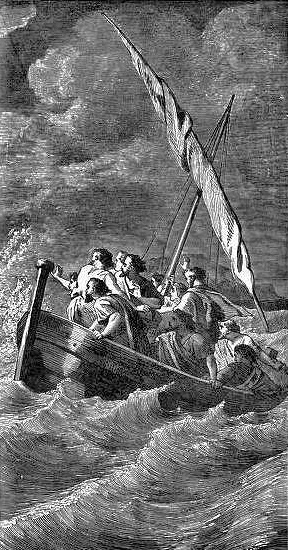
"Sometimes, my brethren, we feel discouraged because we have not kept our good resolutions, and are even ready to say it is better not to make any at all, so often do we break them. I have no doubt there are some listening to me who began the new year courageously and with some sincere promises to God of leading a good life, and have already slipped back into the bad old ways; and now they say, What was the matter with my good resolutions? I did not mean to lie to God, yet I have not kept my word with Him; I have relapsed; I am as bad as I was before, maybe I am worse. What, then, was the matter with my good resolutions?
Now, in considering this question let us not get into a panic. God knows us just as we are, and far better than we know ourselves. Therefore He is not so cruel as to hold us strictly to all our promises. "God is true and every man is a liar," says Holy Writ, and our experience of human nature demonstrates that although we are honestly determined to tell the truth, and do tell it, when we promise to God to behave ourselves properly, yet we know very well that in a moment of weakness we may break down, and that is understood when we make our promise. I remember reading of St. Philip Neri that sometimes on waking in the morning he would say, "O Lord, keep thy hand on Philip today or he will betray Thee."
Hence it is a great folly to say, "I do not want to make a promise for fear I could not keep it." That would be good sense if you were going to swear to your promise, or if you were to make a Vow. But a promise to attend Sunday Mass, to keep out of saloons, to stop stealing, to be more good-natured at home, and the like is a very different matter. In such cases we must shut our eyes and go ahead, and meantime pray hard for God's assistance.
There is such a thing as being too fidgety about the future, looking back too far into it or imagining temptations not likely to come up. Once there was an army officer who led an edifying life, and who came to a priest of his acquaintance and informed him that he was in great distress, and feared that he could not persevere. "What is the matter?" said the priest. "Why I know that duelling is a deadly mortal sin; yet if I were challenged to a duel I fear that I should not have the virtue to decline the challenge and suffer the disgrace which would be sure to follow." But," said the priest, "has any one challenged you or is any one likely to do so?"
"Oh, no! not at all;
but..." -
"But wait until the temptation comes. You have made up your mind not to commit mortal sin, and when this particular temptation comes God will give you grace to overcome it."
Do not cast your net too far out into the stream; do not be in a hurry to promise to abstain from any particular sin or to do any particular act of virtue for your whole life except in a general way. In a general way you are determined to keep God's law, honestly and firmly determined. As to this or that particular sin, you hate and detest it and have made up your mind against it; whenever the temptation comes you are resolved to resist it.
There are three things
about which one should make good resolutions rather than about any
others:
First, the practice of prayer;
Second, going to confession and Communion;
Third, avoiding the occasion of sins.
The first two fill our souls with God's grace and the third keeps us out of danger. Put all your good resolutions into company with prayer (and monthly, or at least quarterly), Communion; and you will have no great difficulty in pulling through. From month to month is not so long a time to keep straight, and a good confession and a worthy Communion is God's best help. Morning and night prayers are a mark of predestination to eternal life; keep away from bad company and dangerous places, and avoiding bad reading and all other dangerous occasions, has very much to do with an innocent life and a happy death."
Source: Five-minute Sermons, by the Priests of the Congregation of St. Paul 1893 (3rd Sunday after Epiphany)
Sunday Sermon: Example of Our Blessed Lady
by VP
Posted on Saturday November 16, 2024 at 04:00AM in Sunday Sermons

"Which is indeed the least of all seeds."-MATT. 13. 32.
1. Parable of encouragement.
2. Take example of our Blessed Lady: the least of all in her life.
3. What did she become? "Shall call me blessed."
4. Her position in the doctrine and her power in the devotions of the Church.
THIS parable of our Blessed Lord is meant for our encouragement. It teaches us that great results can spring from small beginnings. It teaches us that what the world sees is very, very different from what appears before the eyes of God. Humility, purity, obedience, patience are but of small account in the estimation of the world; but they are prized by the all-holy God, and great and wonderful are their results.
How plainly we realize all this, if we study it from an example: the example of our Immaculate Mother Mary herself. Contrast her life in this world, and her dignity, glory, and power, with which she is supremely blessed by God, now and for ever.
Picture, first, the humble house at Nazareth; the Virgin praying; the appearance and message of the Angel Gabriel; and her humility troubled at his saying. And when she had realized the tidings that he had brought, her meek and lowly answer, "Behold the handmaid of the Lord; be it done unto me according to thy word " (Luke 1. 38). No complacency, no exaltation at the dignity conferred upon her! Chosen to be the Mother of the Savior, she only said, "Because He hath regarded the humility of His handmaid” (ibid. 48).
And at Bethlehem - still the least of all seeds- "she brought forth her firstborn Son, and wrapped Him up in swaddling clothes, and laid Him in a manger, because there was no room for them at the inn " (Luke 2. 7). And outcasts again were the Child and His Mother, for the Angel warned St. Joseph to flee with them to Egypt for fear of King Herod. And the long years at Nazareth, where the child grew up - how poor, secluded, uneventful were they. How despised a life in the eyes of the world, for when her Son began His public life, was it not cast against Him, "Can anything of good come from Nazareth?" (John 1. 46).
Come to Calvary! Behold that poor, heartbroken Mother standing by the Cross on which her Son died, scoffed at, derided, blasphemed by those for whom He died. Well may unbelievers sneer at such an apparent failure the life of the Virgin Mother and the death of her Son! But we - thank God for the faith within us- deny the failure and humbly adore God's marvelous providence. The seed must die in the ground before the growth ensues. Yes, Mary was "the least of all seeds", indeed, but we see and believe and bless God for the result of her humility, her acceptance of the Will of God, her hidden life, her poverty, her sufferings. Behold the result! Immaculate Mary herself tells us,"Behold, from henceforth all generations shall call me blessed. Because He that is mighty hath done great things to me" (Luke 1. 48, 49).
This poor, unknown, sorrowful Virgin - what has she become? The Queen of heaven, the Queen of Angels and of Saints! Acknowledged, reverenced from the earliest ages of the Church with a love and devotion increasing as the centuries roll on. A new era began for her at the Resurrection of her divine Son. Then did she realize, as He appeared to her, glorious, impassible, and immortal, what it was indeed to be the Mother of the Savior, for this was the Child of Bethlehem, this the Victim of Calvary. And at the Ascension what a vision of the glory of heaven was revealed to her longing soul! Ten days after, when the Holy Ghost came down upon the Apostles and filled their souls with His marvelous gifts, even Mary's heart was enlarged, she realized that a new work was laid upon her-she became the Mother of the infant Church. For twelve years she remained with the disciples, a living answer to all who doubted that God had become man to redeem the world, for there still amongst them was found His Mother. From the earliest days there were self-opinionated men holding heretical doctrines, but one after another they failed and perished as true belief in Mary was taught and maintained by the successors of the Apostles. The powers of the wicked one, having ensnared the hearts of so many, were concentrated against our Blessed Lady. But the prophecy of old was verified, and the Virgin Mother "crushed the serpent's head" when, in the days of St. Cyril of Alexandria, at the General Council of Ephesus, it was declared as an article of faith that Mary was the Mother of God. The least, indeed, of all seeds had grown and become glorious in its triumph. The title "Mother of God" was the test of orthodoxy.
Not only did Mary become the test and strength of our faith, but hope in her, as the mediator with her divine Son, en-kindled piety and devotion to her.
Through succeeding ages the institution of festivals in her honor; the building of churches dedicated to her name; religious orders choosing her as their special patroness; the multiplication of devotions to win her compassion and her intercession-all these are the proofs of the glory of the Virgin of Nazareth.
Moreover, unlike the empires of this world that rise and fall, that for a space make the world resound with their prowess and their glory, and then pass away into oblivion, leaving scarce a shadow of a name behind - Mary's glory knows no decline! All these centuries has it existed, and now in our own age, in spite of all the evil and infidelity in the world, there is more widespread devotion, more public veneration, than ever. Proofs of this are plain. For witness, "the months of Mary," "the October Rosaries," the confraternities, the processions, the pilgrimages to Lourdes, the miracles that silence the tongue of slander. The whole world is the witness of these glories of Mary. Faith and hope are strengthened by remembering this example of the Mother of God. Let us devoutly ask of her to make us meek and humble of heart; to imitate now her poor and lowly life on earth, trusting that our Mother will welcome us to heaven and its glory hereafter." Short Sermons on the Epistles & Gospels of the Sundays of the Year By Fr. Francis Paulinus Hickey 6th Sunday after Epiphany
Sunday Sermon: A PURE INTENTION
by VP
Posted on Sunday November 10, 2024 at 09:56AM in Sunday Sermons

Do all in the name of the Lord Jesus Christ
"All whatsoever you do in word or in work, do all in the name of the Lord Jesus Christ."-COL. 3. 17.
I. Self the cause of failure.
2. A pure intention to do all for Christ blesses and ennobles all we do.
3. A little thing: fidelity needed.
4. The change it would work in us.
5. Examples of the saints.
How often in our life do we feel disappointed—yea, despondent-at finding so many of our good beginnings and endeavors turning out to be failures. Our confessions make this very evident to us. Do we not find that we have done the very things that we should not, and have omitted those that we should? It is not astonishing, for we are weak of purpose and prone to evil. Is it not very often because we thought that we of ourselves could do better; because it was self making the resolutions; self trying of its own powers to make its way to heaven? Whereas we should have obeyed St. Paul, "All whatsoever you do in word or in work, do all in the name of the Lord Jesus Christ."
A pure intention would have rectified so much and have saved us from many a failure. It is not what we do merely, but why we do it, that makes our lives words and works-pleasing unto God. For instance, even munificent charities can be made valueless in the sight of God, if vainglory and seeking the applause of men were the motives. On the other hand, even the widow's mite, given humbly, lovingly for Christ's sake, will find its eternal reward in heaven.
A moment's thought, the raising of our mind to God, the intending every word or work to be said and done in the name of Christ, for the love of Christ, would spiritualize our lives, and make of them an offering acceptable to God and blessed by Him with an eternal reward. And this pure intention, this morning offering, must be a daily work. We are so fickle, so inconstant, that even then self-love or yearning for praise will creep in. The fairest bud may have a canker in its heart.
No longer let our days be profitless for want of a little thought. With our morning prayers-yea, before them; as soon as our mind awakes-a moment's earnest thought will do-all for Jesus-and the day and all its thoughts, and prayers, and words, and works are offered to God and blessed by Him. "Do all in the name of the Lord Jesus Christ."
You may say that is a trifling thing indeed, and can that bless and ennoble our daily life? Yes, it is a little thing, but, as St. Francis of Sales says, "Little things are but little things, but fidelity in little things is a great thing." And the fidelity in making this pure intention, this offering to do all in the name of Jesus, and for the love of Jesus, is a great thing. For it is this being united to our Blessed Lord that gives its value, its eternal value, to all we do.
Let us picture to ourselves what this pure, heartfelt offering would mean. Sloth and tepidity would instantly stand abashed and ashamed. Sin and all desire for sin would be warned off, for our souls are giving themselves to Christ. The evil one would see that his plans and intrigues were detected and thus rendered powerless. In a moment the bright thought of Mass, of Holy Communion, perchance, would irradiate our soul. Our thought would question-Have we time? Can we make time for them? What an offering indeed to our dear Lord if we can; yea, a pleasing offering indeed for only wishing that we could. The daily toil, whatever it may be-laborious, poorly paid, wearisome-also, offered humbly, without a murmur, according to the blessed Will of God. Recording Angels are busy throughout the day adding up the wages due to such a worker.
This offering, made morning after morning, simple as it may seem, is certain to be lovingly received by our Lord. That blessing gives the value to everything, and graces flow down and intensify the love of the offering and the purity of the intention. Gain the habit, persevere in it, and by degrees you will find yourself renewing it time after time in the day. Every prayer will end by repeating it; every fresh work remind you of it. And especially after some little fall-temper, impatience, uncharitableness, whatever it may beat once, penitent but not disheartened, you will begin again more devoutly and trustfully than ever. Even a fall can help us to rise, through humility and sorrow, and receive fresh help and strength from God.
Yes, doing all with a pure intention for the love of Christ explains to us the mystery how the saints from such humble beginnings became so illustrious in their sanctity, and such models and encouragement to us all. It was because they were doing all for God that they were chosen from the lowliest employments and called to such noble work, in which they devoted their lives to the de fence of the Church and the salvation of countless souls. For instance: St. Vincent of Paul, tending his father's cattle-a slave in Morocco-and yet to become the father and founder of the Mission Fathers, the Dames of the Cross, and the Sisters of Charity. Behold the humblest of beginnings and the greatest of achievements. And St. Peter Damian, abandoned by his mother, feeding his brother's swine, patient in ill-treatment and starvation-and afterwards a monk, a bishop, a cardinal, a trusted counselor of Emperors and of Popes. And the shepherd,
St. Pascal Baylon! Was it not his pure intention, his union with God in
his lowly calling, that made him a saint? When he could not leave his
flock and attend Holy Mass, his soul was at the church, rapt in adoration at the very tolling of the Mass bell. His devotion to the Blessed Sacrament has been honored by the dignity conferred upon him by Pope Leo XIII., as “special and heavenly patron of all Eucharistic Confraternities." Yes, "little things are but little things," and the morning offering, and the pure intention of doing all for love of Jesus, is a little thing, but fidelity to it is a great thing. “All whatsoever you do in word or in work, do all in the name of the Lord Jesus Christ." Short Sermons on the Epistles & Gospels of the Sundays of the Year By Francis Paulinus Hickey (25th Sunday after Pentecost - Fifth Sunday after Epiphany)
