St. Louis Grignion de Montfort, missionary in Brittany and Vendée
by VP
Posted on Tuesday April 28, 2026 at 12:00AM in Saints
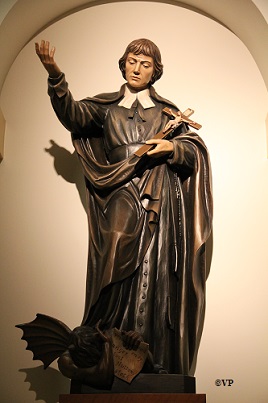
Saint Louis Grignion de Montfort, Saint Catherine of Siena Catholic Church, Wake Forest
"I believe that anyone who wishes to be devout and live piously in Jesus will suffer persecution and will have a daily cross to carry. But he will never manage to carry a heavy cross, or carry it joyfully and perseveringly, without a trusting devotion to our Lady, who is the very sweetness of the cross. It is obvious that a person could not keep on eating without great effort unripe fruit which has not been sweetened." -- St. Louis Marie Grignion de Montfort (Treatise on True Devotion to the Blessed Virgin)
Louis-Marie Grignion de Montfort (b. at Montfort-sur-Meu, Brittany 31 January, 1673; d. at Saint-Laurent-sur-Sèvre, Vendee 28 April, 1716.)
From his childhood, he was indefatigably devoted to prayer before the Blessed Sacrament, and, when from his twelfth year he was sent as a day pupil to the Jesuit college at Rennes, he never failed to visit the church before and after class. He joined a society of young men who during holidays ministered to the poor and to the incurables in the hospitals, and read for them edifying books during their meals. At the age of nineteen, he went on foot to Paris to follow the course in theology, gave away on the journey all his money to the poor, exchanged clothing with them, and made a vow to subsist thenceforth only on alms.
He was ordained priest at the age of twenty-seven, and for some time fulfilled the duties of chaplain in a hospital. In 1705, when he was thirty-two,
he found his true vocation, and thereafter devoted himself to preaching
to the people. During seventeen years he preached the Gospel in
countless towns and villages. As an orator he was highly gifted, his
language being simple but replete with fire and divine love. His whole life was conspicuous for virtues difficult for modern degeneracy to comprehend: constant prayer, love of the poor, poverty carried to an unheard-of degree, joy in humiliations and persecutions. The following two instances will illustrate his success. once gave a mission for the soldiers of the garrison at La Rochelle, and, moved by his words, the men wept, and cried aloud for the forgiveness of their
sins. In the procession which terminated this mission, an officer
walked at the head, barefooted and carrying a banner, and the soldiers,
also barefooted,
followed, carrying in one hand a crucifix, in the other a rosary, and
singing hymns.
Grignion's extraordinary influence was especially apparent in the matter of the Calvary at Pontchâteau. When he announced his determination of building a monumental Calvary on a neighboring hill, the idea was enthusiastically received by the inhabitants. For fifteen months between two and four hundred peasants worked daily without recompense, and the task had just been completed, when the king commanded that the whole should be demolished, and the land restored to its former condition. The Jansenists had convinced the Governor of Brittany that a fortress capable of affording aid to persons in revolt was being erected, and for several months five hundred peasants, watched by a company of soldiers, were compelled to carry out the work of destruction. Father de Montfort was not disturbed on receiving this humiliating news, exclaiming only: "Blessed be God!"
This was by no means the only trial to which Grignion was subjected. It often happened that the Jansenists, irritated by his success, secured by their intrigues his banishment from the district, in which he was giving a mission. At La Rochelle some wretches put poison into his cup of broth, and, despite the antidote which he swallowed, his health was always impaired. On another occasion, some malefactors hid in a narrow street with the intention of assassinating him, but he had a presentiment of danger and escaped by going by another street. A year before his death, Father de Montfort founded two congregations - the Sisters of Wisdom, who were to devote themselves to hospital work and the instruction of poor girls, and the Company of Mary, composed of missionaries. He had long cherished these projects but circumstances had hindered their execution, and, humanly speaking, the work appeared to have failed at his death, since these congregations numbered respectively only four sisters and two priests with a few brothers. But the blessed founder, who had on several occasions shown himself possessed of the gift of prophecy, knew that the tree would grow. At the beginning of the twentieth century the Sisters of Wisdom numbered five thousand, and were spread throughout every country; they possessed forty-four houses, and gave instruction to 60,000 children. After the death of its founder, the Company of Mary was governed for 39 years by Father Mulot. He had at first refused to join de Montfort in his missionary labors. "I cannot become a missionary ", said he, "for I have been paralyzed on one side for years; I have an affection of the lungs which scarcely allows me to breathe, and am indeed so ill that I have no rest day or night." But the holy man, impelled by a sudden inspiration, replied, “As soon as you begin to preach you will be completely cured.' And the event justified the prediction. Grignion de Montfort was beatified by Leo XIII in 1888." Catholic Encyclopedia 1910
Canonized: 20 July 1947 by Pope Pius XIISevere or a lax morality
by VP
Posted on Tuesday April 28, 2026 at 12:00AM in Documents

Curses Against the Pharisees (Imprécations contre les pharisiens) - James Tissot
"What medium is to be observed by a priest between a severe and a lax morality?
There have been priests in every age who have decided this question according to their own fancy and inclination, and priests will continue to do so in the future. There will always be doctors and preachers and directors of souls who, yielding to the prejudices and tastes of the age, or desirous of gaining the good will of individuals, or ambitious to make a name, will change the teachings of the Church, making easy or burdensome the yoke of the Lord; as if it were their right to broaden or make narrow the way to heaven; as if it were their privilege to substitute the changing and fallible opinions of men for the infallible and changeless law of the Gospel of Christ.
(...)
A good priest is certainly not a man who follows the mode of the world and its fashions; he is a man who is loyal to truth and loves order. The truth, then, is this, that laxity and severity are two extremes, both equally bad and dangerous and both skirting along the edge of the precipice.
And first laxity. It is condemned in every page of Holy Writ. Did not our Lord say: Narrow is the gate and strait is the way that leads to life? and again: I came not to send peace upon earth, but the sword? And does not He command what is hard and a trial to flesh and blood? To cleanse the heart of whatever is a snare to it and defiles it, to submit to humiliations, to deny oneself in all things, to return good for evil, to carry the Cross daily- this, in short, is the morality taught by Jesus Christ. This is but saying that the life of a Christian is a life of mortification and self-denial, and that to be a Christian in any true sense one must be generous and courageous, ready to struggle and willing to make war upon oneself and conquer. For this reason the Holy Council of Trent warns ministers of the Sanctuary against that excessive indulgence which causes sinners to slumber on in their sins and against becoming accomplices in disorders which they should combat and correct.
To wish to adjust the teachings of the Gospel to the solicitations of human passion, instead of subjecting human passion to the teaching of the Gospel; to set up principles from which deductions can be drawn indulgent to human nature, ever averse to mortification and self-sacrifice, is to open wide the door to laxity, to create false consciences and to cause the loss of souls under pretext of tranquilizing them. Woe to you who deceive the people, scatter lies and call them oracles; Woe to you who lead them astray and allow them to slumber on in false security! My hand shall be heavy upon you; the corruption of your false maxims shall be visited upon your heads, and in the end you shall know that I am the Lord. ( Ezechiel vi. 13.)
Next, severity. Faith and a decent respect for one-self will be enough to restrain one from disseminating in public or teaching privately a lax morality which is clearly in opposition to the spirit of the Gospel. But this is not true in regard to severity. An excessive severity flatters vanity and gains a reputation for sanctity. A priest who openly parades himself as one of austere life is reputed mortified and a man of irreproachable morals. This was the artifice made use of by the Scribes and Pharisees to lead the people astray and poison their minds with error. A stately walk, and imperious tone of voice, a cold and mortified exterior, long prayers, ceaseless censure of the most innocent actions, a haughty scorn of publicans and sinners, all this but served as a mask for their hypocrisy and was a fitting expression of the severe maxims which they disseminated. Their teaching were an additional burden, and made almost unbearable the already weighty and galling yoke of the Hebrew law. They laid upon others burdens which they themselves were unwilling to bear, and which they would not so much as touch with a finger's tip.
This is why the Lamb of God, who was so gentle and tender to others, who pardoned the woman taken in adultery, who had not even a harsh word for Judas who betrayed Him, nor for the executioners who crucified Him, had for the Scribes and Pharisees only words of scorn and anathema: WOE TO YOU!
And why was our Lord so severe upon them? because God is essentially loving and the Father of mercy, and nothing is so injurious to Him as to represent Him as a gloomy and terrible Master, ever armed with thunderbolts to annihilate us. It is, therefore, beyond all question that nothing is more detrimental to souls than to exaggerate the difficulty of being saved, and to put on grace a higher estimate than that put upon it by our Savior Himself. And after all, His ministers are but the interpreters of His law. If, on the one had, they are forbidden to conceal or disguise its true import and meaning or make it ineffective by unwarranted indulgence, they are, on the other, equally forbidden to render it odious and intolerable by culpable exaggeration.
(...)
It is necessary to keep a middle course between these two rocks and while avoiding one not get wrecked on the other. But to do this an exact and precise knowledge of the doctrine of Jesus Christ is necessary, in order to transmit it to the people just as He brought it from heaven, and just as the Church transmits it to us, without adding to it or taking from it a single iota.
Saint Paul of the Cross
by VP
Posted on Tuesday April 28, 2026 at 12:00AM in Saints

Statue of Saint Paul of the Cross, at the Vatican Basilica of S. Peter. By Ignazio Iacometti, 1876
"On the feast of the Holy Trinity, both said their first masses. Cold must be the heart, indeed, which is not moved with emotion at the first mass. It is that dread moment, when a man offers up in his own hands the Son of God to the Father for the first time. He sees his life, his hope, his all, in his hands, and that he has power to call Him, and that His honour whilst there is committed to his keeping. The smallest faith must realise these sensations to the newly ordained priest. What must be the measure of lively faith in that soul which had lived almost upon faith up to that very moment? A soul which seemed to touch and feel the very truths of our holy religion, so clearly did he apprehend them and so long could he remain absorbed in their mere contemplation. Paul said his first mass, of course, with that extra measure of delight which his perfection would lead us to anticipate. He is said to have received some special graces which made him ever look back to that event with, "Oh, what a sight!"
Custom or habit never brought F. Paul less fervour in celebrating mass. To the end of his life he had the gift of tears, and his humility made him continually repeat mentally to himself, as he approached the altar, "The hour cometh, and now is, when the Son of Man shall be delivered into the hands of a sinner." Often at the mysterious parts of the sacrifice was his face seen to glow with heavenly beauty. Often was he raised aloft in the air whilst contemplating his Incarnate God as he lay upon the corporal, and often again was he enveloped in a strange but lucid cloud. Such was the scene once witnessed and attested in the processes by an opulent and charitable man, named Dominico Costantini, who was serving the Saint's mass in the church of Sta. Lucia, in Corneto.
F. Paul was very particular with regard to the rubrics and ceremonies of the mass, and nothing offended him so much as to see the furniture of the altar either torn or stained. He considered it an offence in the whole congregation if their houses, and especially the pastor's, were like palaces, whilst the house of God was suffered to remain like a stable." (...)
"In the year 1733, they gave their first mission in Orbetello-this was what we should call the post-town of the place, and thus are we told of its fruits. This mission began in February. The attendance was very great; for besides the inhabitants of the town there was a new garrison quartered there, and the soldiers and officers with their wives swelled the audience. The influence of soldiers upon a country town is proverbial. They bring dissipation, amours, and open, or at least badly disguised immorality with them. In Orbetello this barefaced lewdness had gone so far that ladies made it a point to appear in church, in attire much more scanty than our fashionable full-dress. The Saint inveighed so strongly against this profanation that shoulders were moderately covered next night; he went a little further in his invectives, and the female portion of the audience were at length pretty modestly dressed. There was one Frenchwoman there who resented very much these restrictions upon the exhibition of female vanity, and determined to show her disapprobation of the whole business, at the same time resolving to defy the Saint and assert the right her sex lay claim to; namely, that of doing what they please, provided it be in the fashion. She planted herself just under the missionary's eyes, if possible, even more fully dressed than any of her companions had been. The Saint said not a word. He gave one severe reproving look at her, and in a moment her face, hands, arms, and shoulders, became as black as charcoal. All were horrified. She took out a handkerchief and tried to hide her deformity, but could not succeed-grace did its work, and at the conclusion of the sermon she was as demonstrative in the signs of her repentance as she had been at its beginning in those of her vanity and impudence. By the prayers of the Saint she recovered her former colour in a few days; but such was the effect of the incident, that about forty of the most respectable ladies in the town dressed henceforward almost in the garb of as many nuns."
"The Saint was so intent on God that he said one time,-"If anybody should ask me at any moment of the day, what are you thinking about? I think I should answer, of God." Everything reminded him of God, and set him a thinking on the divine perfections. He would be seen sometimes during his walks beating the flowers playfully with his stick, saying,— “Be silent, be silent." When somebody asked him why, he said it was because they were always preaching to him and speaking of God. It was remarked once that he went to say the Rosary in the woods, and after being there ever so long, absorbed in God, he had not got further than "Pater Noster" of the first decade. His faith was shown in everything which betokened its presence. The feasts of the Church, her rites and ceremonies, were observed by him with peculiar devotion and exactitude.
He reverenced priests from
the same principle of faith. Time, and his experience of all the
shortcomings and want of spirit which he was sure to discover, did not
lessen this respect. To the very end of his life he would rise before a
priest, if able. This is the more to be wondered at, as he was the
superior of priests so long himself, and had to administer correction to
them, as if they were pupils. No one could give him a greater offence
than by speaking ill of any priest, no matter how unworthy his life
might be. The hardest thing he was ever heard to say on this point, when
speaking of the great perfection to which priests might attain if they
would, was :— "Ah! how little faith is there in the world; if they
did but know how heavenly is their dignity, they would respect it more."
His devotion and attachment to the Church was equally wonderful. He could not endure the slightest word which, even by insinuation, threw a reflection on her practice. He would say in a stern tone to the author of any such remark, with S. Cyprian,—“ He who hath not the Church for a mother, cannot have God for a father. Would you treat your mother in that way?" When he heard of the evil machinations, which were then rife in Italy against the Church, he was inconsolable. Every book, pamphlet, or publication which touched the Church in any way he would burn if he could, and wished he could come across their authors, in order to reprove them publicly. On the other hand, those who wrote, or spoke, or acted on the side of the Church he could not honour or praise sufficiently. It was remarked that he was always very fond of the students of the Propaganda. He used to envy them their high and noble calling.
The Saint was very devout to the mystery of the Most Holy Trinity. He bowed his head always at the gloria patri, and severely reproved any of the religious who failed to do the same according to the regulations; and it was remarked that his most frequent ejaculation was Sanctus! Sanctus! Sanctus! He said that came from heaven, and its sound brought him there in spirit. His devotion was remarkable also towards the Infant Jesus, because he then contemplated the mystery of the Incarnation. He used especially to love to see an image of the Infant wrapped up in a few rags, on Christmas night, because, he said, "Oh, is it not humiliating to see Omnipotence like that; and nothingness like this, moving about in conscious strength ?"
His devotion found full expression in the presence of the Blessed Sacrament. There he could spend days and nights motionless in prayer. Until he had the Blessed Sacrament in a newly opened house he did not seem to be at all happy. Whenever he came near a town, as soon as he saw the church, he knelt down to adore the Blessed Sacrament kept there, and when he entered he went off straight to the chapel of the Blessed Sacrament, as if by instinct. The fruit of his missions used to be seen principally in the crowds of labourers who turned into the church every evening to visit the Blessed Sacrament as they came home from their work. He introduced this beautiful custom wherever he went.
Only his devotion to the Passion, which was the all-absorbing one of his life, could equal the devotion he had to our Blessed Lady. He began everything with her blessing. Nearly all his greatest favours were received on her feasts, and he was blessed with many surprising visions of her glory. He said one day to the students (the doctrine of the Immaculate Conception was not then defined),-" This doctrine (Immaculate Conception) has not been declared an article of faith by holy Church, but I would give my blood and sacrifice my life in torments in defence of it; and if by doing this I did not become a martyr, I am sure I should give great glory to this august Lady. Oh! happy me, if this might take place." In all his great troubles he used to say,-" These are times when the Blessed Virgin comes in to help." He never pronounced the name of Mary without bowing his head, or taking off his cap, after he began to wear one. Of course, the mystery of her life, which had the greatest attraction for him, was her sufferings at the foot of the cross."The Life of S. Paul of the Cross: Founder of the Congregation of Discalced Clerks of the Holy Cross and Passion of Our Lord, Usually Called Passionists 1867
St. Zita
by VP
Posted on Monday April 27, 2026 at 12:00AM in Saints

S.Zita (Michelangelo Pittatore)
THE GREATNESS OF HUMILITY.-St. Zita, placed by reason of her lowly birth in a position obscure, or vile even, according to the views of the world, knew how to lift herself by faith to the sublime heights of sanctity. She passed her life in domestic work, the object of hatred and calumny: her humility was too great, it was said, to be real; it was sheer hypocrisy. Her submission was too prompt and perfect to be exempt from pride; and if the poor servant were any better than people of her condition, it was merely because she wished to appear so. Zita, however, accomplished all her duties with that perfection which those who wish to please God are wont to employ. She bore reproofs, injuries, bodily and moral sufferings, with that patience and submission which the love of God alone knows how to inspire. She was pious, cherished the poor, and forgave injuries. At last the general voice ended by rendering her full justice, which she by no means looked for. The world was struck with wonderment, and the Church has placed her on her altars. St. Zita died at Lucca in 1272, and was beatified in 1696.
MORAL REFLECTION.-All acts in themselves good become acts of holiness when accomplished with reference to God. "All things are turned into good in the hands of those that love God," saith the Apostle.-(Rom. viii. 28.). Pictorial half hours with the saints. By Abbe Auguste François Lecanu
Priestly Vestments
by VP
Posted on Monday April 27, 2026 at 12:00AM in Tradition

My Catholic Faith: Catholic Priest Vesting, 1949
"Historians may discuss and dispute the time and circumstances in which the Christian priesthood began to use an altogether distinctive dress at the altar; but they have to agree that what was so used was held as sacred. The cloak which St. Paul seemed so careful about was early reported to have been his sacrificing robe. The same character was attributed to Thomas the Apostle’s mantle, long venerated at Rome. The centuries of persecution were not a time for elaborating ceremony or dress, yet pontiffs of the period are on record for restrictions in the use of the same garments at the altar and away from it, or by one order of the clergy and by another. The first pope who enjoyed the freedom of peace, St. Sylvester, introduced an improvement that still holds its ground: our sleeved dalmatics were prescribed by him. St. Jerome mentions the white robes of all ministers within the Sanctuary, as ordinary and long-established. Thence down through the centuries there are adaptations to place, or rite, or monastic or secular garb; but the insistence on sacred vestments, on their sacred significance and sacred employment, goes on ever increasing. Holy to the Lord, is the more and more exclusive mark on them, as on those who are privileged to wear them.
And here, my brethren, I have to call your attention to a point that may somewhat escape your notice – though when well considered it is found most practical. The holiness of the priestly vestments is very much for the priest himself. In blessing them the Church asks that the wearer may be fit and apt for so sacred a ministry; but she also implores that he may be filled with the grace of the Holy Ghost, rendered perseveringly agreeable to God, clad with chastity here and with immortality hereafter. ‘Tis particularly in the words she puts on his lips as he takes each vestment that we divine her maternal solicitude for her priest in person. All scriptural sanctities are invoked on him.
The amice, with which you may have seen him first cover his head and then tuck out of view all trace of his secular dress, is to be to him an unfailing helmet of salvation. Made white like his alb, and, in the very Blood of the Lamb, he is to be fitted for joys eternal. With the binding of his cincture, concupiscence is extinguished. His manipule tells of the exultant harvesting that will follow his tearful sowing; for of him and his fellow-laborers is it prophetically true that “going they went and wept, casting their seeds. But coming they shall come with joyfulness, carrying their sheaves” (Ps. 125). His Stole, the special ensign of the priesthood that is forever, proclaims his right to Everlasting Life and its beatitude; while his Chasuble, though bearing a Cross before and behind, is but the sweet yoke and light burden of the Master who give both the merit and the crown. So it is with these and the other sacred vestures he may have to put on. Panoplied round with them, and with the dispositions they suppose, he is invulnerable to the assaults of every malign spirit. Even human malignity had often to refrain; for Law recognized a peculiarly punishable atrocity in assaults on the vested priest.
To the devout faithful there is an attractive sacredness in the robes which come in contact with the Altar of God; for they vividly recall that Garment, the touch of whose hem was health and holiness. And as far, my brethren, as holy vesture can announce and preserve the sanctity of the wearer, the same faithful have good reason to rejoice. Assuredly they may be said to need nothing, after the grace of God, more than they need the holiness of their priests. God’s ordination carries with it that sanction and consequence. ‘Tis markedly the races and nations most devotedly attached to the chaste sacredness of the priestly character who have best maintained the worship of the Son of the Virgin, the Priest forever according to the order of Melchisedech." Source: By the Rev. G. Lee CSSP ( A Pulpit Commentary on Catholic Teaching: The liturgy of the ecclesiastical year, 1910)
SS. Cletus and Marcellinus, Popes and Martyrs, A.D. 89 and 304
by VP
Posted on Sunday April 26, 2026 at 12:00AM in Saints

"Saint Cletus was the third bishop of Rome, and succeeded St. Linus, which shews his eminent virtue among the first disciples of St. Peter. He suffered martyrdom under the Emperor Domitian. St. Marcellinus succeeded St. Caius in the bishopric of Rome in the year 296. He acquired great glory in those stormy times of persecution, and is always styled a martyr, though he did not actually shed his blood in the cause of religion,
Pleasure in serving God
by VP
Posted on Sunday April 26, 2026 at 12:00AM in Sunday Sermons

Bernhard Plockhorst
(1825–1907)
"Rejoice in the Lord always: again I say, rejoice."— Phil. iv. 4.
"It has often been noticed, my dear brethren, and we every day come across examples of it, that when things are going well men think very little about God and about the practice of their religious duties. We may almost say that, as things are at present, most men will not perform their duty to God unless they are driven to do so by something unpleasant and hard to bear. It is when a man is taken ill that he sends for a priest and makes his confession and receives the Sacraments; as soon, however, as he gets well it is only too probable that he will return to his old ways.
Now, this shows that the service of God is felt by a great many to be a heavy burden and yoke. And I am sorry to say that this feeling is not confined to those whose passions and low propensities are so strong as to hold them down for a great part of their lives in slavery and subjection to sin and vice. Many even of those who have freed themselves for the most part from this degrading bondage seem far from the possession of that spirit of holy joy with which every one trying to serve God should be filled. Many even of these seem to find the yoke of the Lord a heavy one: and if they do not cast it off, it is chiefly because they are afraid to do so.
Now, I am not going to say a word against the service of God which springs from the fear of the Lord, which is the beginning of wisdom.” The fear of God is not merely good-it is necessary for salvation. But it is only the beginning, not the perfection of wisdom. Moreover, it should not be the habitual dominant and constant motive of our religious life it should serve as a motive to fall back upon when higher motives are not felt. As St. Ignatius says: We should ask of God the grace to fear Him, so that if and when through our faults we grow forgetful of God's love, the fear of punishment may hold us back from offending Him. In other words, we ought, as a rule, to be serving God from love and holy joy rather than from fear and dread.
This is the teaching of the Holy Scripture, and especially of the great Apostle our patron, St. Paul. The text is but a sample of similar injunctions which might be found in every one of his Epistles "Rejoice in the Lord always: again I say, rejoice." Do not be always looking upon the service of God as a heavy burden and yoke to which you must be driven as a fear of punishment, but let that service fill your souls at all times with delight and satisfaction. This is what St. Paul enjoins. Why is it not so with us? Why should it be so?
Well, there are ten thousand reasons why the service of God should be delightful and satisfactory; but I can refer to one only this morning— one, however, of which I think that we can all feel the force. As a rule, the man who is carrying on a profitable and successful business is, so long as everything goes well, tolerably happy. You don't see him going about with a long face, and although he may grumble a little, as most men do, you can see that he does not mean it. Now, if this is the case in the midst of the uncertainties which are inseparable from all human transactions, what ought to be the satisfaction and contentment of a man who has seriously taken in hand the one necessary business? For how does the case stand with such a man? The man who has seriously taken in hand the business of saving his own soul must succeed - for him there is no such thing as failure. So long as he is willing he must be prosperous. And why? Because he has Almighty God as a partner. And God is ready to give him what I hope it is not irreverent to call unlimited credit. In this life he pours into his soul His heavenly grace, and this grace gives to all his actions a value which gives him a right to an eternal recompense. No action from morning to night, from week's end to week's end, but may be made profitable and fruitful, if done with a right intention, and, of course, if there is nothing sinful in it. This is the position in which any and every man may be placed and may remain if he so wills, and of the sense and judgment of a man who is not satisfied by such terms I have but a poor opinion." (Third Sunday after Easter - Five-minute Sermons from the Paulist Fathers 1893)
St. Mark, Evangelist
by VP
Posted on Saturday April 25, 2026 at 12:00AM in Saints

St. Mark the Evangelist by Valentin de Boulogne
St. Mark, Evangelist
"He was a disciple of St. Peter, and one of the Evangelists. Pray that the Gospel may be the rule of your life; and while you profess a faith of what it teaches, see that your practice be not a confutation of your profession. Pray for all those who read the Gospel, that they may not wrest it to their own perdition, through presumption and rashness; but being assisted by the same spirit, by which it was written, may be led into all truth.
St. Mark went into Egypt, and was the first who preached the Christian faith at Alexandria, where by his labours the Church was established, and by his example the faithful were trained up in that exact discipline conformable to the rules of the Gospel, that they were a pattern to all believers, and admired even by the enemies of their faith. And after having suffered great persecution, he was called to the reward of his labours, in the fourteenth year of the Emperor Nero. Pray for all who embrace the true faith; and for all the professors of it; that they may live up to the maxims of the Gospel, and give no occasion to unbelievers to blaspheme the name of Christ. There is nothing so scandalous, as a wicked life, joined with the true faith: it carries everywhere contagion with it, infecting both friends and enemies. There is nothing so provoking to Almighty God, as it involves a contempt of His greatest mercies, and therefore draws down His heaviest judgments. Pray for the reformation of all believers, that infidelity may not be the punishment of abused Christianity. (...)." The Catholic Year by Fr. John Gother
April 25. Rogation Days, Prayer without Ceasing
by VP
Posted on Saturday April 25, 2026 at 12:00AM in Tradition
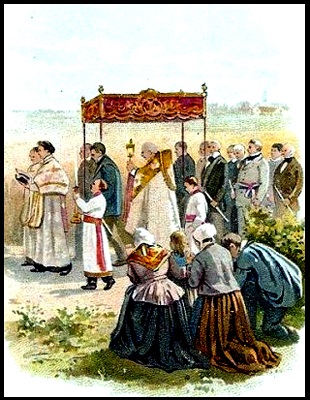
Prescribed days of prayer and penance in
spring. Two sets of rogation days were kept since early Christian
times: the Major Rogation on April 25, the Feast of St. Mark; and the
Minor Rogations on the last three days before Ascension Thursday. They
were instituted to appease divine justice, ask for protection, and
invoke God's blessing on the harvest. (Catholic Dictionnary, Catholic
Culture)
Rogation is simply an English form of the Latin rogatio, which comes
from the verb rogare, which means "to ask". The Monday, Tuesday, and
Wednesday before Ascension day, were called Rogation days or days of
solem supplication and prayer. On these days the priest and people went
in procession, singing the litanies, to beg God’s blessing upon the
fruits of the earth, and be preserved from pestilence, famine, ect.
(Right Rev. Dr. Challoner)
Litany of the Saints
Lord, have mercy on us.
Christ, have mercy on us.
Lord, have mercy on us.
Christ, hear us.
Christ, graciously hear us.
God the Father of Heaven, have mercy on us.
God the Son, Redeemer of the world,
God the Holy Spirit,
Holy Trinity, one God,
Holy Mary, pray for us.
Holy Mother of God,
Holy Virgin of Virgins,
St. Michael,
St. Gabriel,
St. Raphael,
All ye holy Angels and Archangels,
All ye holy orders of blessed spirits,
St. John the Baptist, pray for us.
St. Joseph,
All holy Patriarchs and Prophets,
St. Peter,
St. Paul,
St. Andrew,
St. James,
St. John,
St. Thomas,
St. James,
St. Philip,
St. Bartholomew,
St. Matthew,
St. Simon,
St. Thaddeus,
St. Matthias,
St. Barnabas,
St. Luke,
St. Mark,
All holy Apostles and Evangelists,
All holy Disciples of the Lord,
All Holy Innocents,
St. Stephen,
St. Lawrence,
St. Vincent,
SS. Fabian and Sebastian,
SS. John and Paul,
SS. Cosmas and Damian,
SS. Gervase and Protase,
All holy Martyrs,
St. Sylvester,
St. Gregory,
St. Ambrose,
St. Augustine,
St. Jerome,
St. Martin,
St. Nicholas, p
All holy Bishops and Confessors,
All holy Doctors, pray for us.
St. Anthony,
St. Benedict,
St. Bernard,
St. Dominic,
St. Francis,
All holy Priests and Levites,
All holy Monks and Hermits,
St. Mary Magdalen,
St. Agatha,
St. Lucy,
St. Agnes,
St. Cecilia,
St. Catherine,
St. Anastasia,
All holy Virgins and Widows,
All holy Saints of God, intercede for us.
Be merciful, spare us, O Lord.
Be merciful, graciously hear us, O Lord.
From all evil, deliver us, O Lord.
From all sin,
From Thy wrath anger,
From sudden and unprovided death,
From the snares of the devil,
From anger, and hatred, and all ill will,
From the spirit of fornication,
From lightning and storms,
From the scourge of earthquake,
From plague, famine, and war,
From everlasting death,
Through the mystery of Thy holy Incarnation,
Through Thy Coming,
Through Thy Nativity,
Through Thy Baptism and holy Fasting,
Through Thy Cross and Passion,
Through Thy Death and Burial,
Through Thy holy Resurrection,
Through Thy admirable Ascension,
Through the coming of the Holy Ghost, the Paraclete,
In the day of Judgment,
We sinners, We beseech Thee, hear us.
That Thou wouldst spare us,
That Thou wouldst pardon us, .
That Thou wouldst bring us to true penance,
That Thou wouldst govern and preserve Thy holy Church,
That Thou wouldst preserve our Holy Pope and all orders of the Church, in holy Religion,
That Thou wouldst humble the enemies of holy Church,
That Thou wouldst give peace and true concord to Christian kings and princes,
That Thou wouldst grant peace and unity to all Christian people,
That Thou wouldst recall all who have wandered from the unity of the
Church, and lead all unbelievers to the light of the Gospel,
That Thou wouldst confirm and preserve us in Thy holy service,
That Thou wouldst lift up our minds to heavenly desires,
That Thou wouldst give eternal blessings to all our benefactors,
That Thou wouldst deliver our souls, and the souls of our brethren, relations, and benefactors from eternal damnation,
That Thou wouldst give and preserve from harm the fruits of the earth,
That Thou wouldst grant eternal rest to all the faithful departed,
That Thou wouldst graciously hear us, Son of God,
Lamb of God, who takest away the sins of the world, spare us, O Lord.
Lamb of God, who takest away the sins of the world, graciously hear us, O Lord.
Lamb of God, who takest away the sins of the world, have mercy on us.
Christ, hear us,
Christ, graciously hear us.
Lord, have mercy on us. Lord, have mercy on us.
Christ, have mercy on us. Christ, have mercy on us.
Lord, have mercy on us. Lord, have mercy on us.
Our Father, who art in heaven, ....
Psalm 69
O God, come to my assistance; O Lord, make haste to help me.
Let them be confounded and ashamed that seek my soul.
Let them be turned backward, and blush for shame that desire evils to me.
Let them be presently turned away blushing for shame that say to me: ‘tis well, ‘tis well.
Let all that seek Thee rejoice and be glad in Thee. And let such as love Thy salvation say always: The Lord be magnified.
But I am needy and poor; O God, help me.
Thou art my helper and my deliverer: O Lord, make no delay.
V. Glory be to the Father, and to the Son, and to the Holy Ghost.
R. As it was in the beginning, is now, and ever shall be, world without end. Amen.
V. Save thy servants.
R. Who hope in Thee, O my God.
V. Be unto us, O Lord, a tower of strength.
R. From the face of the enemy.
V. Let not the enemy prevail against us.
R. Nor the son of wickedness have power to hurt us.
V. O Lord, deal not with us according to our sins.
R. Neither requite us according to our iniquities.
V. Let us pray for our Sovereign Pontiff N....
R. The Lord preserve him, and give him life, and make him blessed upon
the earth, and deliver him not up to the will of his enemies.
V. Let us pray for our benefactors.
R. Vouchsafe, O Lord, for Thy Name’s sake, to reward with eternal life all those who do us good. Amen.
V. Let us pray for the faithful departed.
R. Eternal rest give unto them, O Lord, and let perpetual light shine upon them.
V. May they rest in peace.
R. Amen.
V. For our absent brethren.
R. Save thy servants who hope in Thee, O my God.
V. Send them help, O Lord, from thy holy place.
R. And from Sion protect them.
V. O Lord, hear my prayer.
R. And let my cry come unto Thee.
Prayer
Let us pray.
O God, whose property is always to have mercy and to spare, receive our
humble petition: that we, and all Thy servants who are bound by the
chain of sin, may be the compassion of Thy goodness mercifully be
absolved.
Graciously hear, we beseech Thee, O Lord the prayers of Thy
suppliants, and forgive the sins of those that confess to Thee: that, in
Thy bounty, Thou mayest grant us pardon and peace.
In Thy clemency, O Lord, show Thine unspeakable mercy to us: that
Thou mayest both loose us from all the punishments which we deserve for
them.
O God, who by sin art offended, and by penance pacified, mercifully
regard the prayers of Thy people making supplication to Thee, and turn
away the scourges of Thine anger, which we deserve for our sins.
Almighty, everlasting God, have mercy upon Thy servant N, Our
Sovereign Pontiff, and direct him according to Thy clemency into the way
of everlasting salvation, that by Thy grace he may both desire those
things that are pleasant to Thee, and perform them with all his
strength.
O God, from Whom are all holy desires, right counsels, and just
works, give unto Thy servants that peace which the world cannot give:
that both our hearts, given over to Thy commands, and our times, the
fear of our foes removed, may by Thy protection be peaceful.
Inflame, O Lord, our reins and hearts with the fire of the Holy
Ghost: that we may serve Thee with a chaste body and please Thee with a
clean heart.
O God, the Creator and redeemer of all the faithful, grant to the
souls of Thy servants departed the remission of all their sins: that
through pious supplications they may obtain that pardon which they have
always desired.
Prevent, we beseech Thee, O Lord, our actions by Thy inspirations,
and further them by Thy assistance: that every word and work of ours may
begin always from Thee, and by Thee be likewise ended.
Almighty, everlasting God, who hast dominion over the living and the
dead, and art merciful to all, of whom Thou fore-knowest that they will
be Thine by faith and good works: we humbly beseech Thee, that they for
whom we intend to pour forth our prayers whether this present world
still detain them in the flesh, or the world to come hath already
received them out of their bodies, may, through the intercession of all
Thy Saints, by the clemency of Thy goodness, obtain the remission of all
their sins, Through our Lord Jesus Christ Who liveth and reigneth with
Thee, in the unity of the Holy Ghost, world without end.
May the almighty and merciful Lord graciously hear us. Amen
And may the souls of the faithful departed, through the mercy of God rest in Peace.
St. Fidelis of Sigmaringa, Martyr, A.D. 1622.
by VP
Posted on Friday April 24, 2026 at 12:00AM in Saints

For some time he practiced the law as a counselor at Colmar, with great reputation, but still greater virtue. He abstained from all invective, detraction, and whatever might affect the reputation of any adversary. He conceived a disgust, however, for a profession, which was to many an occasion of sin; and determined to enter among the Capuchin friars. He first received holy orders, and having said his first mass in their convent at Fribourg, he consecrated himself to God by taking the habit. From that moment, humiliations, mortification, and implicit obedience were his delight. In regard to dress and furniture, he always chose that for his own use, which was the least valuable and convenient. His life was a continued prayer and recollection; and at his devotions he seemed rather like an angel than a man.
When he had finished his course of divinity, St. Fidelis was employed in preaching and hearing confessions. He reformed many by his zealous labors, and converted several Calvinists. When a pestilential fever infected the Austrian army, he exercised wonderful charity in assisting the sick and dying. He also exerted himself indefatigably in composing differences between neighbors, and relieving those who were in distress. He was most devout to the Blessed Virgin, and regularly recited the holy rosary. By her prayers and those of other saints, he begged that he might shed his blood in the defense of the Catholic faith. His prayer was granted. For the Calvinists were so incensed against him, for his pious labors to convert them, that they murdered him in the year 1622, the forty-fifth of his age.
Pray for all who are engaged in the holy ministry, and laboring for the conversion of souls. To contribute to the conversion of a sinner, is something more excellent than to raise the dead to life. The soul, which from the death of sin is raised to the life of grace, passes from slavery to the devil, to the dignity and privileges of a child of God. By this divine adoption, she is rescued out of the abyss of infinite misery, and exalted to the most sublime state of glory and happiness, in which all the treasures of grace and of heaven are her portion for ever." The Catholic Year by Fr. John Gother