First Sunday of Advent: The Redeemer
by VP
Posted on Saturday November 29, 2025 at 11:00PM in Sermons

Cornelis Schut III (1629–1685)
"Your redemption is at hand.”—St. Luke xxi. 28.
SOLEMN and sublime thoughts should lift up our hearts at the beginning of this holy time of Advent. The anniversary of the coming of our Redeemer is at hand; and gratitude for that blessed coming bids us raise up the eyes of our soul, and reverently peer into the mystery of God's goodness in decreeing that a Saviour should be born to save His people from their sins. From all eternity the Almighty had determined to create mankind. From all eternity He knew of the fall, of man's sinfulness and rebellion against Him, so that it would come to pass, as the Scripture says, "It repented Him that He had made man" (Gen. vi. 6). His justice was outraged; His mercy despised. And poor fallen man, what could become of him? He could not retrieve the past. He could not atone for his own misdeeds. Was there no salvation for the human race? A God was needed to make reparation and atonement for the outrages against a God! for the outrages of unbelief, of blasphemy, of hatred, of the impurities, and of all the evils that spring up from the depraved hearts of sinners. Then was the mystery of love declared that astounded heaven; that caused countless angels to rebel; for poor fallen man was to be more honoured than themselves. The second Person of the Blessed Trinity willingly offered Himself to come to the rescue of mankind. As God, He could not suffer, but a body and a soul united to the divine Person, and behold Emmanuel-God with us, our Redeemer! "Behold! I come," He said. A Man to suffer; a God to offer! The justice of the Almighty to be placated; His mercy to be thanked; His love to be requited! And the gates of heaven to be opened to repentant man. This is the tidings of great joy that Advent brings to the faithful.
But how little did the world understand of the divine mercy that was to come! True, God's chosen people knew that a Messias, a Saviour, had been promised. The prophets had spoken of Him. Devout men had longed for His coming and prayed that they might live to see it. But as time went on these holy aspirations faded, and in a very different and earthly way the children of Israel looked for their deliverer. A leader, a ruler to establish an earthly kingdom, a prince of peace was their expectation. Vague was their knowledge, and their yearnings were for something infinitely lower than what was to come. Not an earthly kingdom but a heavenly one was their Saviour to establish, not transient glory that would shortly perish, but immortality amidst indescribable splendour and happiness. He was to come not to rule merely, but to love mankind. He was to come, not to be inaccessible and seldom to be seen, but to be with them, one of them, whose delight was to be with the children of men.
Oh how blessed are we, who know so well this Saviour, "this most high God and our Redeemer "(Ps. lxxvii. 35). He that had been promised, came not only for the people of Israel, but for all mankind. He came to "save His people from their sins" (Matt. i. 21). Let us realize it more intimately. He came not simply to proclaim a universal pardon for all the multitude of the children of men. He came for me! To pardon me, to win my love, my loyalty: to recognize me as His child for whom He had opened the gates of heaven. And is this all? What could hope expect more than this? If He had brought us redemption once, would not this have been an infinitely bountiful mercy?
Let us bow down in humble confusion as we think of this! Forgiveness once; restored to our heavenly Father's favour once! An eternity of thankfulness would not suffice to pay for such a mercy. But what is the reality? Oh! the times and times that He has poured out upon our souls His "copious redemption." Our very sins bring out His mercy more and more. We are the children of the merciful goodness of God! Let us recall with grateful hearts the times without number that our redemption—our forgiveness—has been renewed. It is always at hand indeed. An act of sorrow; a humble owning of our sins; and He that came to redeem His people from their sins ratifies the words of absolution, and our sins are forgiven us once again. And our relapses, what do they mean? Do we not believe in our forgiveness? Do we despise it? Are we not trespassing on the Almighty's patience, tempting Him to repent that He made us?
Let us resolve that this rejection of God's pardon shall never occur again. But as this blessed anniversary of the coming of our Saviour approaches, let us prepare our hearts to receive Him and bid Him welcome. No wonder good people rejoice at holy Christmas-time ! It is not a mere memory of the redemption that came, but it is an actual redemption that comes again to the souls of men. How many anniversaries of His coming have we celebrated, and yet we are no better than we are! To so many in the world the message of Advent finds no admittance to their hearts. But to us it must not be so. We must prepare a home for Him, lest the first coming should be repeated: "He came unto His own, and His own received Him not " (John i. 11). Short Sermons on the Epistles & Gospels of the Sundays of the Year by Rev. Fr. Francis Paulinus Hickey
Feast of all Saints: The Church reviews Her Successes
by VP
Posted on Saturday November 01, 2025 at 02:00AM in Sermons
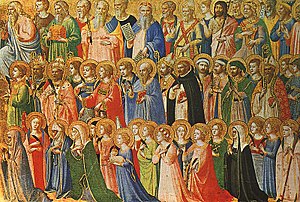
Fra Angelico: The Forerunners of Christ with Saints and Martyrs
"Our yearly liturgical course in living with Christ is fast drawing to a close. That is the reason why these last Sunday Masses have been showing us various aspects of the final reckoning when Christ our Judge will examine us to see how we have profited by all those countless opportunities of grace lavished upon us in every Sacrifice and sacrament throughout the year. What therefore could be more natural for us than, finding within ourselves the same un-Christly Christians as of yore, to feel a sense of frustration at the thought of so great a discrepancy between what was expected of us and what we have actually achieved? Can the liturgical life really be so marvelous a thing, if it shows so little proof of its power in our own daily living? Just such a sense of discouragement on our part the Church seems to have anticipated. For right here, almost at the close of her annual course, she gives us in review a veritable pageant of successful lives lived by those whom she has already graduated into eternity summa cum laude.
These multitudes of human beings from every race and nation, from every clime and century - what are they, one and all, but drops of water in the vast ocean of Christ's redemptive work? Each one, as a member of the Mystical Body on earth, has not only been saved thereby but has also helped to "fill up those things that are wanting of the sufferings of Christ,...for his body, which is the Church." Col. 1:24. Douay-Rheims.
The ocean of redemptive merits became so vast a thing in its multiple human aspect that we could only gaze in wonderment at its unfathomable extent and depth. This is why, for those of us who are able to go to weekday Mass, the liturgy allowed us to examine this redeeming accomplishment of Christ a drop at a time, while we celebrated the feast days of the saints. Thus holding up a tiny particle of Christly glory to the great sun of God's infinite perfections, we could study their separate rays as they were refracted in the various hues of those personalities through which they passed. For the divine attributes, incarnate in mortal men, are, as it were, split into tiny human colors, so that we may more easily study them and try to adapt them to our own poor way of life.
To say, for instance, that God is love does not pass beyond the cold, clear realm of our intellect. But to learn that Francis of Assisi, in reflecting this divine charity, loved every flower and bird and uncouth clod of humankind to romantic folly, has set seven hundred years ablaze. When we are told that God is good, we nod assent and stifle a yawn. But when we read that a Peter Claver, filled to the brim by a participation in this goodness, could spend years of devoted service amid the nauseating slave ships in his endeavor to salvage souls for eternity- ah! then we begin to think that goodness is something real after all.
Thus through this past year the Church has carefully marshaled before us her procession of successes, men, women, and even children. All from the dawn of Christianity have chosen to live the Christ-Life to its fullest extent, regardless of the cost. Each of these heroes has paid in some way the price of life itself, if not by the actual shedding of his blood, then at least by the slow and relentless extermination of self in every form, so that it might be no longer he that lived but Christ in him.
Since, however, the vast majority of Christians, unable to go to daily Mass, cannot study this pageant of Christ's heroes gradually throughout the year, the Church has set aside this feast as a day of obligation. Now all her members may see in one grand review all those whose outstanding success bears witness to the potency of the Christ-Life as lived in and through the liturgical signs which make that Life an ever present reality.
Also the Church's object in thus honoring her heroes is to make us realize her great doctrine, the Communion of Saints. This is that celestial plan of distributive wealth, whereby the millionaires of heaven from their own abundance may effectively subsidize us, their needy brethren. This means that through the very special grace of today's feast of All Saints, we may fill our souls to overflowing with all the riches of Christ's members, who have traded with their talents so as to enrich not only themselves but also their brethren of every age and race and nation." Companion to the Missal, Sister M Cecilia OSB
"Oh! (...) My brethren, let the world have its gods and worship them; let it have its wisdom, which is foolishness with God; let it deride and mock at penance, at asceticism, at Religious vows, at practices of humiliation, at pilgrimages, at devotions, at prayer itself. But let us remember that Christ, and His Church after Him, have cursed the world. Voe Mundo! Let us stand firm, though power, and wealth, and culture be in conspiracy against us. Let us stand firm, though we be persecuted and vilified, and our name cast out as evil for Christ's sake. Let us keep the faith. Let us be imitators of the Saints as they also were of Christ. Let us fix our eyes on the end of all things, on the prize of our high calling in Christ Jesus. Let us never forget those words, so full at once of terror and consolation: "Then shall the just stand with great constancy against those that have afflicted them and taken away their labors. Those seeing it, shall be troubled with terrible fear, and shall be amazed at the suddenness of their unexpected salvation, saying within themselves, repenting, and groaning for anguish of spirit: These are they, whom we had sometime in derision, and for a parable of reproach. We fools esteemed their life madness, and their end without honor. Behold, how they are numbered among the children of God, and their lot is among the Saints." Sermons by the Fathers of the Society of Jesus, Vol. 3, Feast of all Saints.
