Saint Blaise, Bishop and Martyr, A.D. 316.
by VP
Posted on Monday February 02, 2026 at 11:00PM in Saints

Saint Blaise, Brittany, France
"He was bishop of Sebaste, in Armenia, in the primitive times, when prelacy was the recompense of virtue, and almost a certain way to martyrdom. The business of his life was the care of his flock; in which he laboured with wonderful zeal for discharging his own conscience, and supporting theirs, amidst the dangers of those difficult times. Pray that this may be the spirit of all the prelates and pastors in Christ's Church; and make your address to God in behalf of that people, who having preserved Christianity, are yet unhappily separated from the Church. Pray for unity and peace among Christians; and all schisms being healed, they may be all of one spirit and one mind.
The persecution
being very severe, though he earnestly desired to suffer for Christ,
yet he retired into a cave, that he might, in that shelter, be capable of giving
some assistance to his people. But, being discovered, he was seized by
Agricolaus, president under Dioclesian: and after many torments, put to
death by the sword. Pray for patience under all trials, both for yourself and others. Pray that you may learn the true practice of retiring in time of persecution and danger: and remember that the persecution of friends is many times much greater than that of enemies. You are oftener in danger from flattery, than from the sword. While the one threatens your body, and the other your soul, consider whether in this there be not the greater obligation of withdrawing. Pray then for this grace, that you may be ever upon the watch, in observing the many snares and occasions of sin,
into which your most familiar acquaintance are apt to draw you. Happy
are you, if you choose rather to lie hid, than expose yourself to
danger. In this you may disoblige friends, and provoke their raillery;
but you will certainly please God, and draw down plenty of heavenly blessings on your head: and is not this the more Christian part? The courage and constancy of the martyrs condemn your weak resolutions, your pusillanimity and cowardice in the pursuit of virtue. But now at least begin your conversion with great fervour." The Catholic Year by Rev. Fr. John Gother
"When St. Blase arrived at the city and was presented to the governor, he was commanded to sacrifice to the immortal gods. The saint answered: "What a title for your demons, who can bring only evil on their worshipers! There is only One Immortal God, and Him do I adore." Agricolaus, infuriated at this answer, caused the saint to undergo a scourging so prolonged and cruel that it was thought the saint could not possibly survive it; but having endured this torture with placid courage, he was sent to prison, where he continued to work miracles so extraordinary that the governor ordered him to be again lacerated with iron hooks." Source: Victories of the Martyrs: Or, The Lives of the Most Celebrated Martyrs of the Church, Saint Alphonse de Liguori
"The iron combs, hooks, racks, swords, and scaffolds, which were purpled with the blood of the martyrs, are eternal proofs of their invincible courage and constancy in the divine service. But are they not at the same time subjects of our condemnation and confusion? How weak are our resolutions! How base our pusillanimity and cowardice in the pursuit of virtue! We have daily renewed our most sacred baptismal engagements, and our purposes of faithfully serving God; these we have often repeated at the feet of God's ministers, and in presence of his holy altars, and we have often begun our conversion with great fervor. Yet these fair blossoms were always nipped in the bud; for want of constancy we soon fell back into our former sloth and disorders, adding to our other prevarications that of base infidelity. Instead of encountering gibbets and wild beasts, we were scared at the sight of the least difficulty, or we had not the courage to make the least sacrifice of our passions, or to repulse the weakest and most contemptible assaults of the world. Its example, or that dangerous company from which we had not resolution to separate ourselves, carried us away; and we had not the courage to withstand those very maxims which we ourselves condemn in the moments of our serious reflections as contrary to the spirit of the Gospel. Perhaps we often flew back for fear of shadows, and out of apprehensions frequently imaginary, lest we should forfeit some temporal advantage, some useful or agreeable friend. Perhaps we were overcome by the difficulties which arose barely from ourselves, and wanted resolution to deny our senses, to subdue our passions, to renounce dangerous occasions, or to enter upon a penitential life. Blinded by self-love, have we not sheltered our dastardly pusillanimity under the cloak of pretended necessity, or even virtue?"Source: St. Blaise (The Lives of the Fathers, Martyrs, and Other Principal Saints, Volume 1 , Alban Butler p 46)
Prayer:
"O glorious Saint Blaise, who by thy martyrdom didst leave to the Church a precious witness to the faith, obtain of us the grace to preserve within ourselves this divine gift, and to defend, without human respect, both by word and example, the truth of that same faith, which is so wickedly attacked and slandered in these our times. Thou who didst miraculously restore a little child when it was at the point of death by reason of an affliction of the throat, grant us thy mighty protection in like misfortunes; and, above all, obtain for us the grace of Christian mortification together with a faithful observance of the precepts of the Church, which may keep us from offending Almighty God. Amen."
Source: Dom GuerangerPurification of the Blessed Virgin Mary, Candlemas (Presentation of Our Lord)
by VP
Posted on Sunday February 01, 2026 at 11:00PM in Tradition
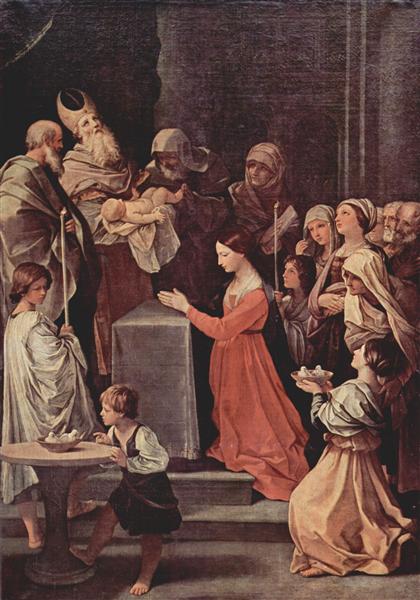
The purification of the Virgin Guido Reni
"On this day, on which we celebrate the purification of the blessed Virgin Mary, consider if you have not sufficient motives to oblige you to undertake your own purification. How much do you want of those holy dispositions, which brought the blessed Virgin this day to the temple? Though you can never hope to obtain either humility or obedience to equal hers; yet the distance between you and her gives scope to your endeavors to advance many degrees beyond what at present are. You have a wide field open before you, wherein to work upon yourself, and make some progress towards that purification, without which you can have no advantage in this day's solemnity.
Candles being blessed and distributed on this day, in memory of Christ's being acknowledged and declared the light of the Gentiles, in taking a candle you are to confess Christ to be the true light of the world, and beg that He will mercifully please to be a light to you, both living and dying. If you follow Him, He will be a light to your feet, and conduct you into the ways of true humility and obedience, who in submission to His Father's will, humbled Himself even to the death of the cross. By His help, you will soon discover all the frauds of your treacherous nature; you will learn to unmask all those vain pretexts, by which you are so often misled, and plainly distinguish between the dictates of self-love or corrupt practice, and the commands of God.
It is for want of this light that you so often go out of the way; while, as in the absence of the sun, you set up other lights in his place, so in not having the light of Christ and His justice to direct you, you substitute in His place a false light, and a false justice to be your guide. To how many unavoidable dangers must you then be exposed, when the way in which you are obliged to walk is so very narrow, and attended with precipices on every side? How can you here go on with any safety, when you have nothing before you but false lights, which confound the sight, and often blind your eyes?
This is the true cause of all the errors, injustices, and wickedness in the world. Men go on in the most unwarrantable ways, and they all have their reasons, which give them a sort of assurance and satisfaction in what they do: they have a kind of light which ever accompanies them, but they are not sincere in examining what light it is. They are not solicitous to take Christ with them; and then the enemy is ready enough to offer them false lights in his place. Their deceitful nature is too ready to accept them, because they lead to what pleases. Hence many taking but one false step in the beginning, it is often followed by most destructive consequences, which are almost irrecoverable. Hence we see a world almost entirely corrupt, and even great numbers of those who pretend to salvation, living in the practice of daily frauds, injustice, and oppressions; in most notorious disorders of prodigality, pride, self-love, and intemperance: and yet all generally persuading themselves that things are well enough. Thus blind and deluded they go on, till the entrance into eternity opens their eyes.
And how will you escape this misfortune; being equally subject to the same misery with others, of deceiving yourself? You have no other means to prevent it, but by making choice of that divine light, which is this day offered you, even Christ Himself. Beg therefore earnestly, that He will ever be a light to you: commit yourself to His guidance: have great confidence in His assistance; begin nothing without Him; submit with humility and obedience to all the ways of His commands and providence; and be ever on the watch, that no consideration of yourself, or the world, may draw you out of this way. Beg of Jesus, to let His light go before you, and to give you so sincere and docile a heart, as ever to follow where He directs." The Catholic Year by Rev. Fr. John GotherTradition: the churching of women
- Some traditional customs of the church can raise hackles. One of those of recent memory is something called “the churching of women.” Many people — incorrectly — believed that women were not allowed to return to Mass after childbirth because of some impurity on their part. While no longer common in the church, this ritual took place until the liturgical changes after Vatican II in the early 1970s and involved the return of mothers to the celebration of Mass after the birth of a child. Why women stayed away from church after a birth? Compass, Official publication Catholic Diocese of Green Bay, Wisconsin By Patricia Kasten | Catholic News Service | February 1, 2015
- "Instruction for women after Childbirth: "Churching of women"The law of purification in the Old Testament, it is true, no longer applies to Christian women, because the Church has done away with Jewish ceremonies. But the spirit and intention of that law the Church would yet have complied with. She permits women, therefore, to remain at home, with a good conscience, for six weeks after childbirth, or so long as circumstances may require, without attending divine service, in order to care for their health. This permission is, at the same time, an excellent admonition:
- to women: that, in order to their recovery, they should refrain from anger, from exposure, from hard labor, from injurious food;
- to men: not to refuse their wives during this period, set apart by God Himself under the Old Law, the rest and attention which their nature requires.
But when this time is past the Church desires that women, should, after the example of Mary, repair to the church with their children, to procure the blessing of the priest, to give thanks to God for their safe delivery, to dedicate their children to Him, and to implore of Him, with the priest, grace to bring up their offspring in piety and holiness. In this consists the so-called "churching of women"; and, from what has been said, it is evident, not only that it contains nothing to be ashamed of, but that it should by no means be omitted by such as desire God's blessing. "
Goffine's Devout instructions on the Epistles and Gospels for the Sundays and holydays:1896
Month of February: The Holy Family
by VP
Posted on Sunday February 01, 2026 at 02:00AM in Monthly Devotion

Holy Family, Saint Joseph Catholic Church Raleigh NC ©CAPG
February: Month of the Holy Family
A prayer to the Holy Family for the fulfillment of our Christian duties.
Jesus,
Mary and Joseph, bless us and grant us the grace to love our Holy
Church as we ought above all earthly things, and to show our love for it
always and with the evidence of deeds. Our Father, Hail Mary, and Glory be to the Father
Jesus,
Mary and Joseph, bless us and grant us the grace to profess, as we
ought, openly, with courage and without human respect, the faith we
received as a gift with holy baptism. Our Father, Hail Mary, and Glory be to the Father
Jesus,
Mary and Joseph, bless us and grant us the grace to co-operate in the
defense and propagation of the faith, as we ought, in the manner proper
to us, by means of our words, our substance, and even the sacrifice of
life itself. Our Father, Hail Mary, and Glory be to the Father
Jesus,
Mary and Joseph, bless us and grant us the grace to bring our life, as
we ought, into perfect conformity with the precepts of the law of God
and of the church, that so we may always live by the charity of which
they are the expression. Amen. The New Raccolta 1903 Pope Leo XIII, May 17, 1890
Virtue: Humility
Whoever humbleth himself, shall be exalted.-Luke, xiv: 11
"Humility is the foundation of all the virtues; therefore, in a soul where it does not exist, there can be no true virtue, but the mere appearance only. In like manner, it is the most proper disposition for all celestial gifts. And, finally, it is so necessary to perfection, that of all the ways to reach it, the first is humility; the second, humility; the third, humility. And if the question were repeated a hundred times, I should always give the same answer. St. Augustine."
The Holy Family
O, to have dwelt in Bethlehem
When the star of the Lord shone bright!
To have sheltered the Holy wanderers
on that blessed Christmas night;
Tho have kissed the tender way worn feet
Of the Mother undefiled,
And with reverent wonder and deep delight,
To have tended the Holy Child!
Hush! such a glory was not for Thee;
But that care may still be Thine;
For are there not little ones still to aide
For the sake of the Child divine?
Are there no wandering pilgrims now
To thy heart and thy home to take?
And are there no mothers whose weary hearts
You can comfort for Mary's sake?
Work for God (Septuagesima)
by VP
Posted on Saturday January 31, 2026 at 11:00PM in Sunday Sermons

Christian Wilhelm Ernst Dietrich: Parable of the Workers in the Vineyard
"Why stand you here all the day idle?"-Matt. xx.
"We are all called by God, my dear brethren, to labor in His vineyard. That is to say: we are called to serve God faithfully; to fulfil His Divine will; to observe His laws and precepts; to avoid the evil He forbids, and to do the good He prescribes. And we are not only called, but we are strictly bound to fulfil all that is included in this service of God. We are bound in justice, we are bound by gratitude to labor in God's vineyard for His honor and glory, for the salvation of our souls.
God has a supreme right to our service. We are His creatures. It is God who created us, who called us out of nothing. To God we owe our life; to Him we owe the preservation of that life during every moment of existence. And therefore does St. Paul say, "In Him we live and move and have our being." Thus we are entirely dependent on God: we belong to Him, and He has supreme jurisdiction over us; He has the right to prescribe how we should live, how we should serve Him. There can be no exception to this law; He has the sole right to require every one to labor in His vineyard. Where there is a right, there must also be a corresponding duty. It is God's right to command the service of every one; it is the duty of every one to obey.
Hence there can be no idlers in God's vineyard; no man can offer the excuse that he has not been hired.
Every act of neglect of God's service, every evasion of His law, is always an act of injustice. Every sin has, besides its specific malice, the malice of injustice. Every idler in the vineyard of the Lord is in a state of sin; if he says that he has not been hired, he is a liar. God hires every man who comes into this world.
Besides the claim God has on us in justice, He has also a claim on our service by reason of the Redemption. We belong to Him because of the price He has paid for our salvation. "He has redeemed us at the price of His Precious Blood." Justice makes us serve Him, but higher than justice is the claim of love. And His Love constrains us to obey Him. Love makes Him sovereign Lord and Master. We belong neither to the world, nor to the devil, nor to ourselves: we owe nothing to them; we owe everything to Him whose love for us has moved Him to buy us with His blood. And so it is, my brethren, that every act of rebellion against God's law is always an act of ingratitude as well as injustice; every sin, besides its special malice, has the malice of injustice and ingratitude.
What pitiful, what hardened creatures we are when we forget these plain truths: when we act as though we were a law unto ourselves, and practically act as though we are responsible to no one. How dull is our sense of justice, how hardened is our heart when we can forget or ignore God and the claims He has upon us. We let the devil rule us, we make passion our master, we lift up self in place of God.
Are there any amongst us here this morning who have forgotten what they owe to God? Are there any whose years of sin and neglect of God have made them so deaf that they cannot hear His call to them; who do not know that their place is in His vineyard? To such as these does God now say, "Why stand you idle?" You who have wasted the morning, the noon, perhaps the evening of life in idleness, in sin; "go you into my vineyard"; there is still a chance for you to redeem the wasted time. Wake up out of your lethargy. Shake off the stupor that unhallowed pleasure and secret sin have cast over you. Smash the chains that have bound you to the service of the devil, the slavery that has smothered within you every instinct of justice, every worthy prompting of the heart, every noble aim in life. "Why stand you here idle?" This is the call of God to you. Go you into the vineyard of His service. What though for years you have neglected His call, His mercy is still near you, and He will pay you what is just— will pay you with life eternal.
We are now on the threshold of Lent - the special season of prayer and penance. Be no longer idle. Enter upon God's service with courage, with honest zeal, with firm hope in God's mercy. Begin at once - begin with a good confession. God is now calling you; for many of you it is even now the eleventh hour; for many of you this call may be the last."
Source: Five minutes sermons for Low Masses for every Sundays of the Year by the Priests of the Congregation of Saint Paul 1893
Saint Brigid Patroness of Ireland
by VP
Posted on Saturday January 31, 2026 at 11:00PM in Saints

LOVE OF GOD AND YOUR NEIGHBOR.-St. Brigid, patroness of the Irish, who esteemed her as a second Mary, was born in the year of our Lord 453, and from an early period of her life devoted herself to the service of God. The sanctity of this consecrated maiden has been justly celebrated by the Venerable Bede and other great writers, who described her as having been constantly occupied in holy contemplation or the active exercise of charitable works. She founded the far-famed monastery of Kildare, where she lived as abbess, and died in the year 523, after having glorified God for long years by the many virtues and miracles recorded in her history. With the example of this holy virgin before them, the Irish youth of both sexes made rapid progress in the acquisition of all those eminent characteristics which secured for them, through many ages, the designation of children of the Saints.
Moral Reflection: -Let us always bear in mind that,
no matter what our state of life may be, we can sanctify ourselves by
communing with God, and contributing to our neighbour's edification.
"Thou shalt love the Lord thy God with thy whole heart, and with thy
whole soul, and thy neighbour as thyself." Pictorial half hours with the saints by Rev. Fr. Auguste François Lecanu LeCanu 1865
Prayer:
"O holy St. Brigid, thou who art the light, the ornament, and the glory of the Church of Ireland, be the heavenly patron of its people, and be the especial friend and the protectress of the priests of the sanctuary. Let those who offer sacrifice to the name of God, be worthy of their exalted duties.
Shew forth in their lives the form of all
perfection and cover them with the robe of holiness. Let them love
justice and hate iniquity. Let their prayer be like incense in the sight
of heaven. Let their doctrine be saving and salutary to the people, and
let the odor of their lives be the delight of the Church of God." Source: Ecclesiastical Meditations, page 254
Saint Ignatius of Antioch, Bishop and Martyr, A.D. 107
by VP
Posted on Saturday January 31, 2026 at 11:00PM in Saints
"16. Do not be deceived, my brethren. Those who ruin homes will not inherit the kingdom of God. Now, if those who do this to gratify the flesh are liable to death, how much more a man who by evil doctrine ruins the faith in God, for which Jesus Christ was crucified! Such a filthy creature will go into the unquenchable fire, as will anyone that listens to him.
17. The Lord permitted myrrh to be poured on His head that He might breathe incorruption upon the Church. Do not let yourselves be anointed with the malodorous doctrine of the Prince of this world, for fear he may carry you off into captivity, away from the life that is in store for you. Why do we not all become wise, having received knowledge of God, that is Jesus Christ! Why do we perish in folly, failing to appreciate the gift which the Lord has sent us in truth!" Source: St. Ignatius of Antioch Epistles To the Ephesians, 1946 p 66.
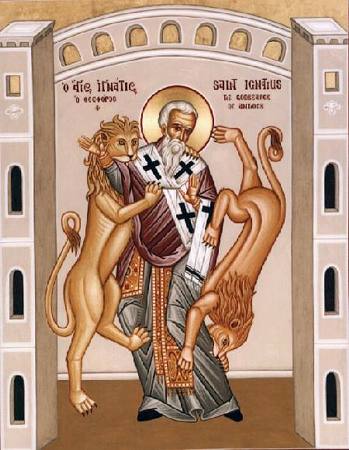
"He was the third bishop of Antioch after St. Peter and Evodius, and governed that Church above forty years with apostolic zeal and piety, which has rendered him eminent to all succeeding ages. Pray for all bishops of Christ's Church, that his spirit may be revived in them. Pray for the people of that city and diocese, now subject to the tyranny and errors of the Turks, that they may once more be the object of his mercy.
St. Ignatius was apprehended by order of the Emperor Trajan, and by him sentenced to be carried to Rome, there to be devoured by lions in the amphitheatre. He received his sentence with joy, having long desired to offer himself a sacrifice to Christ. Being shipped under the custody of ten soldiers, whom he calls leopards, he suffered very much by their cruelty but "their iniquity," says he, "was my instruction."
The spirit of this holy prelate, and the earnest desire he had of suffering for Christ, is plainly discovered in his epistle written to the Romans, which he sent before him. "I wish," says he, "I may come to those beasts, which are prepared for me; I hope they will be ravenous to devor me; I will provoke them to their prey, lest they should spare me, as they have done other martyrs. And if they will not seize me, I will force them; I will put myself upon them, that I may be devoured. Pardon me, my children, I know what advantage it will be to me. It is now I begin to be a disciple of Jesus Christ: I desire nothing upon earth, that so I may find Christ."
Being exposed in the theatre, and hearing the lions roar, he cried out: "I am the wheat of Christ, let the teeth of lions grind me, that I may become pure bread, fit to be offered to him." He was forthwith torn by the lions, and his relics were carried by his disciples to Antioch. Pray for the spirit of this holy man, and that love of God which inflamed his breast." The Catholic Year by Rev. Fr. John Gother
Foster Vocation
by VP
Posted on Saturday January 31, 2026 at 11:00PM in Articles

"The priest should attract others to the priesthood by his own personality. He should strive to live a life so truly Christ-like that his character will be manifest as being beautifully and delightfully Catholic. The young love to see realized in themselves an ideal. Hence there is no doubt that the number of those entering the priesthood would be doubled, even trebled, if we who are now living the priestly life would endeavor scrupulously and continually to live before God and man as "other Christs." Then the young would be filled with respect, reverence, and love for the priest and his sacred office; and, drawn by personal attraction, they would feel a yearning desire to become like unto us."
Source: The Sunday-School Director's Guide to Success by Rev. Patrick James Sloan 1909
Don Bosco, Confessor, 1888 A.D.
by VP
Posted on Friday January 30, 2026 at 11:00PM in Saints
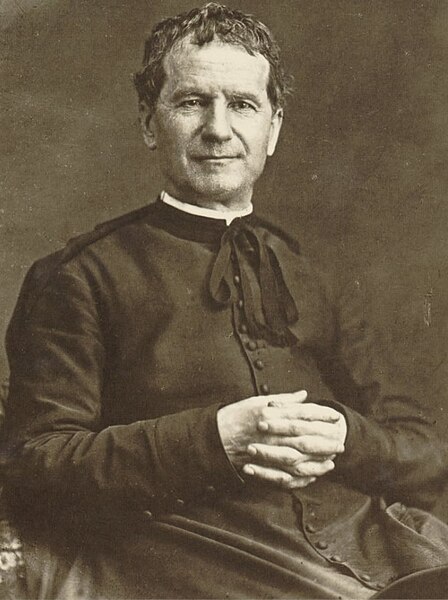
Don Bosco la Torino in 1880
- "At Castelnuovo, where there was a family gathering and great rejoicing, his mother said to him, what he calls "these memorable words": "You are a priest. In saying Mass henceforward you are then nearest to Jesus Christ. Remember, however, that to begin to say Mass means to begin to suffer. You will not realize it at once, but little by little you will see that your mother has told you the truth. I am confident that every day you will pray for me, whether I am living or dead: that is enough for me. Henceforward, think only of the salvation of souls, and don't be troubled in mind about me." Source: R.F. O'Connor Venerable Don Bosco The American Catholic Quarterly Review ..., Volume 46 1921
"Only two means are left to save Her (the Church) amidst so much confusion: Frequent Communion and Devotion to Mary most holy, making use of every means and doing our best to practice them and having them practiced everywhere and by everybody."
"When speaking of public scandals: Don’t be surprised at anything. People and waywardness go hand in hand. The Church has nothing to fear because even if all were to conspire to overthrow Her, the Holy Spirit would still uphold Her."
- Don Bosco, Apostle of the Papacy:
"The Pope!", says Fr. Lemoyne, biographer of Don Bosco, "there is the theme that Don Bosco wished to develop without ceasing, in order that the supremacy and the glory of the Vicar of Jesus Christ might stand uppermost in the mind of the faithful." The American Ecclesiastical Review, Volume 147 edited by Herman Joseph Heuser 1962
Prayer for Imploring Holy Popes
Kyrie eleison! Christe eleison! Kyrie
eleison! Lord Jesus Christ, You are the Good Shepherd! With your
almighty hand you guide Your pilgrim Church through the storms of each
age.
Adorn the Holy See with holy popes who neither fear the powerful of this
world nor compromise with the spirit of the age, but preserve,
strengthen, and defend the Catholic Faith unto the shedding of their
blood, and observe, protect, and hand on the venerable liturgy of the
Roman Church.
O Lord, return to us through holy popes who, inflamed with the zeal of
the Apostles, proclaim to the whole world: “Salvation is found in no
other than in Jesus Christ. For there is no other name under heaven
given to men by which they should be saved” (see Acts 4:10-12).
Through an era of holy popes, may the Holy See—which is home to all who
promote the Catholic and Apostolic Faith— always shine as the cathedra
of truth for the whole world. Hear us, O Lord, and through the
intercession of the Immaculate Heart of Mary, Mother of the Church,
grant us holy Popes, grant us many holy Popes! Have mercy on us and hear
us! Amen.
+ Athanasius Schneider Auxiliary Bishop of the Archdiocese of Saint Mary in Astana
- SPIRITUAL, MORAL AND EDUCATIONAL ASPECTS (Don Giovanni Bosco as an Educator By Carola E. Kopf-Seitz 1926)
"Among all the means which Don Bosco used in education, by far the most important is religion. Even at the Sunday-Oratories so great a part of the time was given to religious exercises that one might feel inclined to think that Don Bosco required more than might be justified. On the other hand, the continual increase in the number of those coming to the Oratory from all quarters showed that the time given to religious exercises was not considered excessive by his auditors, especially since Don Bosco knew how to make them always attractive and entertaining.
In the institutions, the whole life of the community came under the influence of religion. Don Bosco taught the children to offer the first moment of the day to God. After the morning prayer all assisted at Holy Mass during which, besides other prayers, the rosary was to be recited. At every Mass, the children were to have an opportunity for confession and communion. Every task during the day was to be begun and ended with prayer. Special value was placed upon an occasional visit, some time during the day, to the Blessed Sacrament. No day was to pass without spiritual reading. To avoid distractions during the sermons, these were to be short, practical and rich in illustrations. Don Bosco admonished the children never to leave after a sermon without having made some firm resolution which could be carried out during the occupation which followed. He also considered the short address, given in the evening just before retiring, of great importance. Evening prayers in common concluded the day.
Monthly pious exercises, such as the exercise of a holy death on the first Sunday of each month, the solemn celebration of the feasts of the Church, processions and the like, were used by Don Bosco to accustom the children to the frequent reception of the Sacraments and to inspire them with renewed zeal. Frequent confession and communion were in his eyes probably the most important of all the factors of education. In spite of this, probably just because of this, he did not want to see constraint used under any circumstances. In order that the children, in receiving the Sacraments, might obtain their full benefit, he urged them to select a constant confessor to whom they might reveal every corner of their heart.
In order to keep alive the zeal of the children, and in a sense to organize the exercise of their good works, he established several fraternities, for example, the fraternity of St. Aloysius and the Sodality of the Immaculate Conception, in the latter of which only the best and most deserving boys could be received. For the St. Aloysius fraternity, he himself drafted the constitutions, in which he urged upon the members chiefly: frequent communion, the avoiding of evil companions, mutual encouragement to piety, a zeal for duty, obedience towards parents and superiors, and the practice of charity towards neighbors.
By teaching and example he sought to awaken and to cultivate in his protégés a love of prayer; he warned them against listless or inattentive prayer, saying it would be better not to pray at all than to pray poorly. He also warned them of "too much prayer"; they should not take up new devotions without the permission of their father confessor and should go by the words of St. Philip Neri: "Non vi caricate di troppo divozioni, ma siate perseveranti in quelle que avete prese." ( Do not burden yourselves with too many devotions, but be persevering in those you have taken.)
The importance attached by Don Bosco to
the religious life, as a factor of education, is evident also from the
fact that he added to his Regolamento a special chapter about conduct in
the house of God, that he appointed a special catechist to supervise
the religious exercises of the students and that he specified at length
in the Regolamento the duties of this office."
Septuagesima Time
by VP
Posted on Friday January 30, 2026 at 11:00PM in Tradition
"Septuagesima Time lasts three weeks. The first week is called Septuagesima Week, the second Sexagesima Week, and the third Quinquagesima Week ; names taken from the Sundays beginning each week.
(...)
The
number seven is found in numberless places in the Bible, and here the
holy Church invites us to stop and ponder on this number, and on these
seasons of the year. Let us go back to the olden times of the fathers of
the Church. St. Augustine says "there are two seasons, one the time of
our trials and of our temptation during this life, the other the time of
our happiness and of our glories in the other life. We celebrate these
times, the first before Easter, the second after Easter. The season
before Easter represents the trials of the present life, the season
after Easter signifies the happiness we will have in heaven. Such is the
reason we pass the first of these seasons in fasting and in prayer,
while the second season is consecrated to canticles of joy, and then
fasting is not allowed."
The Church, the guardian and the
interpreter of the Holy Bible, tells us that there are two places
relating to the two seasons spoken of by St. Augustine. They are Babylon
and Jerusalem. Babylon is the symbol of this world of sin and of
temptation, in the midst of which the Christian must pass his time of
trial ; Jerusalem is the heavenly country where the good Christian rests
after his trials and his labors of this life. Of these two cities, the
one worldly, the other heavenly, St. Augustine writes in his immortal
work, " The City of God." The people of Israel, whose history in the
Bible is but a grand figure of the history of the human race, were
exiled from Jerusalem and were held as captives in Babylon. Their
captivity in Babylon lasted for sixty-six years, and according to the
great writers on the Liturgy of the Church, the seventy days of fasting
and of prayer, from Septuagesima Sunday to Easter, recall the captivity of the Jews in Babylon.
Seven
is a mystic number. In six days, God made the world and he rested on
the seventh day. The most ancient traditions of Christianity tell us
(...) that the race of man upon the earth is divided into seven great
epochs. The first dated from the creation of Adam to the Flood, the
second from Noah to the calling of Abraham, the third from Abraham to
Moses, the fourth from Moses to David, the fifth from David to the
captivity in Babylon, the sixth from the captivity to the coming of the
Savior, and the seventh from the time of our Lord to the end of the
world. Thus the age of man on the earth is measured by these great
epochs. During these different times the Lord prepared the race to
receive their Redeemer, and to come into the Church He established for
their salvation. In the first epoch, from Adam to Abraham, all justice,
all goodness, all godliness, which look down from heaven and was planted
in the heart of man, was driven out by sin. In the second, from Abraham
to Moses, God called the people of Israel and made of them his chosen
race, to receive the prophecies relating to His Son. In the third, from
Moses to David, God commanded the tabernacle to be made, the Rites and
Services of the Jewish law to be carried out, to prefigure the Services
of our Church. In the fourth, from David to the Captivity in Babylon,
the nation of the Jews were ruled by kings, the temple of Solomon stood
grand and gorgeous, and the world saw the greatest glories of the people
of God. In the sixth, from the captivity to the days of our Lord, the
Jewish people were the prey of conquering nations; the Maccabees alone
could restore in part their departed splendors. In the seventh, from
Christ to the end of the world, the Church, founded and established by
our Lord, shines out before the nations called to the faith. Its glories
are far greater than those of the tabernacle of Moses. The cathedrals
of Christendom exceed in splendor Solomon's temple. The ceremonies in
our sanctuaries are more sublime than the most gifted imagination of the
Jewish priests could fancy. (...)
Thus the number seven is
deeply planted in the works of the Creator of the universe. Thus for
seven weeks we bow our heads in prayer and fasting before the coming of
the glorious day of Easter, and in joy and praise we raise our heads for
seven weeks during the glorious Paschal time following Easter. The
seven weeks of sadness for our sins before the passion of our Lord, are
followed by the seven weeks of happiness following His resurrection.
Thus after having fasted and prayed like the Savior in the desert, we
rejoice with Him as we rise from the sackcloth and ashes of Lent. We
rise with our souls filled with the seven gifts of the Holy Spirit
imprinted in our souls. This is what the mystic writers on the
ceremonies of the Church tell us. They say that the seven weeks before
Easter, and the seven weeks following Easter, are according to the
mystic number seven, revealed to man from heaven.
The seven weeks from Septuagesima
to Easter yearly come and go, while the years of our lives, like the
waters of the rivers, flow onward to be lost in the vastness of the
ocean ; thus our years pass rapidly on toward the boundless ocean of
eternity. The Church, our mother, tells us each year to stop and to
think of the Babylon of this world in which we live as strangers, exiled
from our home. She tells us to hang our harps on the willows growing on
the banks of the Euphrates, like the Jews of old held captives in
Babylon, and to prepare for our call to our heavenly Jerusalem above,
which is our home beyond the skies, and whose glories we celebrate
during the joyful time which follows Easter. She wishes us to sing the
canticles of joy in her services, and that while we live here, far from
our home in heaven, yet to keep our thoughts on God while in this world,
lest attached to earthly things we may be exiled for ever from
everlasting bliss with him, for our unfaithfulness while here below,
yet,"How shall we sing the song of the Lord in a strange land?"
Following thus the inspired Book, the songs and hymns of gladness are
hushed in the Church Services during this time of penance, signifying
our exile here below. At other times of the year the heavenly Alleluias
are often repeated, now they are heard no more, for exiles in the
Babylon of this world of sin, we are traveling onward toward the
Jerusalem which is above, for "we are travelers far from the Lord."
(...)
The
joyful forty days of the Christmas season have passed. With happiness
have we celebrated the birth of God on earth. Now the Church enters the
sad and solemn time when we prepare for the mysteries of the suffering
and the dying Savior. All around us in the Church are the sombre signs
of penance. We are entering in amid the three weeks of our baptism of
penance, that we may well and worthily celebrate the Lord's baptism of
blood in his sufferings for us on Calvary's cross. We are leaving
Bethlehem and going to Calvary. We are leaving the infant God in his
mother's arms, and following his steps to see him fasting in the desert.
We are leaving him in the manger, and looking for him in Gethsemane.
The Illuminating Life of the Christmas time has passed, and the
Preparing Life of the Septuagesima time
has come. We have seen him in his sweetness as a child; we are going to
see him in his weakness as a man, fasting in the desert. But we must
pray God for his light, in order to see his Son as each year the Church
shows him to us. We must ask for grace to look first into ourselves, and
see the sins which dim the brightness of our souls and keep us from
seeing the truths of religion. We must ask the light of God to clearly
understand how the human race had fallen when our parents sinned by
eating in the garden, and to realize the deep wickedness of our sins and
the deeper mercy of God in becoming man to save us from being lost
forever.
The Septuagesima
Season, then, is the time of the year for the deepest thought. In the
words of a great writer of the eleventh century, the Apostle says, " We
know that every creature groaneth and travaileth in pain, even till now ;
and not only it, but ourselves, also, who have the first fruits of the
spirit, even we ourselves groan within ourselves, waiting for the
adoption of the sons of God, the redemption' of our body. ' That
creature which groans is the soul looking at the corruption of sin which
weeps to be still subject to the vanities of this world in this exile
of tears. It is the cry of the Royal Prophet, " Woe is me that my
sojourning is prolonged." Thus holy David desired the end of his exile
in this vale of tears. The Apostle who was wrapped up to the third
heaven says, "I am straightened between two, having a desire to be
dissolved and to be with Christ."St. Paul wishes to be taken from this
world of sorrow and to be with Christ.
Such are the thoughts which the Church brings before her children during this holy time of Septuagesima, that all may be prepared to celebrate well and worthily the holy Season of Lent. "
Source: The Festal Year, Or, The Origin, History, Ceremonies And Meaning Of The Sundays, Seasons, Feasts And Festivals Of The Church During The Year, Explained For The People by Fr. James L. Meagher 1883
Fast for the Church
by VP
Posted on Thursday January 29, 2026 at 11:00PM in Quotes

"Today is a Friday, traditionally a day of fasting and abstinence from meat. Fasting is Apostolic, it expands our ability to love, it casts out demons and brings peace to Holy Church. Fast for the Holy Father, for the bishops, for your pastor, for vocations, for unity, for the dying, the sick, for victims of abuse, for the troubled, for peace, for those suffering through natural disasters. FAST!" Monsignor Ferrari
Prayer: Remember, O most loving Heart of Jesus,
that they for whom I pray are those for whom You prayed so earnestly the
night before Your death. These are they to whom You look to continue
with You in Your sorrows when others forsake You, who share Your griefs
and have inherited your persecutions, according to Your word: That the
servant is not greater than his Lord.
Remember, O Heart of
Jesus, that they are the objects of the worldʼs hatred and Satanʼs
deadliest snares. Keep them then, 0 Jesus, in the safe citadel of Your
Sacred Heart and there let them be sanctified in truth. May they
be one with you and one among themselves, and grant that multitudes may
be brought through their word to believe in You and love You. Amen.
