The Condemnation of Priests
by VP
Posted on Sunday November 30, 2025 at 11:00PM in Books
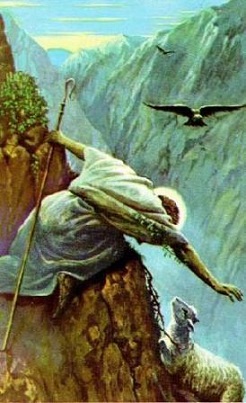
"Every tree that bringeth not forth good fruit shall be cut down, and shall be cast into the fire. Wherefore by their fruits you shall know them" St. Martt. VII. 19,20
1. Every tree that bringeth not forth good fruit: Our Saviour had spoken of false Prophets, and in their person had signified wicked Priests : He had enjoined His disciples to avoid them, but He had not enjoined them to punish them. He fills them with fear, threatening them with the punishment of God (says St. Chrysostom). A wicked Priest has, indeed, need of threats rather than of promises, and for his amendment he has need to think of the former rather than of the latter. And, did he but reflect on the tremendous truth which is here inculcated — that is to say, that a Priest may be condemned for failing to produce good fruit — then surely he would never bring forth those many evil fruits which may be traced to him. He would shrink from incurring that dreadful curse, " You shall bear the iniquity of the sanctuary . . . you shall bear the sins of your priesthood" (Numb, xviii. 1).
If we are branches of that great Vine, which is Jesus Christ, we ought to remember His word, " Every branch in Me that beareth not fruit He will take away;" and again, "If any one abide not in Me, he shall be cast forth as a branch, and shall wither, and they shall gather him up, and cast him into the fire, and he burneth " (St. John xv. 2, 6). Let us, then, fear the fulfillment of so terrible a menace ; let us fear the teeth of the dragon (says St. Bernard); let us fear the belly of hell, the roaring of fierce beasts that stand ready to devour, the worm that ever gnaws, the fire that always burns, the smoke, the brimstone, the whirlwind, and the exterior darkness. It may be that our death is near, and that " the axe is already laid to the root of the tree " (St. Matt. iii. 10) ; it may be the Watcher and the Holy One has already cried aloud from heaven, " Cut down the tree " (Dan. iv. 1 1 ). Whither shall we then flee from the wrath of the Lamb ? Why do we not now by penance forestall this fatal stroke ?"
2. Shall be cut down. What terrible words are these ! They point to separation from the heavenly kingdom, which separation is incomparably more terrible than eternal fire ; although (as St. Chrysostom says) many fear hell more than they fear the loss of heaven. But the loss of a kingdom, and that the kingdom of God, will be most terrible for Priests, who have held the keys of it, who have opened it to others, and who will hear from the lips of devils that they have lost it, as the devils have lost it, without hope of recovery : " Thou also art wounded as well as we, thou art become like unto us" (Is. xiv. 10). — " Shall be cut down." They shall be separated from the Eternal Father Who had communicated to them immense power, Who had confided to them His Son, Who had made them Ministers of His mercies, but Who now says, " I will hide My face from them, and they shall be devoured " (Deut. xxxi. 17). — " Shall be cut down. " What an awful punishment is that of Priests — to be separated from Christ, to become the object of His hatred, and to hate Him and curse Him, through all eternity, after having been so familiarly associated with Him — after having called Him down so many times from heaven, held Him in their hands, taken Him for food, dispensed Him to the Faithful ! The punishment of ten thousand hells could not equal this (says St. Chrysostom). — "Shall be cut down". How terrible for Priests to be separated for all eternity from the Holy Spirit, by Whom they were anointed, illuminated, sanctified, and made the instruments of diffusing Him on Whom the Angels, whose name and office they have borne, "desire to look!" (i Pet. i. 12). — "Shall be cut down." Surely, nothing ought to be so terrible to Priests who still retain their faith as the thought of losing for all eternity the sight, the possession, the enjoyment of the Blessed Trinity, with Whom they have been so closely associated on earth.
3. Shall be cast into the fire. The fire which is kindled by God's wrath is "a fire full of wisdom;" that is, it punishes each one according to the number and heinousness of his sins. Hence the sins of Priests, which are most heinous — because of their contempt of Divine light, their ingratitude for the Divine benefits, and because of the fatal consequences of such sins — will bring upon them a more severe and intense suffering than those of any others. Supreme is God's indignation against His reprobate Ministers, and therefore against them in an especial manner is " a fire kindled in His wrath, which shall burn even to the lower heir' (Deut. xxxii. 22). The breath of Almighty God, which, when breathed upon them, gave His Priests power to remit sins, will then be "as a torrent of brimstone" to punish their iniquity (Is. xxx. 33). Let us consider that the devils have already prepared a dwelling for us, and desire to see us precipitated into that furnace of fire ; " for Topheth is prepared from yesterday, deep and wide ; the nourishment thereof is fire and much wood." (Ibid.) What anguish for Priests to see themselves changed from shining stars into firebrands of hell !
O Jesus, Author of the Priesthood, and Supreme High Priest, abandon not Thy unworthy Minister. Convert me and save me.
" Deliver, O God, my soul from the sword, my only one from the hand of the dog." — Ps. xxi. 21.
" Which of you can dwell with devouring fire ? Which of you shall dwell with everlasting burnings ? " — Is, xxxiii. 14.
Source: 7 week after Pentecost Meditations for the use of the clergy : for every day in the year. On the Gospels for the Sundays, Volume 3 (Msgr. Scotti, Archbishop of Thessalonica)
Prayer for Priests Who Have Become Unfaithful to Their Vocation
Divine Savior Jesus Christ, Thou are the
Good Shepherd who gives His life for His sheep. Oh, be in a very
special way the Good Shepherd of those poor lost priests who are also
appointed by Thee to be leaders of Thy people, but who have broken the
oath of their holy ordination and have become unfaithful to their
exalted calling. Bestow upon these poorest of the poor the very fullness
of that pastoral solicitude with which Thou dost so faithfully seek the
sheep that are lost! Touch their hearts with the irresistible ray of
grace which emanates from Thine all-merciful love! Enlighten their minds
and strengthen their wills, that they may turn away from all sin and
error and come back to Thy holy altar and to Thy people. O most
compassionate Savior! Remember that Thou didst once redeem the souls of
Thine erring priests with Thy Precious Blood and in infinite
preferential love didst impress upon them the indelible character of the
priesthood. Put wholly to shame those miserable helpers of Satan who
lay snares for the virtue of priests and endanger the holy ideal of the
priesthood. Most graciously accept our prayers and sacrifices for poor
priests who have gone astray and hear our earnest petition. Amen
obtain for us holy priests.
St. John-Mary Vianney, model of sacerdotal holiness,
obtain for us holy priests.
St. Francis Xavier, patron of missionary priests,
obtain for us holy priests.
St. Therese of the Child-Jesus and of the Holy Face, victim offered for the sanctification of priests,
obtain for us holy priests.
Saints and Servants of God, obtain for us holy priests.
Imprimatur - Bishop John F. Null (April 18, 1948)
Source: Cure d'Ars Prayer Group
The preacher who likes applause
by VP
Posted on Sunday November 23, 2025 at 12:42AM in Books
"What is the end of a preacher? Is it to please? To gain applause? To obtain promotion? Or is it to give men life; to make them " Sorrowful unto penance"?
I am of opinion, writes St. Francis of Sales, that a preacher ought not to aim at the gratification of the ear, which is the result of artifice, of worldly elegance, of merely ornamental oratory. He who desires to please his audience says only "pleasant things". The craving for applause blinds him to the truth. He relies almost exclusively on the persuasive words of human wisdom, he makes little or no account of the Word of God, which ought to be the chief source of sacred eloquence, and he speaks in a style more suited to the platform than to the pulpit, more profane than sacred.
Hence there arises amongst the people and even amongst the clergy, a vitiated taste in respect to the Word of God, which gives scandal to the pious and no profit to the incredulous; for these latter, although they sometimes come to the church, especially if attracted by such high-sounding words as Progress, Fatherland, Modern Science, and loudly applaud the preacher, go forth from it no better than they entered."
Source: The Priest of Today, Rev. Thomas O'Donnell 1911 page 226
The Holy Mass
by VP
Posted on Saturday November 08, 2025 at 11:00PM in Books

The daily celebration of the Mass over the whole Christian world fulfills the prophecy contained in the first chapter of Malachias V.11.
"For from the rising of the sun, even to the going down, My Name is great among the Gentiles" (i.e., among those who were to form the present Christian world); "and in every place there is sacrifice, and there is offered to My Name a clean oblation; for My Name is great among the Gentiles, saith the Lord of Hosts."
The Mass is this fore-told sacrifice, and clean oblation. It is offered from the rising to the going down of the sun; and it is the self-same sacrifice as that offered once in a bloody manner upon the Cross, but now in an unbloody manner on every Catholic altar. The self-same Christ is at once the High-Priest and the Victim.
The Sacrifice of the Mass is not inconsistent with the truths that, firstly, there is but One Sacrifice; secondly, that the merits of the Sacrifice of the Cross are all-sufficient; and, thirdly, that Christ, having once died, can do so no more. The Mass and the Oblation on Calvary are one, because there is the same Divine victim, Jesus Christ, in each case. It is not held to create new merits by adding to those gained on the Cross, but only apply daily those so gained.
Christ does not die on the Altar, yet remains a perfect victim. Death is not essential for a sacrifice, as we learn by the old anti-type of the offering of Mass, when the Scape-Goat, being offered up as a sacrifice to God, was afterwards allowed to go free into the wilderness. (Lev. xvi, 10.)
Sacrifice has always been the one supreme from of Divine worship, and nothing more perfectly shows forth the death of the Lord, till he come (i. Cor. xi, 26), and so well obeys the Divine injunction on this matter, as the offering of the Holy Mass.
The Holy Eucharist is at the same time a sacrifice in itself and also a memorial of the Sacrifice of Calvary. The Sacrifice of the Mass does not lose its rightful claim to be a sacrifice because it is at the same time commemorative of another sacrifice. "The action of the Last Supper looked forward to that action on Calvary, as the action of the Holy Mass looks backwards upon it. As the shadow is cast by the rising sun towards the west, and as the shadow is cast by the setting sun towards the east, so the Holy Mass is, I may say, the shadow of Calvary, but it is also the reality: (Cardinal Manning - Glories of the Sacred Heart).
The words of the Mass were not primarily intended to be recited or even followed by the people. The Congregation only assist at the action, priests alone being set apart to sacrifice by the reception of the powers conferred in the Sacrament of Holy Orders; and non-Catholics, if uninformed, are naturally surprised to find a priest celebrating Mass recite much of it in silence. As a proof of the former proposition, there is a portion of the Mass still called the Secret; and in ancient times a screen was drawn between the priest and the laity, so that the latter were not permitted even to see the act, yet were considered as duly participating in all its merits by their mere presence. Today the laity are rather recommended to follow the words, and these are set down in all their prayer-books in English and Latin; yet every one assisting at Mass is free to use any private form of prayer and meditation.
We have strong confirmation of the antiquity of the Mass in the writings of the pagan Romans, whose calumnies show that the Mass was always the one principal service of the early Christians. These writers refer to the slanderous stories of their times, that the Christians killed an infant and ate its flesh at their religious meetings. Such misrepresentations were very common, and prove that the primitive Christians did sacrifice and receive the Body and Blood of our Lord in their Holy Communions. Those pagan tales with their half-truths are evidently founded on the celebration of the Holy Mass wherein Christ is sacrificed.
The words of the Mass are almost solely derived from Scripture, and could the Catholic Church more practically and more publicly venerate its Divine inspiration than in this full use of the Bible in its greatest act of worship?
Source: Guide to a Catholic Church: for non-Catholic Visitors, by Fox, WL and O'Gorman, RA. 1904
