The Catholic Priest
by VP
Posted on Sunday May 31, 2020 at 12:00AM in Documents

It is quite generally believed that of all the mortals who journey through life’s weary pilgrimage, the Catholic priest is the most fortunate. For the priest, who is true to his exalted vocation, lives of the life of grace, has God as his portion in time and eternity, may well be envied. It is not, however, to the spiritual blessings enjoyed by the true priest men refer when calling him fortunate. “What a fine time the priest has,” says one, “plenty to eat and nothing to do.”
Such is the popular view of priestly life. The real priest is a very different sort of man. The guide and ruler of his flock, his every word and act is closely observed. His most heroic acts of self-sacrifice and virtue pass unnoticed, his
slightest imperfection is magnified and trumpeted abroad. Though he labors for years with the most disinterested zeal for the good of religion, depriving himself of the pittance to which he is entitled for his own support that the poor may be provided for and the faith preserved among the youth; though for long years he makes of himself a very martyr for the benefit of his people, if but one error of judgment be found in his life’s work, all the good effected is forgotten and his one mistake alone held in lasting remembrance. The approbation of men not being the object of the priest’s life, the world’s verdict matters little to him so long as he is conscious of having done his duty; nevertheless, men should endeavor to be just to one another, even in trivial matters.
The ideal priest has a pleasant life of it. He says his daily Mass, recites his office, amuses himself with the little children, visits his people, and lives to a ripe old age. No trouble, no labor of any kind. The real priest finds souls going to perdition for want of religious instruction. He must found and support Catholic schools. He finds the intemperate habits of the people undermining faith and proving a stumbling-block in the way of searchers after the truth. He must wage war against a powerful element among his flock. He finds family feuds of long standing to be overcome. There are perhaps several opposing factions in the congregation. The church, through some cause or other, is burdened with debt, or stands in need of repairs. The poor of the parish must be attended to. Here is work enough to do, and done it must be. Money is needed to support the schools. The expenses of the church must be met and money is required wherewith to meet them. The poor must live, and money is necessary for their support. The orphans require aid. Again money is needed. As Catholic charity knows no limit, the real priest makes known to his people these various needs of religion, confident that many will heed his words and correspond with his wishes. But how many there are who seem to think that the priest is begging for himself when he appeals for money on these different occasions! Listen to some members of the congregation leaving the church on a Sunday after a “money-sermon” has been preached. We recently heard a young man, the recipient of many favors from his pastor, pouring forth his pent-up indignation because his good pastor had asked him to contribute a few dollars toward a charitable object. The ungrateful wretch could not understand what the priest did with all the money he received, though he understood very well that the priest had never received any money from him. This young man’s parents died when he was six years old, and the writer of this article knows for a positive fact that the priest’s money was once used for paying for food and clothing for this same young man. He was educated by his pastor, and it was owing to his influence that this young ingrate now holds a splendid position.
Busy days and often sleepless nights, financial difficulties, disappointments, misrepresentation, exposure to heat and cold and contagion—these are a few of the temporal blessings enjoyed by the priest here below. Add to these the fact that after a long life of usefulness one mistake may suffice to cast him adrift upon the world without means and without friends, and the life of the average priest appears in its true colors—a life of weary anxiety and suffering; a life awaiting no human reward, but expecting the reward of the life to come.
Source: Truth, (A Monthly Magazine for the Dissemination of the Truth concerning the Doctrines, History, and Practices of
the Catholic Church.) Published by The International Catholic Truth Society. Rev. Fr. Wm. F. McGinnins, D.D. Editor-in-Chief NY Vol. XIX. April, 1915 NO.4
Thrones and Scepters
by VP
Posted on Saturday May 30, 2020 at 12:00AM in Quotes
Thrones and scepters and crowns have withstood the hierarchy of the Church; but, immutable, like God, who laid its foundation, it is the firm, unshaken center round which the weal and woe of nations move - weal if they adhere to it - woe if they separate from it.
If the world takes from the Pope, the bishops, and priests of the Catholic Church, the cross of gold, they will bless the world with one of wood. If necessary, popes, bishops and priests can suffer and die for the welfare of the world, as Jesus suffered and died. The hierarchy of the Catholic Church is immortal.
Source: The Catholic Priest, Rev. Michael Muller C.S.S.R
Ideals, False and True
by VP
Posted on Friday May 29, 2020 at 12:00AM in Books
" Unless your justice abound more than that of the Scribes and Pharisees, you shall not enter into the kingdom of heaven" — Matt. v. 20.
At all times men have had ideals of goodness
which they looked up to and admired, and which the best among them have had the
ambition to imitate. The popular ideal of the Jews
when Christ came, was represented by the Pharisees,
— men orthodox in faith, correct in life, ardent in
the love of country, strict in the observance of the
Law. Such men could not fail to win influence and
popularity; and they enjoyed both in a high degree.
The people who gathered round Our Savior on
the Mount did not conceive of any form of life
higher or better than what they had hitherto looked
up to in their accredited teachers; yet He tells them
plainly that their qualities were entirely insufficient
to secure admittance into His kingdom. What a shock it must have been to them to hear this for
the first time! But if they will only wait, the divine
Teacher will show them how incomplete, and in
most cases how hollow, were the lives they so admired.
From the facts of the Gospel narrative, and still more from the unsparing denunciations of Our Lord himself (Matt, xxiii. 13, and foll., Luke xvi. 39, and foll.), we may easily gather what were the shortcomings and vices of the Pharisees. Their "formalism" first of all, their exaggerated concern for externals, for the minutiae of the law, united with a practical disregard for its fundamental principles. Next, "their pride" and self-importance, revealing itself at every step, and leading to hardness of heart, and contempt for others. Finally, " their ostentation " and constant display of whatever in their lives and actions could win them the admiration of the people.
The Gospel is the opposite of all this. It leads men back to fundamental things, to the indestructible principles of justice and of love. It teaches them to act righteously for righteousness' sake, to look to God for approval, not to man. It keeps their weaknesses before them, humbles them, and makes them think more of others than of themselves. In a word, the Christian type is the exact opposite of that of the Pharisee, and something incomparably nobler and higher, even in the most unpretending of those who follow it.
Indeed, the Pharisaic type, in its crude, unmitigated form, has become unbearable to the modern mind, fashioned by Christian traditions. But because it is, after all, true to man's natural instincts, it has not entirely disappeared from the world. Something of it may be found even in the life of a priest. He may be good, faithful, zealous ; yet, at the same time, self-important, exacting, sedulous in cultivating public opinion, eager for praise. His composed demeanor and his devotional practices may conceal even from himself much that is mean and selfish. In his concern for minor objects, he may "neglect the weightier things of the law : judgment, and mercy, and faith ; " and while " cleansing the outside of the dish" overlook the impurities it may contain.
A priest, too, may select and follow false ideals; nor is the thing at all uncommon Thus he may not fully believe in the purely Christian virtues, — such as humility, gentleness, self-denial — or in the special requirements of the priestly character. He may not even believe in the higher forms of natural virtue, all based on self-sacrifice. His ideal may be practically that of the popular priest, the successful priest ; that is, successful in doing external work, or in reaching positions of honor or emolument. His principal ambition may be to secure what will lighten, and lengthen, and sweeten existence — just like any man of the world. And yet, " unless his justice abound more than that " of those men to whom he looks up with envy, he is unfit for the work of the priesthood; and, if he has assumed its responsibilities and fails to bear them, he is unfit for the kingdom of heaven.
The truth is, the ideal of the priesthood is not an open question at all. What sort of man a priest ought to be, what is implied in his sacred character, what he is really pledged to by the reception of orders, is determined almost as precisely as the doctrines of faith, and has varied as little in the course of Christian ages. It can be gathered from the Gospel; it is found in St. Paul ; it is spread out in the pages of the Fathers, in the enactments of councils, in the teachings of the Saints ; and everywhere it is visibly and unmistakably the same.
Source: Daily thoughts for priests, Rev. Fr. John Hogan, 1899
You are not your own
by VP
Posted on Thursday May 28, 2020 at 12:00AM in Quotes
The priest is a steward in charge of interests not his own. He is a servant, as servant of all work, expected to be helpful all round and all day long. He can work for nobody but his Master. His rule is that of our Lord himself.
Priests of God, you are not your own.
Source: Daily thoughts for priests by Fr. John Hogan 1899
Restless Activity
by VP
Posted on Wednesday May 27, 2020 at 12:00AM in Quotes
We live in a country and in a period of restless activity, of advertising and being advertised,
of nervous anxiety for results almost at any cost. How sad to see priests caught up and carried
away by the flood, losing the merit of their lives, not to say their very souls, while saving others!
Like those of whom Our Lord speaks, they prophesy by the earnestness of their preaching; they
cast ou devils by the power of the sacraments; they work wonders of material construction and
organization; but they are sustained in it all and borne along chiefly by natural impulse, by
exuberant activity, by the spirit of pride, by the desire to be talked of by their people and by
their fellow priests, by all manner of human motives worthless in the sight of God.
Only at the judgment of God - "on that day"- will they know, will the world know,
in what depths of spiritual poverty they have lived and died.
Source: Daily Thoughts for Priests, Fr. John B. Hogan
Priests are drones in the Hive! of What use are they?
by VP
Posted on Tuesday May 26, 2020 at 12:00AM in Books
Answer: They are of use in saving souls! Certainly, here is an employment which is at least as good as many others.
The mechanic works upon matter; the priest works on the soul. As much as the soul is higher than matter, so much is the priest's work higher than all the labors of the earth.
The priest continues the great labor of the salvation of mankind. Jesus Christ, his God and his Model, began it; His priests continue through all ages.
After His example, the priest goes about doing good. He is a man who belongs to all; his heart, his time, his health, his diligence, his purse, his life, belong to all; above all, to the lowly ones of the earth, to children, to the poor, the neglected, those who weep, and who are friendless. He expects nothing in exchange for this devotedness; most frequently, indeed, he receives only insults, abominable calumnies and ill treatment. True disciple of his Divine Master, he replies only by continuing to do goo.
What a life! What superhuman abnegation!
In public calamities, civil wards, contagious diseases, in times of cholera, when the Protestants ministers and philanthropists think of personal preservation, the priest is to be seen exposing his life and health to relieve and save his brethren; such was Monseigneur Affre, Archbishop of Paris, on the barricades; such were Belzunce and St. Charles Borromeo, in the time of the plage at Marseilles and Milan; such, during the cholera in 1832 and 1849, all the clergy of Paris and so many other towns, who made themselves the public servants of the whole people.

This, then, is the use of priests! I should like to know if those who attack them are of more use.
The ungrateful wretches! They are never weary of loading with insults him whom they summon to their bedside in time of sorrow or privation, who has blessed them in their earlier years, and who never ceases to pray for them.
All the miseries of our country arise from our not practicing what the priests teach. And unfortunate France, torn with civil discords and political commotions, may apply to herself the language addressed to the chaplain of one of the Paris prisons by a poor convict, who had returned to God with all his heart. The priest had given him a little Christian's manual. "Ah Father!" he said one day, showing the little book, "If I had known the contents of this, and had practiced these maxims all my life, I should not have done what I have now done, nor should I have been where I now am!"
If France had always known, and if she now knew what priests really do teach, and if she had always practiced those doctrines, and continued doing so, she would not have been tossed about by three or four revolutions in the space of fifty years, and be reduced to ask herself in the present day, Am I about to perish entirely? Can I still hope to be saved from destruction?
She may hope to be saved, if she will again be truly Catholic! She may hope to be saved if she will but take heed to the ministers of Him who SAVES the world.
The priesthood is then the safety of France! For without religion society would be destroyed.
Her children, then, owe honor, veneration, gratitude, more than ever to the priestly character. Those who repulse the idea have not the intelligence of our age or country.
Away with these worn-out prejudices, then. Away with these coarse and injurious epithets, with which the blind impiety of Voltaire and his followers have so long assailed the Catholic Priesthood!
Let us respect our Priests. If we see imperfections, even vices occasionally, among them, let us remember that we must ascribe to the man all that belongs to frailty.
Let us endeavor, in those cases, not to look at the man, to see nothing but the priest; as a priest, he is always worthy of respect, and his ministry is always a holy one; for he is the perpetuator of the office of Jesus Christ, the great High Priest, through successive ages, and it is of him that the Savior has said, " He that heareth you, heareth Me; and he that despiseth you, despiseth Him that sent you."
Source: Short Answer to Common Objections Against Religion, by Louis Gaston Adrien de Segur
The Faith of the Cure of Ars
by VP
Posted on Tuesday May 12, 2020 at 05:06PM in Books
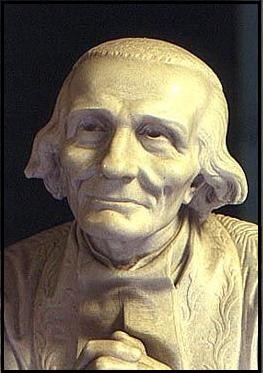
The faith of the Curé of Ars was his whole science; his book was our Lord Jesus Christ. He sought for wisdom nowhere but in Jesus Christ, in His death and in His cross. To him no other wisdom was true, no other wisdom useful. He sought it not amid the dust of libraries, not in the schools of the learned, but in prayer, on his knees, at his Master's Feet, covering His Divine Feet with tears and kisses; in the presence of the holy tabernacles, where he passed his days and nights before the crowd of pilgrims had yet deprived him of liberty day and night, he had learnt it all.
Source: The Spirit of the Cure of Ars by John E. Bowden 1865
The Persecuted
by VP
Posted on Monday May 11, 2020 at 03:30PM in Books
"Blessed are they that suffer persecution for justice's sake, for theirs is the kingdom of heaven." Matt. V.10
There is nothing for which Christ seems more concerned to prepare His Apostles than the active, violent opposition of the world. He warns them repeatedly that they must not expect to fare better than Himself; that they will have to suffer all manner of ill treatment on His account; that they will be taken up and dragged before unscrupulous judges, cast into prison and tortured; that their very friends and relatives will turn against them and betray them; finally that they will be an object of universal distrust and hatred among their fellow-men.
Subsequent events abundantly verified the Savior's prediction. The lives of the apostles, so far as we are acquainted with them, seem to have been full of suffering and trials, and all ultimately crowned by martyrdom. St. Paul, the apostle whom we know best, tells the Corinthians what he had to endure. "Of the Jews five times did I receive forty stripes, save one. Thrice was I beaten with rods, once was I stoned; thrice I suffered shipwreck; a night and day I was in the depths of the sea. In journeying often, in perils of waters, in perils of robbers, in perils from my own nation, in perils from the Gentiles, in perils in the city, in perils in the wilderness, in perils in the sea, in perils from false brethren. In labor and painfulness, in much watching, in hunger and thirst, in fastings often, in cold and nakedness. " 2 Cor. ii. 25....
For three hundred years the history of the Church is a history of persecutions; nor did they cease with the conversion of Constantine. Under many of his successors, confiscation, exile, prison, and death were the lot of Christians true to their faith. In deed it may be said that at all times the good have had to suffer, and to suffer "for justice's sake;" that is, because of their very goodness. The dishonest, the corrupt dislike them, as interfering with their pursuits and their pleasures, and because the very life of the just man is a protest against their methods. It is thus that they are described in the book of Wisdom: (ii.12), "Let us therefore lie in wait for the just because he is not for our turn (he is of no use to us), and he is contrary to our doings, and upbraideth us with transgressions of the law, and divulgeth against us the sins of our way of life. He is become a censurer of our thoughts. He is grievous to us, even to behold, for his life is not like other men's and his ways are very different."
And so will it be, St. Paul tells us, to the end of the world. "All that will live godly shall suffer persecution." At the hands of the evil-minded, the good will be made to pay the penalty of their goodness; the faithful and fervent will have to bear the criticism of those who choose not to follow in their footsteps; converts to the true faith will forfeit position or fail to reach it because they have not closed their eyes to the light; born Catholics will seek in vain for what they might easily reach if they were known to be indifferent to religious truth, or to have eschewed all belief; men of integrity who hold office or fill positions of trust will be driven from them because they refuse to share in the dishonesty of others or interfere with their crooked ways; at every turn of life the conscientious will have to suffer for conscience's sake.
The priest does not escape the common law. He too has occasionally to suffer for justice's sake. He may be led by a simple sense of duty or by the impulse of zeal to a manner of action which is not approved of by all. He is often found fault with, criticized, not only by the ignorant, the thoughtless, and the wicked, but sometimes by good people, and even by his fellow-priests. But he finds an encouragement that never fails in the voice of his conscience and in the promise of his Divine Master: "Be glad and rejoice, for your reward is very great in heaven." Yet, he must be sure that what he has to endure is not of his own making. With the best intentions a man may be injudicious in his action, indiscreet in his methods. His firmness may degenerate into obstinacy, his zeal into intolerance. He may, under the name and cover of duty, become self-righteous, narrow-minded, impatient of contradiction, thus awakening opposition and leading to trials hard to bear, but for which there is no reward.
"It is good for us sometimes to suffer contradictions, and to allow people to think ill and slightingly of us, even when we do and mean well.
"These are often helps to humility, and rid us of vain glory. For then we more earnestly seek God to be witness of what passes within us, when outwardly we are despised by men and little credit is given to us. " Imitation i, 12.
Source: Daily Thoughts for Priests, Very Rev. J. B. Hogan S.S., DI president of St. John's Seminary Brighton, Mass 1899
Re Consecration of the United States May 1, 2020
by VP
Posted on Friday May 01, 2020 at 12:00AM in Prayers
